


























Views
Downloads
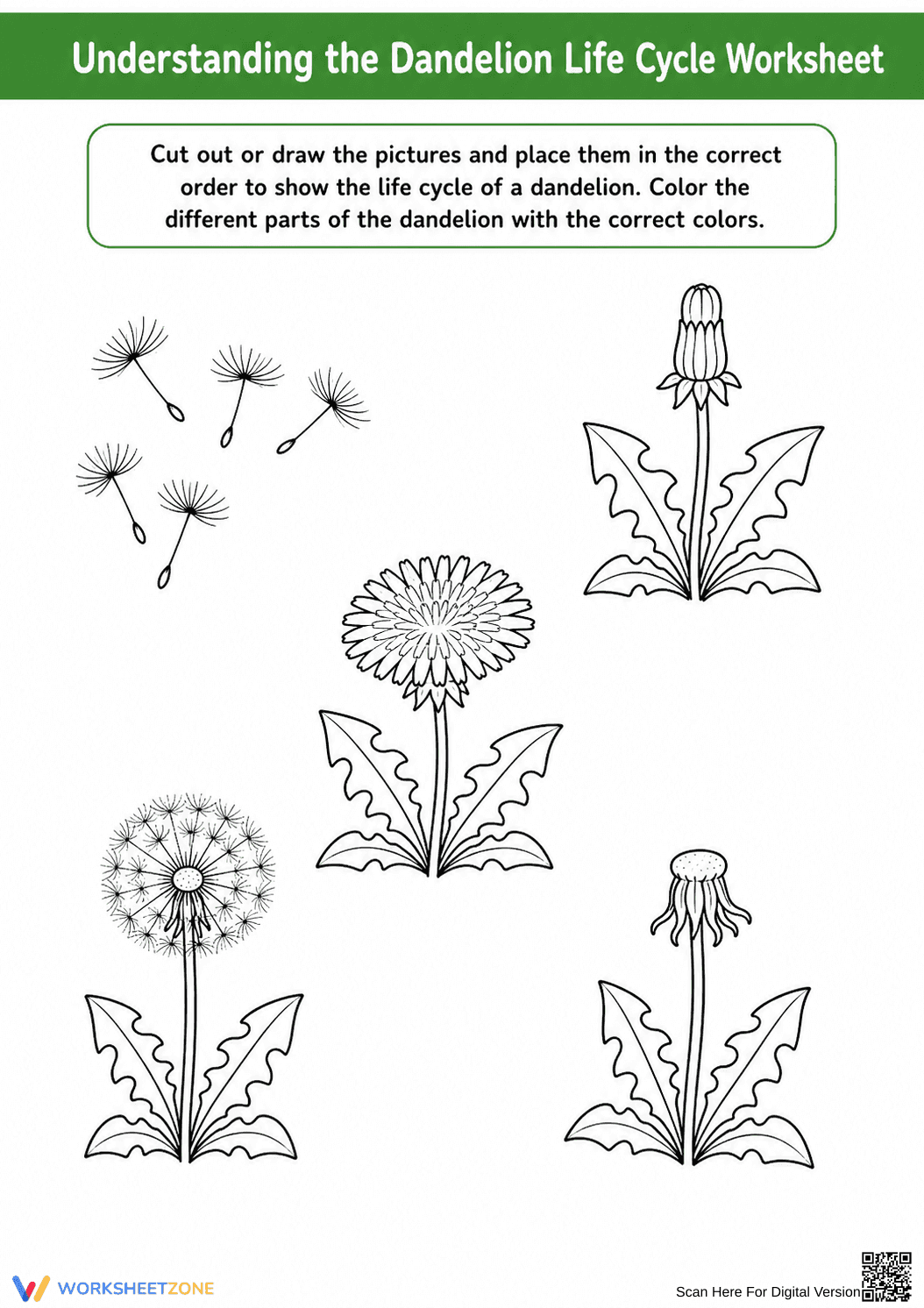

Grade 3 Dandelion Life Cycle — Printable No-Prep Worksheet
Paste this activity's link or code into your existing LMS (Google Classroom, Canvas, Teams, Schoology, Moodle, etc.).
Students can open and work on the activity right away, with no student login required.
You'll still be able to track student progress and results from your teacher account.
This Grade 3 science worksheet helps students visualize and sequence the stages of plant growth by focusing on the dandelion life cycle. By cutting, ordering, and coloring the five distinct developmental phases, young learners actively build their understanding of how organisms grow, reproduce, and change over time.
At a Glance
- Grade: 3 · Subject: Science
- Standard:
3-LS1-1— Develop models to describe organism life cycles.- Skill Focus: Sequencing Plant Life Cycles
- Format: 1 page · 5 problems · No answer key · PDF
- Best For: Independent practice or science centers
- Time: 15–20 minutes
This single-page resource features five detailed, black-and-white illustrations representing the key stages of a dandelion's life: seeds dispersing, a closed bud, a blooming flower, a mature seed head, and a wilted stem. Students cut out these images or draw them to arrange the sequence chronologically. The clear layout provides ample space for coloring, making biological concepts accessible.
Zero-Prep Workflow
- Print (1 minute): Simply print the single-page PDF. No special materials are required beyond standard classroom scissors, glue, and crayons.
- Distribute (1 minute): Hand out the sheets during your science block. The instructions are self-explanatory, allowing students to begin immediately.
- Review (3 minutes): Quickly check student sequences as they paste them down to ensure they understand the progression from seed to mature plant.
With total prep time under two minutes, this activity is perfect for emergency sub plans or science centers.
Standards Alignment
This activity aligns with 3-LS1-1: Develop models to describe that organisms have unique and diverse life cycles but all have in common birth, growth, reproduction, and death. By sequencing the dandelion stages, students create a visual model of this biological progression. Both standard codes can be copied directly into lesson plans, IEP goals, or district curriculum mapping tools.
How to Use It
This worksheet works perfectly as an independent practice activity following direct instruction on plant biology. After learning how seeds grow, students can spend 15 to 20 minutes sorting the dandelion stages. Alternatively, use it as a formative assessment tool during a science center rotation. As students arrange the cut-outs, teachers can observe whether they correctly identify the seed dispersal stage as the final step of reproduction before the cycle begins again.
Who It's For
This resource is designed for third-grade science students, though its highly visual nature makes it suitable for second graders or English Language Learners needing vocabulary support. The hands-on cutting and pasting provides excellent fine motor practice alongside the academic content. Pair this worksheet with a classroom nature walk or a living plant observation station to bridge the gap between the illustrated model and real-world biology.
Understanding biological sequences is a foundational component of early elementary science education. According to the ScienceDirect TpT Analysis, hands-on modeling activities significantly improve student retention of complex biological processes compared to passive reading alone. This worksheet directly supports 3-LS1-1 by requiring students to develop models to describe organism life cycles. When learners actively manipulate, color, and sequence the distinct stages of a dandelion, they transition from merely memorizing facts to constructing a working model of birth, growth, reproduction, and death. This active engagement helps solidify the core scientific concept that while life cycles are diverse across different species, the fundamental progression remains constant. Integrating visual and kinesthetic tasks into daily science instruction ensures that abstract concepts become concrete, measurable learning outcomes for young students, setting the stage for more advanced biological studies.


