Tulip worksheets: Teaching Plant Life Cycles in Early Elementary
These tulip worksheets resources give PreK–3 teachers a complete set of printables for one of spring's most instructionally distinctive plants — a flower that grows from a stored-energy bulb rather than a seed, a biological detail that reframes everything students think they already know about how plants begin. Across anatomy labeling, life cycle sequencing, Venn diagram comparison, and daily observation journaling, the worksheets carry a class through a full botany unit without requiring teachers to hunt down supplementary materials.
What's Inside the Set
Each worksheet targets a distinct skill within early elementary plant science:
- Anatomy labeling: Two diagrams — a cross-sectioned bulb and a full flowering plant — with word banks covering basal plate, fleshy scales, roots, stem, leaves, and petals. Students color each part after labeling it.
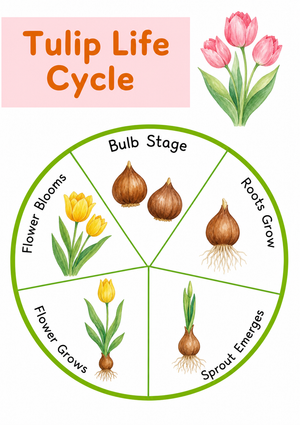
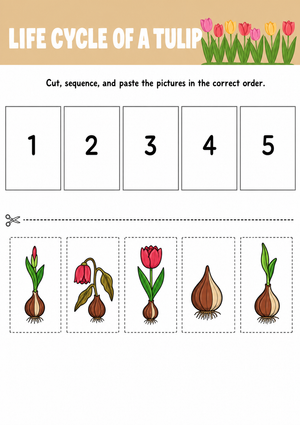
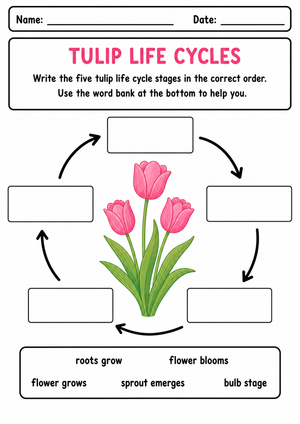
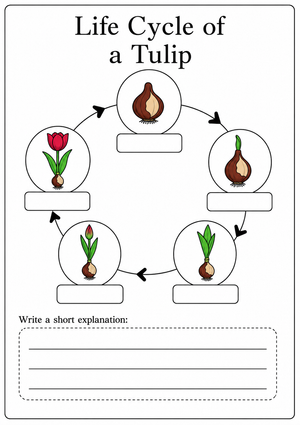
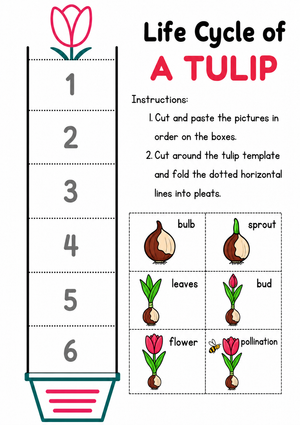
- Life cycle sequencing: Four illustrated cards (dormant bulb, emerging sprout, closed bud, open bloom) that students cut out, arrange in correct order, and paste onto a recording strip.
- Bulb vs. seed comparison: A Venn diagram placing a tulip bulb opposite a sunflower seed. Both require water and sunlight; only the bulb contains a fully formed miniature flower and a season's worth of stored nutrients before it ever enters soil.
- Vocabulary work: Context-sentence and matching tasks covering dormant, perennial, tunic, and basal plate.
- Observation journaling: Dated recording pages with prompts for daily measurements and sketches tracking stem height and root development over time.
Second and third grade worksheets add short informational reading passages — roughly 120 words each — on tulip cultivation history and bloom cycles, followed by multiple-choice and short-answer comprehension checks.
Why the Bulb Changes the Lesson
Most primary classrooms teach plant life cycles through seeds — beans, sunflowers, pumpkins. The tulip bulb disrupts that pattern productively. A bulb is not a dormant seed waiting to germinate; it is a modified stem that stores carbohydrates, with a fully differentiated flower bud already sitting at its center from the moment it goes into the ground. When first graders open their anatomy worksheet and see the internal layers labeled, the cognitive surprise is real: there is already a flower inside. That moment of recognition is worth building toward explicitly, and the labeling activities are designed to create it rather than describe it abstractly.
The perennial nature of tulips also introduces a concept that bean-plant lessons never reach — the idea that one plant can survive winter underground, recharge, and bloom again the following spring. A tulip worksheets set that treats the dormant phase as a genuine life cycle stage, rather than just a waiting period before spring, teaches students that survival and death are not the same thing. That is a real conceptual leap for seven-year-olds, and it maps directly onto the NGSS 3-LS1-1 expectation that students recognize organisms have diverse life cycles.
Frequent Student Errors Worth Catching Early
The most predictable labeling error is swapping "roots" and "basal plate." Both structures appear at the bottom of the bulb diagram, and students who work quickly assume the basal plate label belongs on the threadlike roots hanging below it. Telling the class before distributing the worksheet that the basal plate is the flat disc from which roots grow — not the roots themselves — reduces this error noticeably. A quick pointing gesture on the projected diagram takes about twenty seconds and saves five minutes of re-teaching during review.
On sequencing tasks, students regularly place the bud card before the sprout card. Their reasoning is intuitive: color is more visually striking than height, so the red-tipped bud feels more like "something happening" than a green shoot does. A whole-group modeling step — laying all four cards on the board and asking "what has to exist before we see any color at all?" — usually resolves this before students work independently. The dormant stage generates a separate confusion: in any given class, roughly a quarter of students describe the winter bulb in their observation journals as "dead" or "asleep," not yet distinguishing dormancy as an active biological strategy from death. The vocabulary worksheet's treatment of dormant addresses this directly, but the misconception is persistent enough to revisit in discussion even after students complete that activity.
Working These Worksheets Into Your Week
The sequencing and vocabulary worksheets work well as Monday warm-ups at the start of a spring science unit — they take about twelve minutes and establish terminology students will use throughout the week. Reserve the anatomy labeling worksheet for the day students first handle a real bulb; the printed diagram and the physical object reinforce each other most effectively when they appear together in the same lesson. If the calendar allows, begin forcing a chilled tulip bulb in a clear glass vase at the unit's opening — water just touching the basal plate, set in a sunny window — and have students record daily measurements on their observation journal pages. By the time they reach the reading comprehension worksheet in week two, they have already watched white roots lengthen and a green shoot add centimeters; the text becomes a description of something they personally witnessed rather than abstract content to decode.
A tulip worksheets set also integrates naturally into the literacy block for second and third grade. The informational passages are short enough to pair with a close-reading annotation task, and the botanical vocabulary from the science worksheet recurs in the text — which reinforces retention without requiring additional prep time from the teacher.
Standard Alignment
The anatomy labeling and observation journaling worksheets align with NGSS 1-LS1-1, which expects first graders to use observational information to describe how plant external parts help the organism survive, grow, and meet its needs. Labeling roots as water absorbers and leaves as sunlight collectors is the direct instructional act that standard calls for — not an indirect connection to it. The life cycle sequencing worksheets align with NGSS 3-LS1-1, which asks students to develop models showing that organisms have unique life cycles involving birth, growth, reproduction, and death. Using the cut-and-paste sequencing activity as an entry point into that standard, before students encounter any textbook definition, positions model-building where it belongs: as a tool for making sense of evidence rather than illustrating a concept already memorized.
Adjusting These Worksheets for a Range of Learners
For PreK and kindergarten, the anatomy diagrams function as guided coloring activities with pre-printed labels already in place — the task is color-coding by plant part rather than word retrieval. The sequencing activity can be simplified to two cards (bulb in ground, flower in bloom) for students not yet ready to track four sequential stages with intermediate steps.
First and second graders use the full word bank labeling format as written. Students who finish quickly benefit from a retrieval challenge: after completing the labeled worksheet, they flip it over and reconstruct the labels from memory on a blank diagram. This adds a meaningful extension without requiring the teacher to prepare additional materials. Third graders ready for deeper work on the reading comprehension worksheet can move past multiple-choice questions to write a short explanation — "Why does a tulip bulb need cold temperatures all winter?" — which requires synthesizing the dormancy concept with the vocabulary they have practiced. Those written responses are useful formative data for identifying which students are ready to move into a broader ecosystems unit. A tulip worksheets set that spans PreK through grade 3 gives teachers enough range to make those adjustments within a single set of materials rather than sourcing separate resources for different groups.
Frequently Asked Questions
Do students need access to a real bulb to use these worksheets?
No, though having a physical bulb available during the anatomy labeling lesson increases engagement substantially. A single grocery-store tulip bulb costs under a dollar in early spring and does more for student comprehension of the cross-section diagram than extended verbal explanation. Students who hold the bulb, feel the papery tunic, and press the basal plate with a fingernail have a physical reference point when they return to the labeled diagram. If live bulbs are unavailable, the diagrams are detailed enough to stand on their own.
When in a plant life cycle unit should these worksheets be introduced?
Vocabulary and anatomy worksheets work best at the unit's opening — establishing terms before students encounter them in reading or class discussion. Sequencing activities are most effective mid-unit, after students have observed growth either directly or through video, because sequencing requires recognizing stages rather than memorizing a list. Save the reading comprehension worksheets for the back half of the unit, when students have enough context to read critically rather than encountering unfamiliar content cold.
How do the worksheets explain the difference between a bulb and a seed to young students?
The Venn diagram worksheet handles the comparison most explicitly, but the anatomy labeling activity carries the real conceptual weight. When a student draws a line from "basal plate" to the correct structure and colors the fleshy scales that store nutrients, they are building a mental model of why a bulb behaves differently from a seed — not reading a definition. Students who complete that labeling exercise can typically explain the difference in their own words by the end of the lesson, which is a more reliable indicator of understanding than a correct answer on a matching task.
Are answer keys included?
Yes. Each worksheet in the set includes a corresponding answer key covering labeling, sequencing, and comprehension activities. The vocabulary matching keys also include brief explanatory notes on each term, which teachers find useful for fielding student questions during review without needing to look up definitions separately.
Clear All