


























Views
Downloads

Dandelion Life Cycle Worksheet | Essential Grade 6 Science
Paste this activity's link or code into your existing LMS (Google Classroom, Canvas, Teams, Schoology, Moodle, etc.).
Students can open and work on the activity right away, with no student login required.
You'll still be able to track student progress and results from your teacher account.
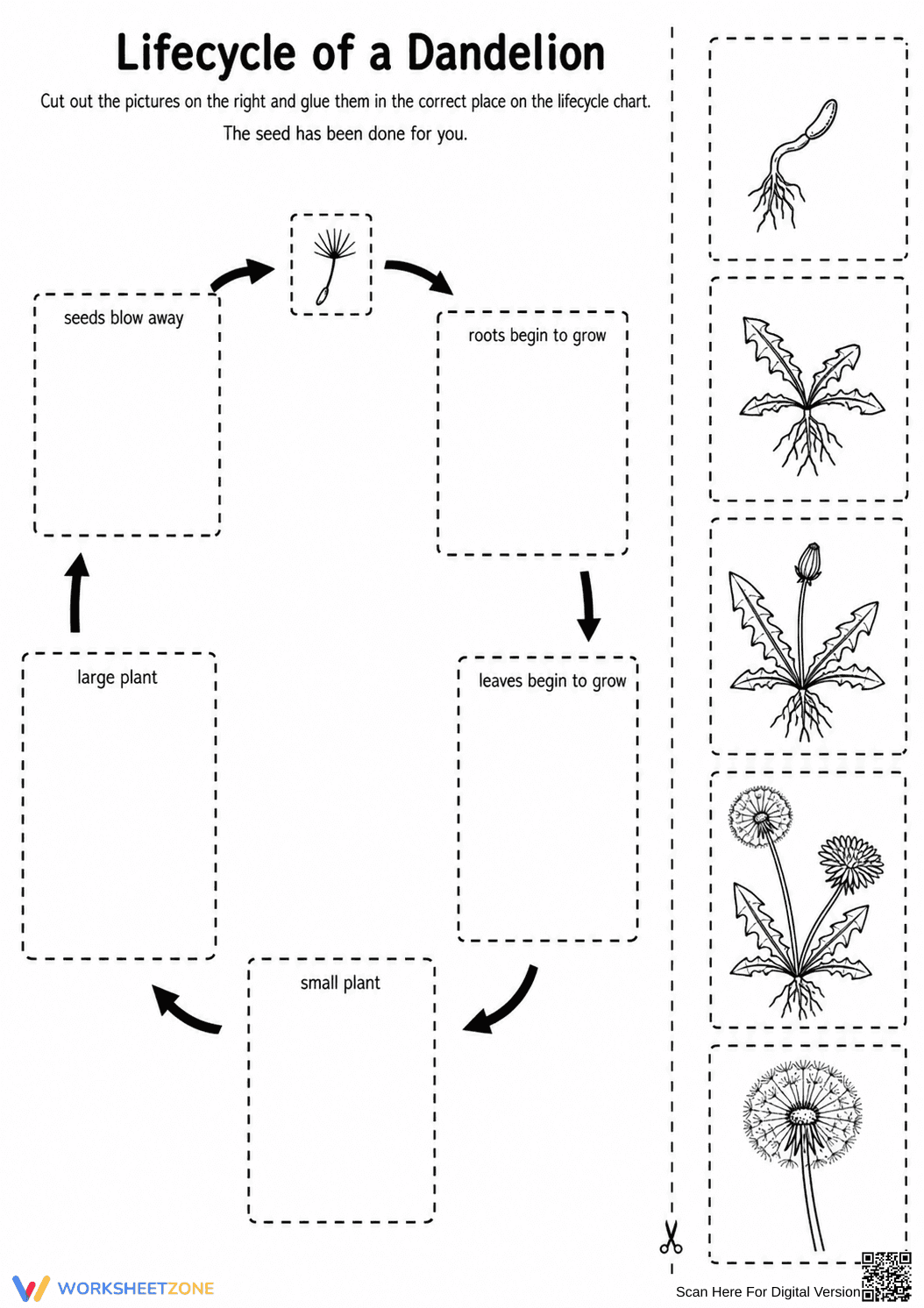
This dandelion life cycle worksheet provides a hands-on approach to understanding plant development. By engaging in a cut-and-paste activity, students demonstrate how a seed progresses through growth stages to become a mature plant. This resource transforms abstract biological concepts into a tangible sequencing task that reinforces scientific vocabulary and observation.
At a Glance
- Grade: 6 · Subject: Science
- Standard:
MS-LS1-4— Specialized plant structures affect the probability of successful reproduction- Skill Focus: Biological sequencing and modeling
- Format: 1 page · 5 problems · Answer key included · PDF
- Best For: Introduction to plant reproduction and growth
- Time: 15–20 minutes
This one-page PDF features a circular flow chart with six stages. One stage is pre-filled to provide a starting point. Five detailed illustrations on the right depict the dandelion from root growth to seed dispersal. The worksheet includes clear cutting lines and directional arrows to guide students through the chronological order of the plant's life cycle.
Zero-Prep Workflow
- Print: Generate the single-page PDF for each student in under 1 minute.
- Distribute: Provide scissors and glue; students spend 10 minutes cutting and placing the five images.
- Review: Discuss the completed cycles as a group to verify the sequence in 5 minutes.
This workflow requires under 2 minutes of teacher prep, making it ideal for emergency sub plans or quick formative assessments.
Standards Alignment
This resource is primarily aligned with `MS-LS1-4`, which tasks students with explaining how specialized plant structures affect reproduction. While the content is accessible, it supports middle school standards regarding plant development and dispersal mechanisms. Both standard codes can be copied directly into lesson plans, IEP goals, or district curriculum mapping tools.
How to Use It
Use this worksheet during the "Explore" phase of instruction to allow students to hypothesize growth stages. It also functions as a post-lesson assessment to verify mastery of biological sequencing. While students work, observe their ability to distinguish between the "small" and "large" plant stages to gauge attention to detail. Completion typically takes 15 to 20 minutes in a standard classroom setting.
Who It's For
This activity is designed for students requiring fine motor practice or visual support in science. It pairs naturally with a classroom observation of real plants or a time-lapse video of growth. The clear illustrations make it a versatile tool for diverse learners who benefit from kinesthetic and visual learning modalities in the science classroom.
The MS-LS1-4 standard requires students to support explanations for how specialized plant structures affect the probability of successful reproduction. This dandelion life cycle worksheet facilitates this by providing a visual representation of plant development, specifically highlighting the "seeds blow away" stage as a dispersal mechanism. According to Fisher & Frey (2014), the use of graphic organizers and manipulative tasks like cut-and-paste activities significantly enhances the "gradual release of responsibility" by providing a concrete scaffold for abstract biological sequences. By identifying these structures, students engage with the mechanics of plant reproduction. This resource serves as a foundational tool for building scientific literacy, allowing educators to assess a student's ability to conceptualize temporal changes in living systems. The 5-stage model ensures that learners recognize the cyclical nature of life, meeting core curriculum requirements for evidence-based modeling in middle school science.


