6th grade human body systems printable worksheets give science teachers something a textbook chapter alone rarely delivers: repeated, varied exposure to the same content in formats students can actually work through on their own. A strong set covers the circulatory, respiratory, digestive, muscular, skeletal, nervous, and excretory systems — but the real value lies in the question types that push students past memorization into genuine functional understanding.
What Each Worksheet Builds
At this grade level, the goal is not simply naming organs. Students who can recite "the heart pumps blood" still freeze when asked what happens to oxygen delivery if heart rate slows during rest. These worksheets move students through four connected skill areas:
- Identifying major body systems and the organs that belong to each one
- Matching specific organs to their functions — not just to a system name
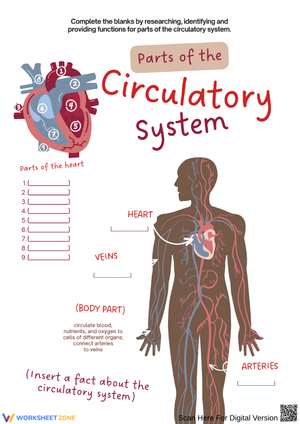
- Explaining how organs within a single system cooperate, such as how the trachea, bronchi, and alveoli work in sequence during inhalation
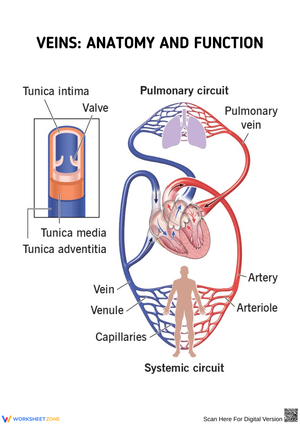
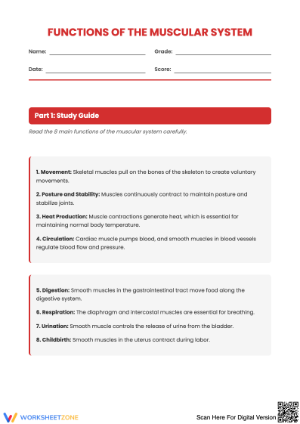
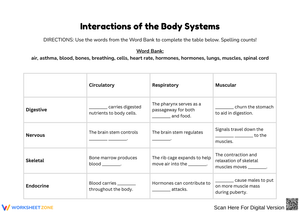
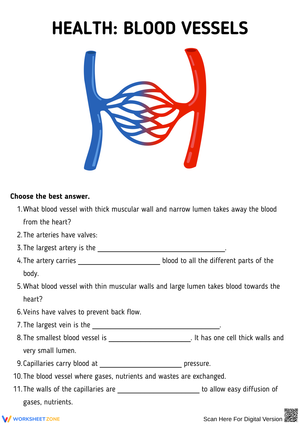
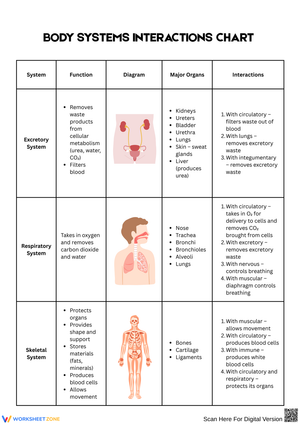
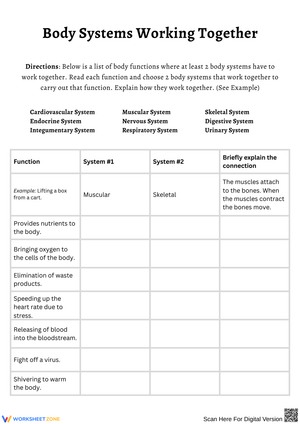
- Describing interactions between two systems, such as how the muscular and skeletal systems coordinate during movement or how the respiratory and circulatory systems hand off oxygen at the alveolar surface
That last skill is where 6th graders consistently need the most time. They can memorize individual organ functions in isolation but struggle to trace a process — oxygen intake, nutrient absorption, nerve signal transmission — across system boundaries. Worksheets that ask students to do exactly that are doing the harder and more important instructional work.
Student Error Patterns Worth Watching Before the Unit Assessment
One of the most common misconceptions at this grade level: students write that "the lungs make oxygen." They know oxygen is involved with breathing, but they conflate the respiratory system's intake function with oxygen production. A well-constructed worksheet question — Where does the oxygen in your blood come from, and which system brings it in? — separates those two ideas cleanly and surfaces the error before a unit test instead of during one.
A second consistent problem is conflating the excretory and digestive systems. Students who correctly describe digestion as breaking down food for nutrients will still list the kidneys as part of the digestive system because "they both get rid of stuff." Worksheets that ask students to name the specific waste product each system removes — undigested food versus metabolic waste filtered from blood — force that distinction more effectively than a whole-class discussion can on its own.
The third pattern shows up on interaction questions. Students know the heart pumps blood and the lungs bring in oxygen, but when asked to explain how those two facts connect during a sprint, they write two separate, unlinked sentences. An application question that requires one explanation spanning both systems — not two isolated facts placed side by side — is the fastest classroom tool for identifying that gap while there is still time to address it.
Building These Worksheets Into a Body Systems Unit
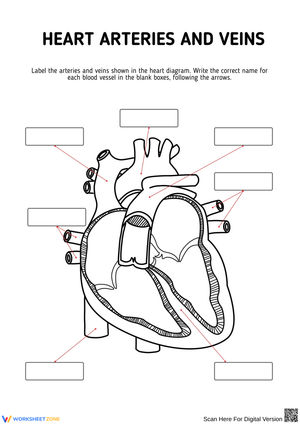
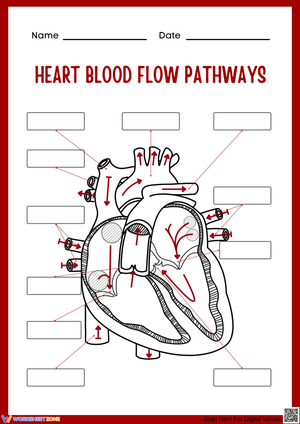
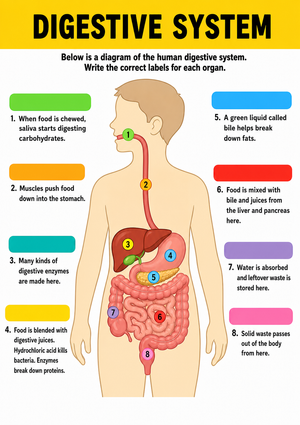
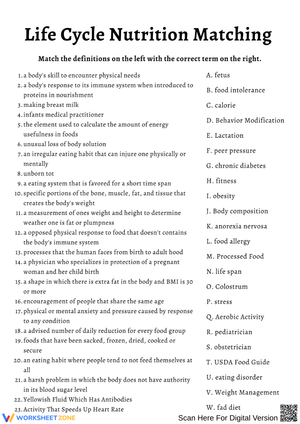
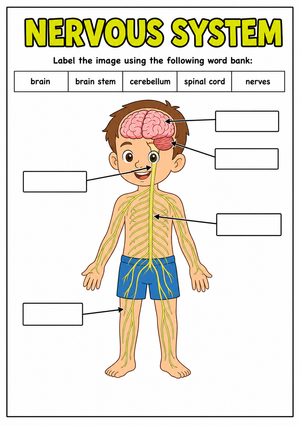
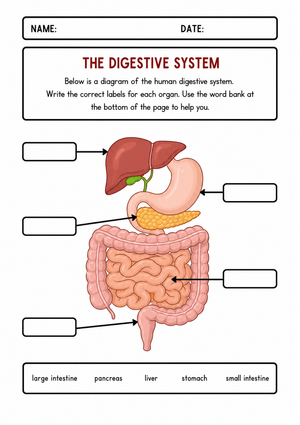
6th grade human body systems printable worksheets are most effective when integrated into the daily rhythm of instruction rather than saved for test week. A reliable pattern: open with a five-minute vocabulary matching worksheet before direct instruction begins. Students activate prior knowledge, and you get a quick read on where gaps already exist before you have said anything about the day's system. After a short mini-lesson, a labeled-diagram worksheet gives students an immediate, concrete task that keeps guided practice focused rather than open-ended.
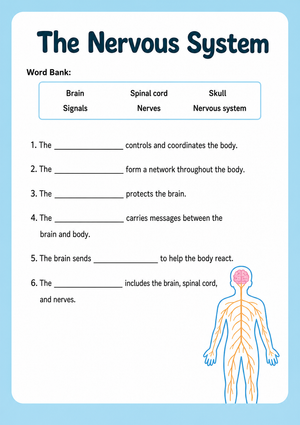
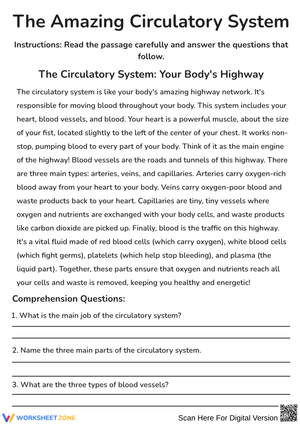
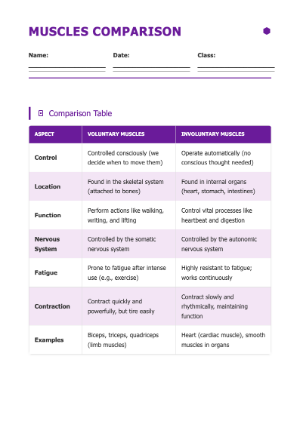
Stations work especially well with this content because the topic naturally divides by system. One station might use a labeling worksheet on the skeletal system; another might use a short reading passage on the nervous system with four text-dependent questions; a third might present a compare-and-contrast task on the respiratory and circulatory systems. Students rotate through them across a class period, which distributes the cognitive effort and avoids the flat experience of completing the same task format for an entire block.
These worksheets also hold up as substitute plans without any setup. A worksheet on the digestive system with a labeled diagram and four short-answer questions runs itself — on days when a last-minute absence means no sub plan exists, that kind of low-prep resource earns its place in the file cabinet.
Standard Alignment
The primary standard these worksheets address is NGSS MS-LS1-3: "Use argument supported by evidence for how the body is a system of interacting subsystems composed of groups of cells." The interaction questions on each worksheet — especially compare-and-contrast tasks and application prompts that ask students to trace a substance or signal across two systems — directly target this standard's expectation. Students are not just labeling organs; they are constructing an explanation of how those organs function within an integrated system.
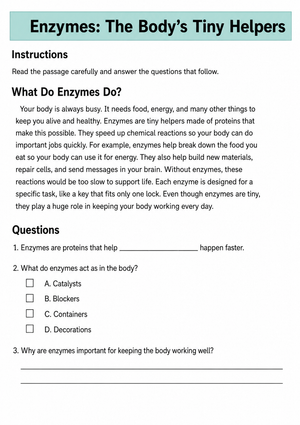
The reading-passage worksheets also align with CCSS.ELA-LITERACY.RST.6-8.3, which asks students to follow a multistep process described in a scientific or technical text. Worksheets that include a short passage and ask students to sequence how food moves through the digestive system, or how a nerve signal travels from receptor to muscle, satisfy that cross-disciplinary standard without pulling instructional time away from science content.
Adjusting the Worksheets for a Mixed-Ability Science Class
Middle school science classes rarely arrive with uniform background knowledge. Some students have strong elementary science foundations; others are meeting the term "alveoli" for the first time. These 6th grade human body systems printable worksheets support tiered access without requiring teachers to produce entirely separate materials for different groups.
For students who need more support, partial-label diagrams — where some organs are already identified and students fill in the rest — lower the retrieval demand while still requiring genuine engagement with the content. Adding a word bank to vocabulary-heavy worksheets keeps the task moving without eliminating the thinking. Matching formats build confidence before open-response formats ask students to produce their own explanations.
For students ready for more challenge, removing the word bank, requiring complete-sentence answers for every response, and assigning compare-and-contrast worksheets that ask students to trace oxygen, glucose, or a nerve signal across more than one system in sequence are all effective moves. Asking a student to write a short explanation of what happens to the food on their lunch plate from noon through overnight is an extension task built entirely from worksheet content — no separate assignment needed. Co-taught and intervention classes benefit from keeping the same worksheet in front of all students while the level of support shifts, because a shared content reference makes whole-class discussion easier to anchor afterward.
Frequently Asked Questions
Which body systems are typically covered in a 6th grade unit?
Most 6th grade life science courses include the circulatory, respiratory, digestive, muscular, skeletal, nervous, and excretory systems. Students are expected to identify the major organs in each system, explain the system's primary function, and describe how systems interact to maintain the body's basic processes.
How should these worksheets be used after students have already read about a system?
After reading, application and interaction questions do more useful work than re-labeling diagrams students have already completed. A short worksheet asking students to explain what would happen to nutrient delivery if the digestive system broke down — and how that would affect the circulatory system — checks whether students retained conceptual understanding, not just vocabulary. That kind of question is harder to answer from memory alone and surfaces gaps that re-reading would not.
Do these worksheets work for students who struggle with reading-heavy tasks?
Labeling and matching worksheets carry minimal reading demand and work well for students who find text-heavy tasks difficult. Short-passage worksheets can be read aloud during class or paired with audio support. The variety of formats across the set means teachers are not locked into one approach for every learner.
Can these be used for test preparation at the end of a unit?
The mixed-format review worksheets — those covering several systems on one worksheet with a range of question types — are the most useful for test prep. These 6th grade human body systems printable worksheets cover vocabulary, labeling, function explanation, and system interaction in the same kinds of formats students encounter on a unit assessment, which makes the review block at the end of a unit practical rather than repetitive.












 Interactive Worksheet Maker
 Quiz Maker
 Word Search Maker
 Crossword Puzzle Maker
 Word Scramble Generator
 Sentence Scramble Generator
 Handwriting Worksheet Generator
 Name Tracing Generator
 Fill In The Blank Generator