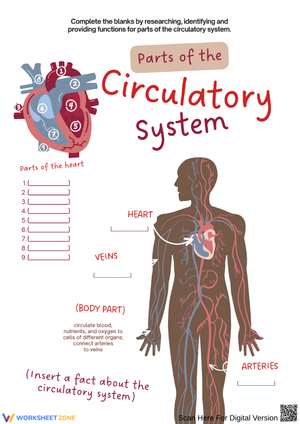
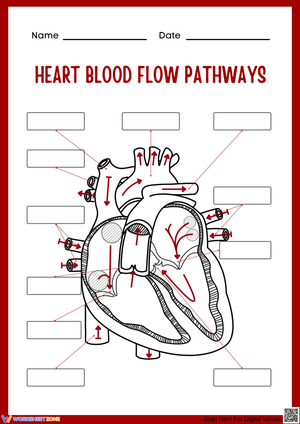
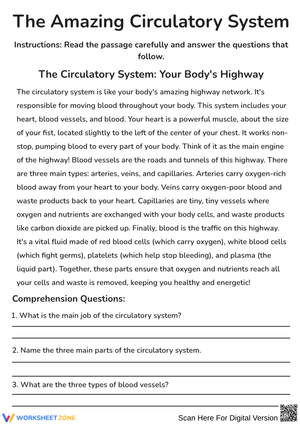
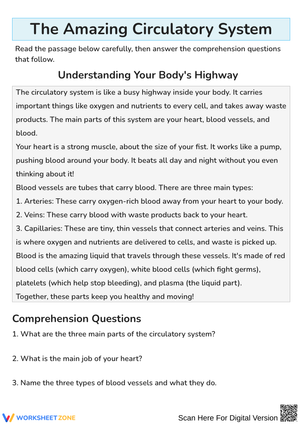
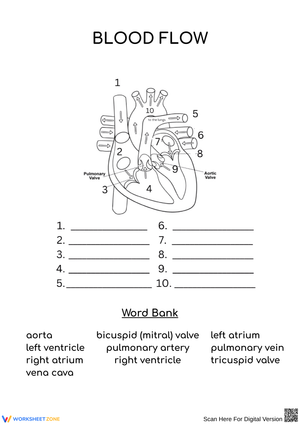
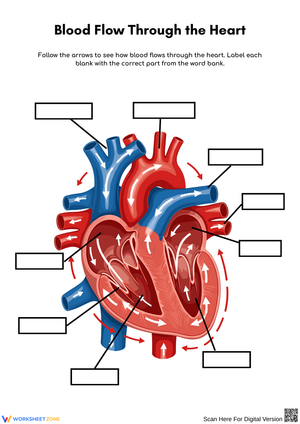
These circulatory system pdf worksheets for 6th grade give teachers focused, printable practice for a human body systems unit — labeling heart chambers, tracing blood pathways, sorting vessel types, and reinforcing the vocabulary students need before they can explain how oxygen actually reaches body tissue. The set addresses the concepts that most 6th graders find slippery on first encounter: where the heart sends blood and why, what distinguishes an artery from a capillary, and what happens during pulmonary circulation specifically.
What's Inside the Set
Sixth grade is typically the first time students engage with the circulatory system at genuine anatomical depth. Rather than simply knowing "the heart pumps blood," students at this level are expected to understand which chambers handle which direction of flow, which vessels carry oxygenated versus deoxygenated blood, and how the pulmonary and systemic circuits divide the work. Each worksheet in the set addresses one layer of that content.
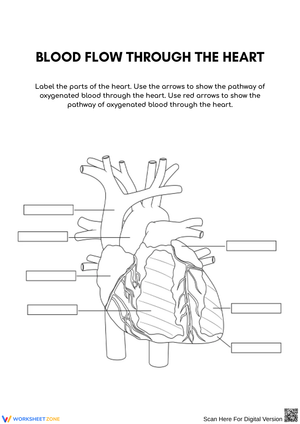
- Heart structure labeling: Students identify the four chambers, the major valves, and the points where blood enters and exits.
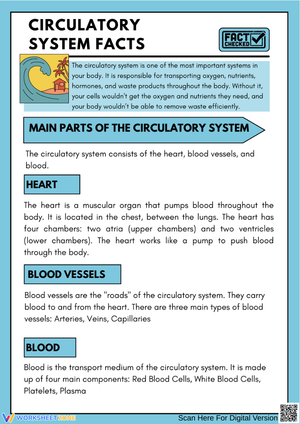
- Blood vessel identification: Students distinguish arteries (carrying blood away from the heart), veins (returning blood to the heart), and capillaries (where gas exchange occurs at the tissue level).
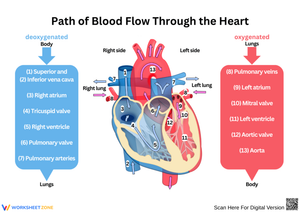
- Blood flow tracing: Students follow a step-by-step path from the right ventricle through the lungs and back to the left atrium, then through the systemic circuit to body tissues.
- Blood component matching: Red blood cells, white blood cells, platelets, and plasma are matched to their functions using accessible, grade-appropriate language.
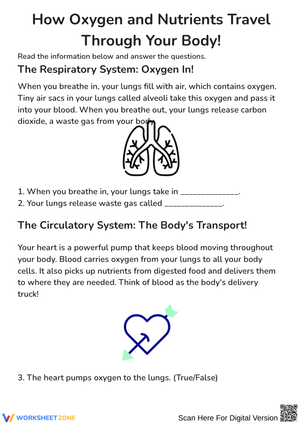
- Vocabulary reinforcement: Terms like circulation, pulse, artery, vein, capillary, and carbon dioxide appear in multiple formats — labeling, matching, and written explanation — so students encounter each term more than once across the set.
Frequent Student Errors Worth Watching For
Two misconceptions appear consistently in 6th grade student work on this topic. The first is a color-association problem. Students encounter blue-shaded veins in textbook diagrams and conclude that venous blood is literally blue, or at least a different substance from arterial blood. When a fill-in-the-blank worksheet asks them to describe the blood entering the right atrium, a surprising number write "blue blood" or "dirty blood" rather than "deoxygenated blood." The diagram worksheet addresses this directly by asking students to label blood as oxygenated or deoxygenated at specific points in the circuit — separating the concept of oxygen content from the color convention used in diagrams.
The second error is directional, and it trips up students who think they already understand the concept. Many learn "arteries carry oxygen, veins carry carbon dioxide" as a shortcut. That rule collapses the moment they encounter pulmonary circulation, where the pulmonary artery carries deoxygenated blood to the lungs and the pulmonary veins carry oxygenated blood back to the heart. No amount of vocabulary matching catches this confusion the way a blood-flow tracing task does. Having students follow a single red blood cell from the right ventricle through the full circuit — step by step, labeling what that cell carries at each stage — surfaces the misunderstanding and corrects it at the same time.
Fitting These Worksheets Into Your Planning
The labeling worksheet works well as a Monday opener at the start of a circulatory system week. Students spend 6 or 7 minutes reviewing major structures before direct instruction begins — low stakes, familiar content from the previous lesson, activating what they already hold. The reading-and-response worksheet fits directly after instruction as structured independent practice. While students work, the teacher can move through the room and listen for the directional errors described above before those errors calcify into test answers.
For sub plans, the fill-in-the-blank review worksheet is the most self-contained resource in the set. Clear directions mean a substitute can distribute it without additional explanation, and checking responses takes roughly two minutes. It also works as a Friday exit check before moving to a new body system — a quick read on whether students can still sequence the blood flow pathway after a week of instruction.
Science centers that include one visual worksheet, one vocabulary worksheet, and one written-response worksheet cover the same core content from three angles in the same class period. That design is intentional: students who can label a diagram correctly but cannot explain in a sentence why capillaries matter have not yet internalized the concept. Pairing a labeling task with a short written explanation task in the same lesson gives a more accurate picture of understanding than using one format alone. Retrieval practice works when students encounter the same idea in a different form — not when each activity introduces something new.
Standard Alignment
These circulatory system pdf worksheets for 6th grade align to NGSS MS-LS1-3, which asks students to use evidence to support the claim that the body's organization exists to sustain cell-level functions — including receiving oxygen and removing waste. At 6th grade, the circulatory system is one of the most direct examples available for making that standard concrete: the heart, blood vessels, and blood cells work together to deliver oxygen specifically at the cellular level, not just across the body in a general sense. Teachers using the blood-flow tracing worksheet as a formative check can evaluate whether students understand that distinction — between "the heart pumps blood to the body" and "the heart pumps blood so that individual cells receive the oxygen they need to function."
Differentiating Across Readiness Levels
The circulatory system pdf worksheets for 6th grade in this set work across a range of readiness levels when teachers are deliberate about which worksheet they assign first and what support they build in alongside it. Start every student with the same essential concept — blood carries oxygen from the lungs to body tissues and returns carbon dioxide to the lungs — then vary the level of support from there.
Students who need more structure work best with the diagram worksheet when it includes a word bank. Reducing the labeled structures from eight to four — keeping the heart, the lungs, and the two major vessel types — lets those students practice the core blood flow idea without getting buried in anatomical names they are not yet ready to retain. On-level students can complete the full labeling task, the vocabulary matching, and the short-answer questions about blood flow. Students who finish early and need more depth benefit from a written extension prompt: ask them to explain why pulse rate increases during exercise. That question requires connecting heart function to the body's changing oxygen demand — a step beyond identification that most 6th graders can reach when the prompt is specific enough.
One practical note: resist handing out every worksheet in the set at once to students who tend to work ahead without reading carefully. The blood-flow tracing task depends on working through the path in order. Releasing each worksheet as the lesson calls for it prevents students from filling in later sections before they understand the earlier ones.
Frequently Asked Questions
What content should a 6th grade circulatory system worksheet cover?
At minimum: heart chambers and their function, the three blood vessel types and their directional roles, the path of blood through both the pulmonary and systemic circuits, and core vocabulary including artery, vein, capillary, oxygen, carbon dioxide, and pulse. A set that combines diagram labeling with short written explanation covers that ground more thoroughly than labeling alone.
Do these worksheets come with answer keys?
Yes. Answer keys are included with the set. They make the resources practical for independent practice stations, homework checks, and sub plans — situations where a teacher cannot verify responses in the moment. They also help during reteaching: if a class struggles with the blood-flow tracing task, the answer key shows exactly where the pathway breaks down in student work.
How do these fit into a test-prep context?
Many state science assessments at the middle school level include body systems items that ask students to identify structures, explain a function, or trace the movement of materials through a system. The circulatory system pdf worksheets for 6th grade in this set address all three of those task types, making them useful review material in the weeks before a state assessment — not just during the initial body systems unit.












 Interactive Worksheet Maker
 Quiz Maker
 Word Search Maker
 Crossword Puzzle Maker
 Word Scramble Generator
 Sentence Scramble Generator
 Handwriting Worksheet Generator
 Name Tracing Generator
 Fill In The Blank Generator