


























Views
Downloads
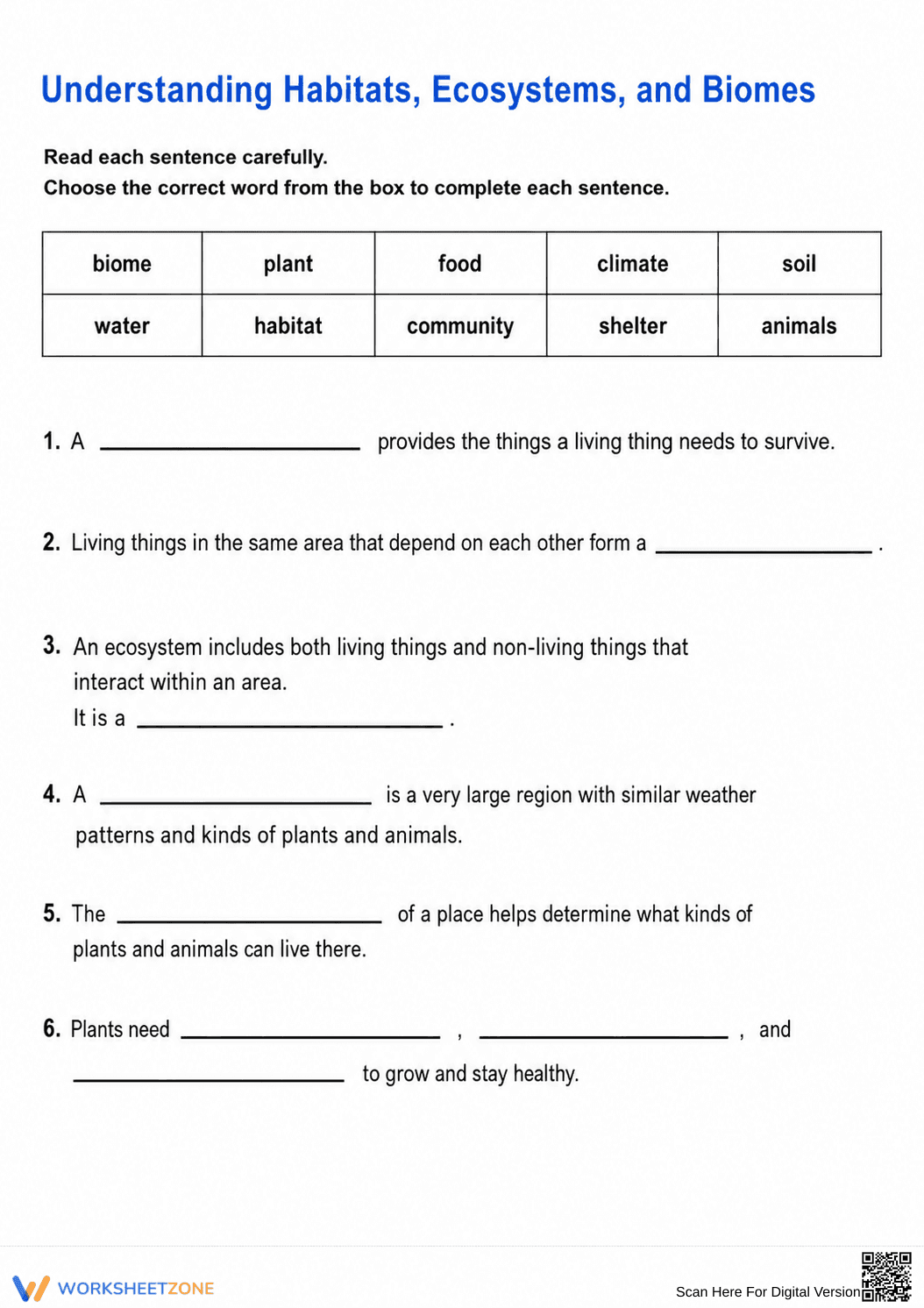

Grade 6 Ecosystems & Biomes — Printable No-Prep Worksheet
Paste this activity's link or code into your existing LMS (Google Classroom, Canvas, Teams, Schoology, Moodle, etc.).
Students can open and work on the activity right away, with no student login required.
You'll still be able to track student progress and results from your teacher account.
This Grade 6 science worksheet helps students master essential ecology vocabulary by exploring how living and nonliving things interact. By completing targeted fill-in-the-blank sentences, learners will solidify their understanding of habitats, communities, and biomes to build a strong foundation for advanced life science concepts.
At a Glance
- Grade: 6 · Subject: Science
- Standard:
MS-LS2-3— Describe interactions among living and nonliving parts of an ecosystem- Skill Focus: Ecology Vocabulary
- Format: 1 page · 6 problems · Answer key included · PDF
- Best For: Independent practice or review
- Time: 10–15 minutes
What's Inside
This single-page resource features six fill-in-the-blank sentences supported by a comprehensive ten-word vocabulary bank. Students will select the correct terms—such as climate, community, and shelter—to complete definitions and conceptual statements. A complete answer key is included to ensure accurate grading and immediate feedback.
Zero-Prep Workflow
- Print (1 minute): Simply print the PDF and copy a class set. No special materials or prior setup required.
- Distribute (1 minute): Hand out the worksheet as a warm-up, exit ticket, or independent assignment.
- Review (3 minutes): Go over the answers together using the provided key to reinforce the vocabulary in context.
Total teacher prep time is under two minutes, making this an excellent option for emergency sub plans or quick transitions.
Standards Alignment
Aligned to MS-LS2-3: Develop a model to describe the cycling of matter and flow of energy among living and nonliving parts of an ecosystem. This vocabulary practice provides the foundational terminology needed before students can successfully model these complex interactions. Both standard codes can be copied directly into lesson plans, IEP goals, or district curriculum mapping tools.
How to Use It
Assign this activity during direct instruction as a guided notes check, or use it after a lesson on biomes to assess retention. Teachers can quickly observe which students struggle with distinguishing between "habitat" and "ecosystem" to guide future review. Expect students to complete the task in 10 to 15 minutes.
Who It's For
This resource is designed for middle school science students, particularly those in sixth grade. The embedded word bank provides built-in scaffolding for English Language Learners and students needing vocabulary support. It pairs perfectly with an introductory reading passage on global biomes or a visual diagram of a local ecosystem.
Mastering scientific terminology is a critical first step in scientific literacy. By aligning to MS-LS2-3 and requiring students to describe interactions among living and nonliving parts of an ecosystem, this worksheet reinforces essential academic language. According to Fisher & Frey (2014), explicit vocabulary instruction combined with contextual practice significantly improves students' ability to comprehend complex informational texts. Providing a structured word bank allows learners to focus on conceptual relationships rather than rote memorization, ensuring a deeper understanding of ecological systems.


