


























Views
Downloads


Enzymes Reading Worksheet | Essential Grade 5-8 Science
Paste this activity's link or code into your existing LMS (Google Classroom, Canvas, Teams, Schoology, Moodle, etc.).
Students can open and work on the activity right away, with no student login required.
You'll still be able to track student progress and results from your teacher account.
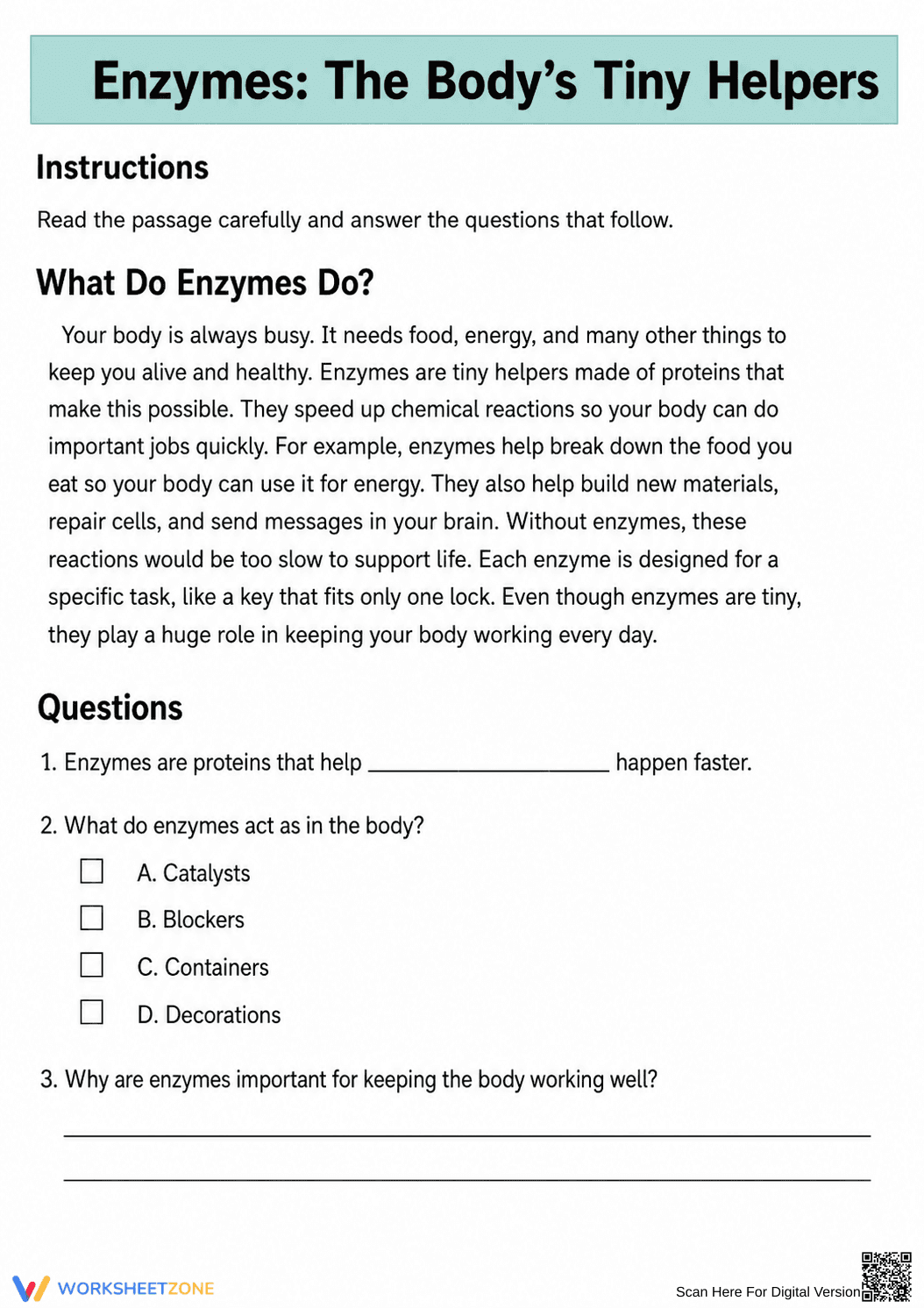
This reading worksheet introduces students to the fundamental role of enzymes as biological catalysts in the human body. By exploring how these proteins accelerate chemical reactions, students gain a clear understanding of metabolism and digestion. The text uses accessible analogies, like the lock-and-key model, to ensure complex biochemical concepts are easily understood by middle school learners.
At a Glance
- Grade: 5-8 · Subject: Science
- Standard:
MS-LS1-7— Develop a model to describe how food is rearranged through chemical reactions- Skill Focus: Enzyme function and biological catalysts
- Format: 2 pages · 5 problems · Answer key included · PDF
- Best For: Introductory biochemistry and human body units
- Time: 20–30 minutes
What's Inside
This two-page resource features a high-interest reading passage titled "Enzymes: The Body’s Tiny Helpers." The first page defines enzymes as proteins and catalysts, while the second expands on substrates and their reusable nature. The assessment includes one fill-in-the-blank task, one multiple-choice question on catalyst definitions, and three short-answer prompts requiring students to synthesize information about digestion and cellular health.
Zero-Prep Workflow
- Print (1 minute): Select the two-page PDF and print copies for your class. No additional materials are required.
- Distribute (1 minute): Hand out the worksheets as a silent reading activity or guided lesson. Clear headings make it easy to follow.
- Review (5 minutes): Use the included answer key to facilitate a quick discussion or grade the 5 tasks as a formative assessment.
This streamlined structure makes the worksheet ideal for emergency sub plans or as a transition activity.
Standards Alignment
The primary focus is MS-LS1-7, requiring students to understand how molecules are broken down and rearranged in the body. By identifying enzymes as the primary agents of these chemical changes, students build background knowledge for higher-level biology. This standard code can be copied directly into lesson plans or curriculum mapping tools.
How to Use It
This worksheet is best utilized during the "Explain" phase of a 5E lesson cycle. After exploring digestion, use this reading to provide formal vocabulary and scientific explanations for chemical breakdown. For a formative assessment, observe students answering question five; linking enzyme function to overall health indicates conceptual mastery. Expect students to finish within 25 minutes.
Who It's For
Designed for middle school science students in grades 6-8, this resource is also accessible for advanced 5th-grade learners. It is effective for students who benefit from structured reading supports and clear visual cues. This worksheet pairs naturally with a digestive system diagram or a hands-on enzyme lab.
According to research by Fisher & Frey (2014), providing high-quality informational texts is critical in moving from teacher-led instruction to independent mastery. This worksheet supports that transition by focusing on MS-LS1-7, which asks students to describe chemical reactions that sustain life. By breaking down the complex role of enzymes into a "tiny helper" narrative, the resource reduces cognitive load while maintaining scientific rigor. Data from the RAND AIRS 2024 report suggests targeted reading interventions in science significantly improve retention of technical vocabulary. This 2-page PDF provides the structured practice necessary for students to explain how enzymes act as catalysts in digestion, ensuring they are prepared for advanced biological studies.


