




























Views
Downloads

Grade 4 Nervous System — Printable No-Prep Worksheet

Paste this activity's link or code into your existing LMS (Google Classroom, Canvas, Teams, Schoology, Moodle, etc.).
Students can open and work on the activity right away, with no student login required.
You'll still be able to track student progress and results from your teacher account.
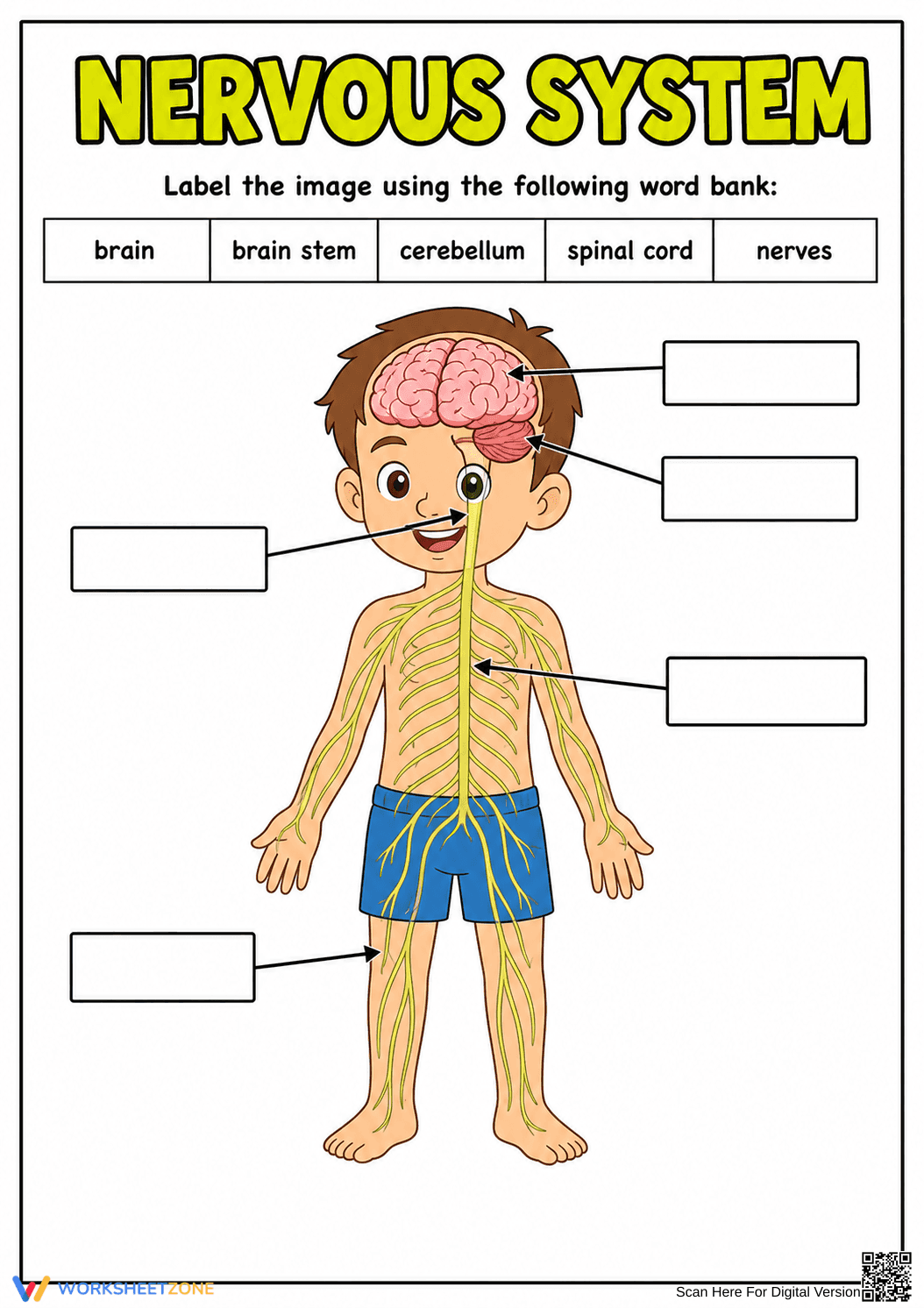
This printable science worksheet helps students identify and label the major components of the human nervous system. By using a clear diagram and a provided word bank, learners will accurately locate the brain, spinal cord, and nerves, building foundational anatomy knowledge and essential life science vocabulary.
At a Glance
- Grade: 4 · Subject: Science
- Standard:
4-LS1-1— Identify internal structures that support survival and behavior- Skill Focus: Labeling the nervous system
- Format: 1 page · 5 problems · Answer key included · PDF
- Best For: Independent practice
- Time: 10–15 minutes
Inside this single-page resource, educators will find a high-quality, student-friendly diagram of the human body highlighting the nervous system network. The activity features five fill-in-the-blank labeling tasks pointing to specific anatomical structures. A convenient word bank is positioned at the top of the page, offering built-in spelling support and scaffolding for students. A complete answer key is also provided to ensure accurate grading and quick reference.
This resource is designed for a smooth, zero-prep classroom experience. First, print the PDF copies for your class, which takes less than one minute. Next, distribute the pages directly to students; the clear instructions and word bank mean no additional teacher setup is required. Finally, review the correct anatomical terms together as a class. The entire preparation workflow takes under two minutes, making this an ideal, stress-free option for emergency sub plans or quick science center rotations.
This activity is aligned to 4-LS1-1, requiring students to understand that animals have internal and external structures that function to support survival, growth, behavior, and reproduction. By mapping the nervous system, students visualize the specific internal structures responsible for transmitting signals throughout the body. Both standard codes can be copied directly into lesson plans, IEP goals, or district curriculum mapping tools.
Deploy this worksheet during the middle of a human body unit after introducing the basic functions of the brain and nerves. It serves as an excellent independent practice assignment or a quiet morning work activity. As a formative assessment tip, observe which students rely heavily on the word bank versus those who can label the diagram from memory, indicating their mastery of the vocabulary. Students should be able to complete the five labeling tasks within 10 to 15 minutes.
This resource is primarily designed for fourth-grade students, though it serves as an excellent review tool for fifth and sixth graders studying life science. The inclusion of a word bank provides natural differentiation for English Language Learners and students who struggle with spelling complex anatomical terms. It pairs perfectly with an introductory direct instruction lesson on how the brain communicates with the rest of the body.
Mastering anatomical vocabulary through visual diagrams is a critical step in elementary science education. When students practice identifying internal structures that support survival and behavior, as outlined in standard 4-LS1-1, they build a mental model of how complex biological systems interact. According to a ScienceDirect TpT Analysis, integrating visual aids with targeted vocabulary practice significantly improves long-term retention of scientific concepts in upper elementary learners. This specific labeling exercise bridges the gap between abstract biological processes and concrete anatomical structures. By physically mapping terms like the cerebellum and spinal cord onto a human figure, learners transition from passive reading to active spatial reasoning. This foundational knowledge is essential for subsequent middle school biology coursework, ensuring students are fully prepared to tackle more advanced physiological concepts in the future.


