


























Views
Downloads
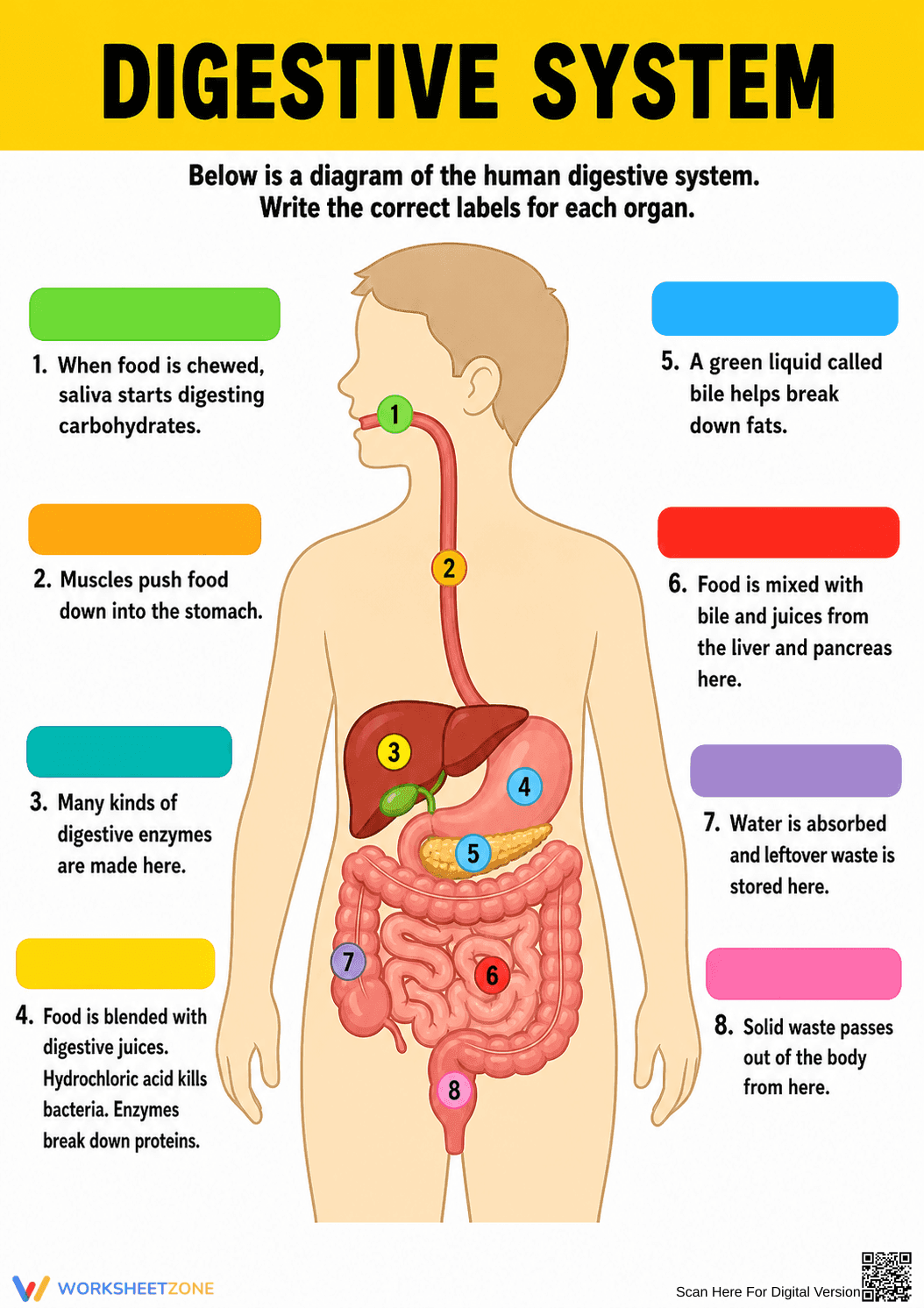
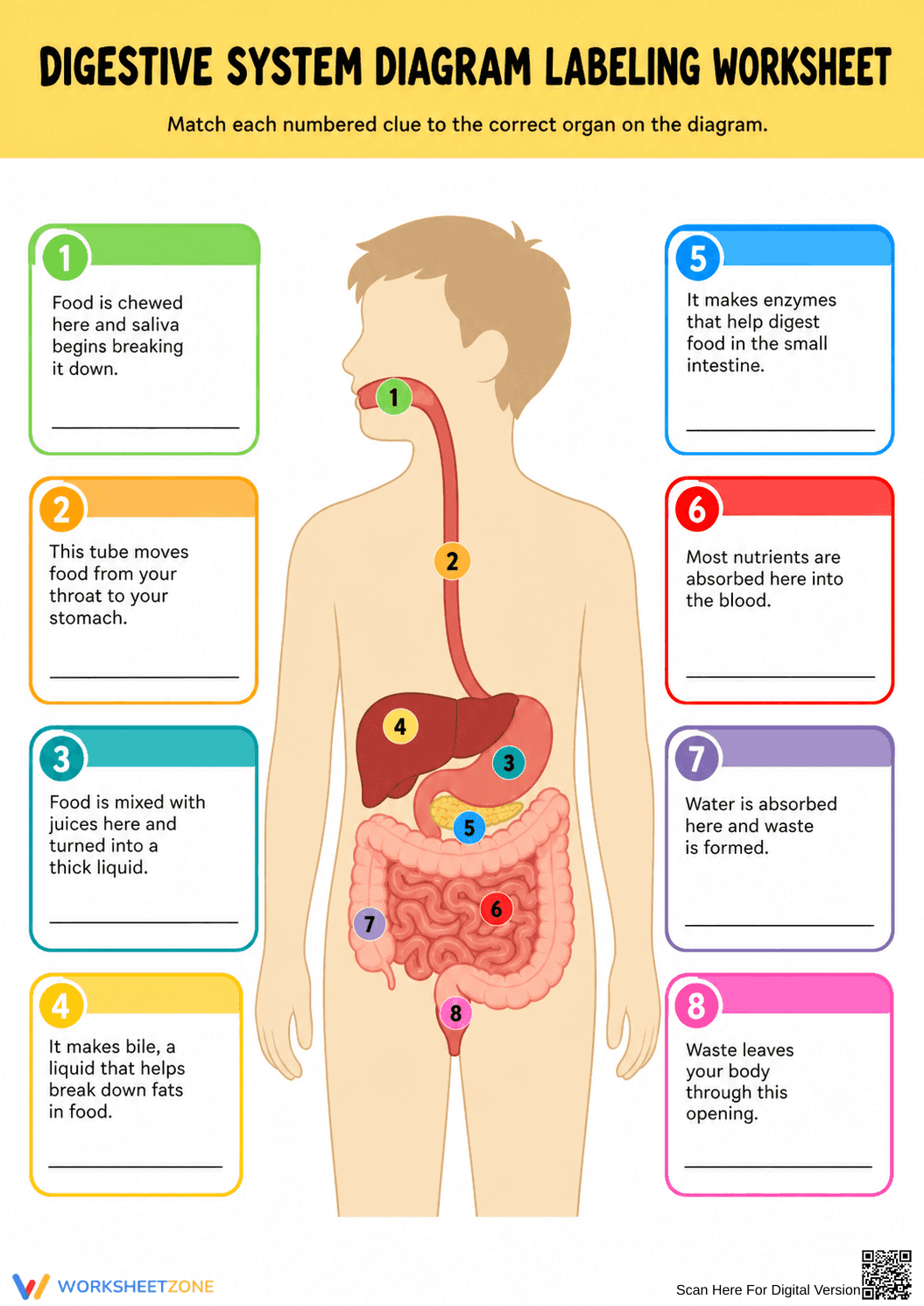

Essential Digestive System Labeling Worksheet | Grades 3-6
Paste this activity's link or code into your existing LMS (Google Classroom, Canvas, Teams, Schoology, Moodle, etc.).
Students can open and work on the activity right away, with no student login required.
You'll still be able to track student progress and results from your teacher account.
This digestive system diagram labeling worksheet helps students identify 8 major organs while connecting anatomical structures to their biological functions. By matching descriptive clues to a clear human body diagram, learners develop a concrete understanding of how food moves through the body. It is an ideal resource for life science units.
At a Glance
- Grade: 3-6 · Subject: Science
- Standard:
4-LS1-1— Construct an argument that animals have internal structures that support survival- Skill Focus: Digestive organ identification and function
- Format: 2 pages · 8 problems · Answer key included · PDF
- Best For: Life science units and anatomy review
- Time: 15–20 minutes
This resource contains two versions of a high-quality anatomical diagram featuring the human digestive tract. Each page includes 8 numbered callouts pointing to specific organs, including the esophagus, liver, pancreas, and small intestine. Students are provided with functional descriptions—such as where bile is produced or where water is absorbed—to guide their labeling. A full answer key is provided for quick grading.
Zero-Prep Workflow
The zero-prep workflow for this activity is designed for maximum efficiency. First, print the single-page PDF for your class (30 seconds). Next, distribute the worksheets as a transition activity or independent practice (1 minute). Finally, review the answers as a whole group using the provided key to clear up misconceptions about organ roles (5 minutes). Total teacher preparation time is under 2 minutes.
Standards Alignment
This worksheet is aligned to 4-LS1-1, which requires students to understand how internal and external structures function to support survival, growth, and behavior. By identifying how the stomach breaks down proteins or how the large intestine manages waste, students gather evidence for how the body maintains homeostasis. This standard code can be copied directly into lesson plans, IEP goals, or district curriculum mapping tools.
How to Use It
Use this worksheet during the "Explain" phase of a 5E lesson model to reinforce direct instruction about the human body. It serves as an excellent formative assessment tool; observe if students struggle to distinguish between the roles of the liver and pancreas. The activity typically takes 15 to 20 minutes to complete, making it a perfect bell-ringer or exit ticket.
Who It's For
This resource is designed for elementary and middle school science teachers, homeschool educators, and tutors. It is particularly effective for visual learners who benefit from seeing the spatial relationship between organs. It pairs naturally with a digestive system anchor chart or a video demonstration of the mechanical and chemical digestion process.
Effective science instruction requires students to move beyond rote memorization toward functional understanding. This worksheet utilizes the 4-LS1-1 standard to bridge the gap between naming an organ and explaining its role in the broader biological system. According to Fisher & Frey (2014), visual scaffolds like labeled diagrams are essential for developing academic vocabulary in the sciences, particularly for complex systems like human anatomy. By requiring students to process 8 distinct functional clues, the activity promotes active retrieval practice, which is shown to increase long-term retention of scientific concepts. This resource provides a structured pathway for students to master the basics of the digestive system, ensuring they are prepared for more advanced physiological studies in later grades. The inclusion of clear, numbered prompts reduces cognitive load while maintaining high academic rigor for Grade 3 through Grade 6 learners.


