


























Views
Downloads

Grade 4 Digestive System — Printable No-Prep Worksheet
Paste this activity's link or code into your existing LMS (Google Classroom, Canvas, Teams, Schoology, Moodle, etc.).
Students can open and work on the activity right away, with no student login required.
You'll still be able to track student progress and results from your teacher account.
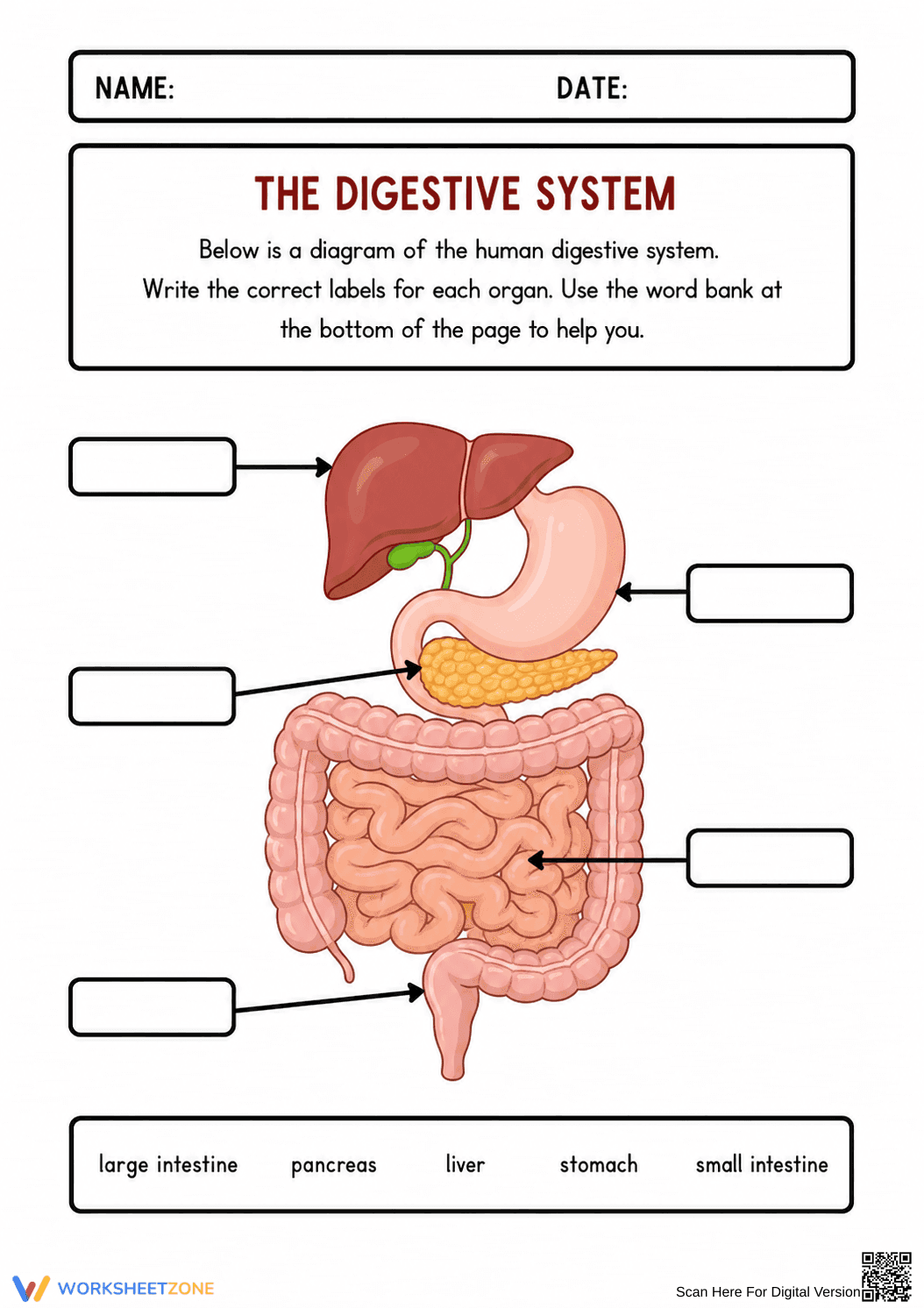
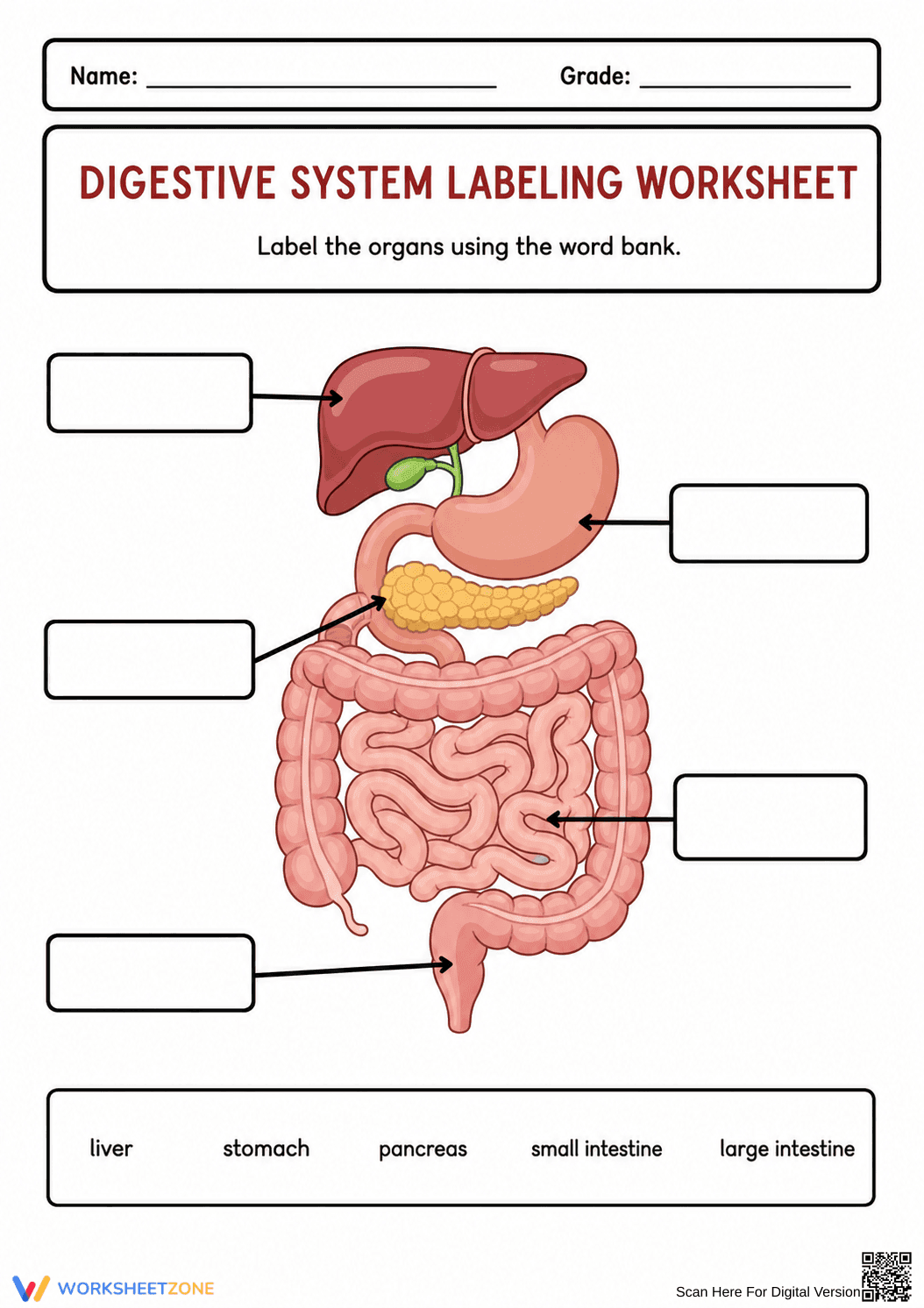
This printable digestive system labeling worksheet helps students visually identify and map the major organs of the human body. By matching terms from a provided word bank to a clear anatomical diagram, learners build essential life science vocabulary and develop a foundational understanding of how internal structures support digestion.
At a Glance
- Grade: 4 · Subject: Science
- Standard:
4-LS1-1— Identify internal structures that function to support survival.- Skill Focus: Digestive system organ identification
- Format: 2 pages · 5 problems · Answer key included · PDF
- Best For: Independent practice or science centers
- Time: 10–15 minutes
This resource features a clear digestive system diagram with five labeling boxes pointing to the liver, stomach, pancreas, small intestine, and large intestine. A convenient word bank at the bottom of the page scaffolds spelling and vocabulary recall. A complete answer key is also provided to ensure accurate grading.
Designed for immediate classroom use, this zero-prep resource streamlines your workflow:
- Print (1 minute): Download the PDF and print. No special formatting required.
- Distribute (1 minute): Hand out as students transition to their science block.
- Review (3 minutes): Use the included answer key to quickly check responses.
With a total teacher prep time of under two minutes, this activity is an excellent addition to emergency sub plans.
This worksheet is directly aligned with Next Generation Science Standard 4-LS1-1: Construct an argument that plants and animals have internal and external structures that function to support survival, growth, behavior, and reproduction. It also supports general elementary life science frameworks by reinforcing anatomical vocabulary. Both standard codes can be copied directly into lesson plans, IEP goals, or district curriculum mapping tools.
Integrate this labeling activity directly into your life science unit. It serves as an excellent formative assessment after direct instruction on the human body; simply have students complete the diagram to verify their spatial understanding of the organs. Alternatively, use it as a warm-up activity where students reference their textbooks to find the correct answers. As a formative observation tip, watch to see if students confuse the small and large intestines, which provides an immediate opportunity for targeted reteaching. Expected completion time is a brief 10 to 15 minutes.
This resource is primarily designed for fourth-grade students, though it is highly suitable for grades three through six depending on your specific curriculum pacing. The included word bank provides built-in differentiation for visual learners, English Language Learners (ELLs), and students needing spelling support. For a comprehensive lesson, pair this worksheet with a reading passage detailing the journey of food through the digestive tract or a whole-class anchor chart mapping human anatomy.
Effective science instruction relies heavily on visual representations to bridge the gap between abstract concepts and concrete understanding. When students identify internal structures that function to support survival, as outlined in standard 4-LS1-1, they are engaging in critical spatial reasoning. According to EdReports 2024, high-quality instructional materials in science must provide students with clear, accurate diagrams that allow them to connect anatomical vocabulary directly to physiological functions. This digestive system labeling activity supports that pedagogical goal by isolating key organs and reducing cognitive load through the use of a targeted word bank. By requiring learners to map terms like the pancreas and liver to their correct physical locations, educators can effectively assess foundational life science knowledge while reinforcing essential academic language in a highly structured, accessible format.


