




























Views
Downloads
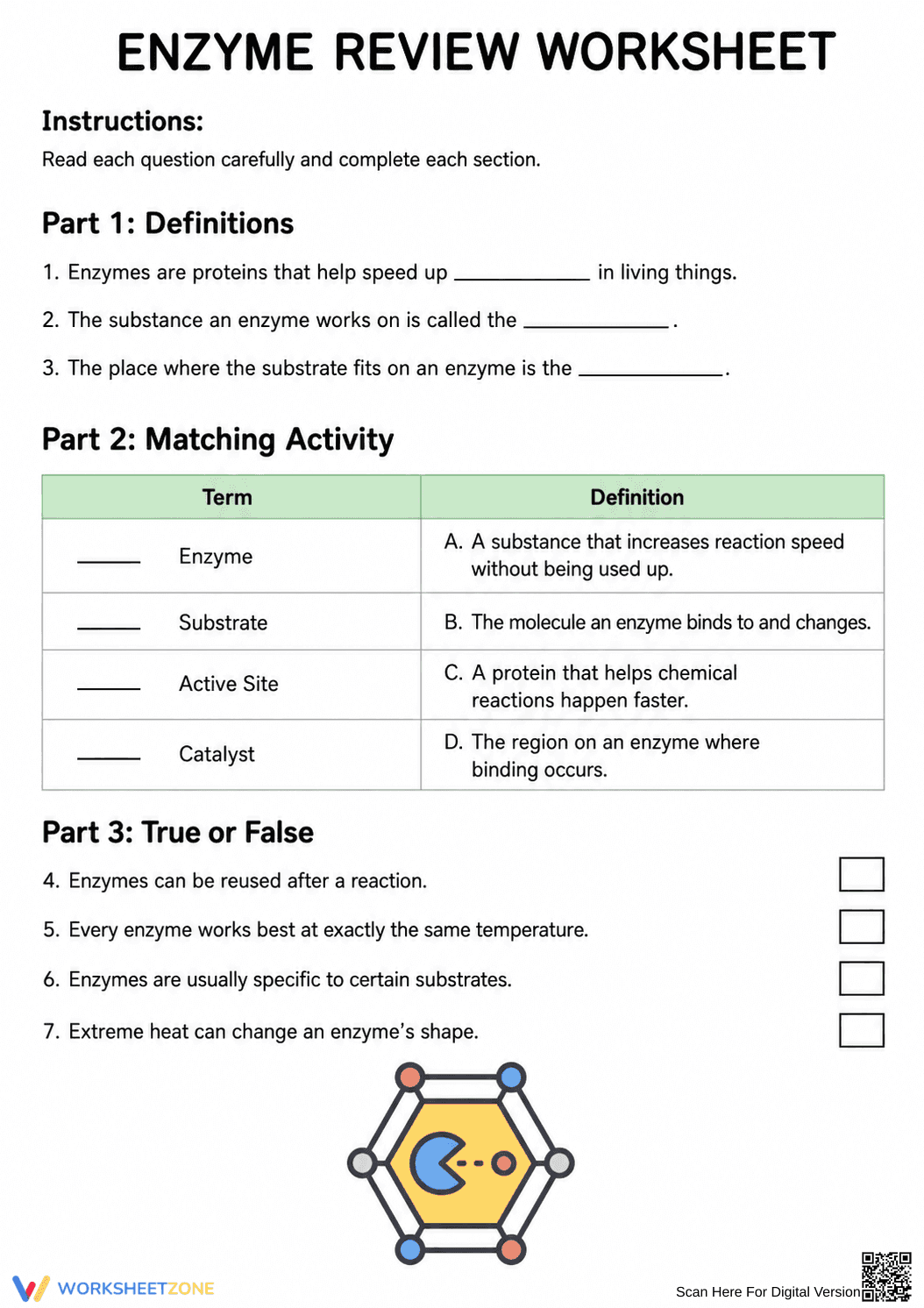
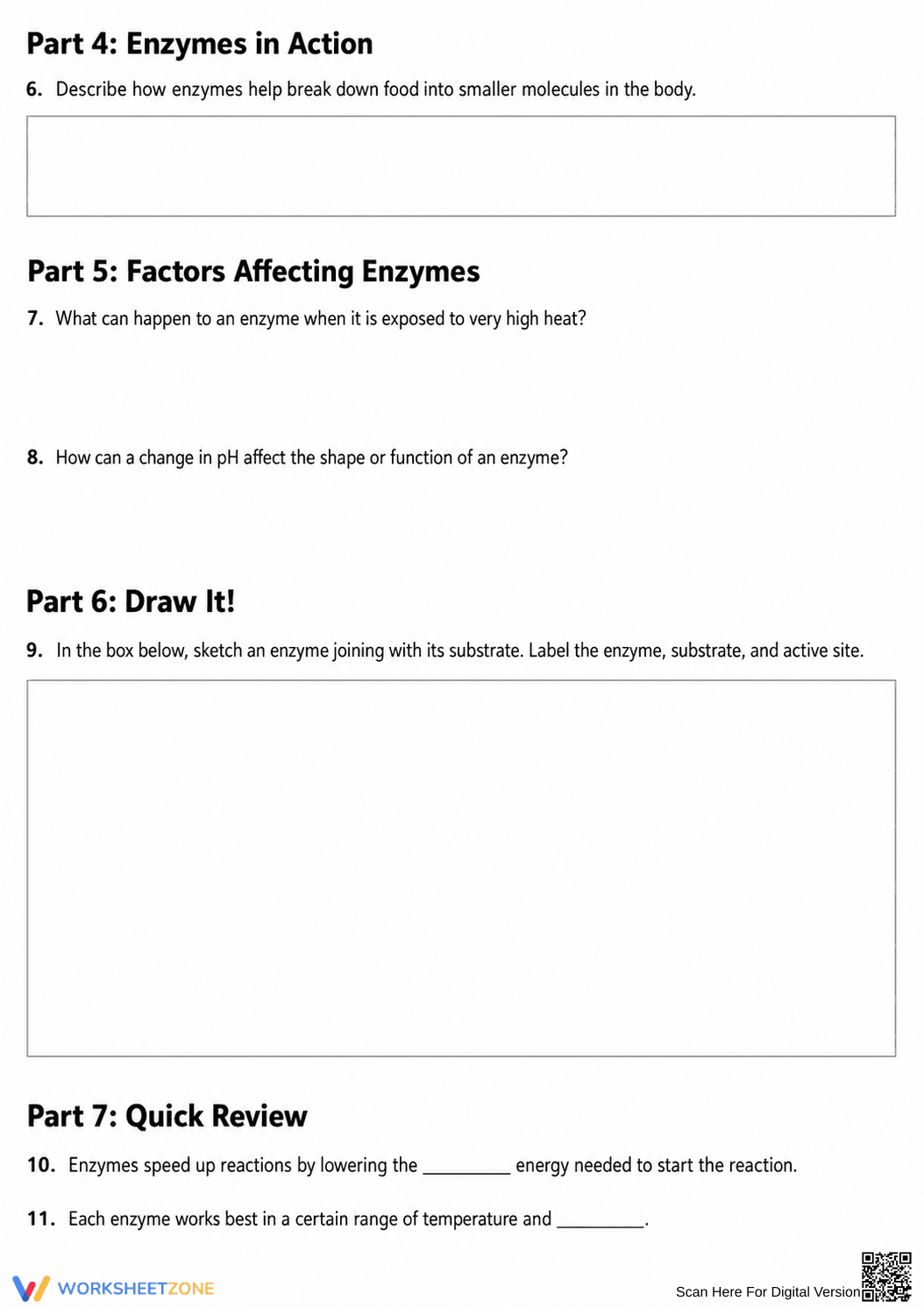

Enzyme Review Worksheet | Essential Grade 6-9 Science

Paste this activity's link or code into your existing LMS (Google Classroom, Canvas, Teams, Schoology, Moodle, etc.).
Students can open and work on the activity right away, with no student login required.
You'll still be able to track student progress and results from your teacher account.
This enzyme review worksheet provides a clear pathway to understanding how biological catalysts function within living systems. By engaging with multiple question formats, learners solidify their grasp of substrate specificity, active sites, and the factors that influence reaction rates. This resource ensures students can accurately describe the role of proteins in metabolic processes before moving to complex laboratory investigations.
At a Glance
At a Glance
- Grade: 6-9 · Subject: Science
- Standard:
MS-LS1-7— Describe how chemical reactions rearrange molecules to support growth and energy- Skill Focus: Enzyme vocabulary and function
- Format: 2 pages · 17 problems · Answer key included · PDF
- Best For: Quick review or sub plans
- Time: 20–30 minutes
What's Inside
The document features 17 distinct tasks organized into seven logical sections. It begins with foundational definitions and a matching activity to secure key vocabulary like catalyst and substrate. The middle sections challenge conceptual understanding through true-or-false questions and short-answer descriptions of pH and temperature effects. A dedicated drawing box requires students to create a visual model of the lock-and-key mechanism, while the final quick review reinforces the concept of activation energy.
Zero-Prep Workflow
This resource is designed for immediate classroom integration with a total teacher prep time of under 2 minutes. Follow these three steps: 1. Print the two-page PDF (30 seconds). 2. Distribute to students for independent or partner work (30 seconds). 3. Review the 17 tasks using the included answer key to provide instant feedback (1 minute setup). It is an ideal sub plan or transition activity.
Standards Alignment
This resource is primarily aligned with `MS-LS1-7`, which requires students to develop a model to describe how food is rearranged through chemical reactions to support growth and/or release energy. By focusing on enzymes, the worksheet provides the necessary chemical context for how these rearrangements occur. It also supports HS-LS1-6 by illustrating the role of carbon-based molecules in life processes. Both standard codes can be copied directly into lesson plans, IEP goals, or district curriculum mapping tools.
How to Use It
Use this worksheet as a formative assessment immediately following a lecture on cell biology or biochemistry. As students work through the factors affecting enzymes section, circulate the room to observe if they understand the relationship between heat and protein shape; this provides an immediate indicator of who may need additional support. It also functions perfectly as a 25-minute exit ticket or a comprehensive homework assignment to reinforce classroom instruction.
Who It's For
This material is for middle school life science and early high school biology learners. It is particularly effective for students who benefit from scaffolded instruction that moves from rote memorization to visual representation. Pair this worksheet with a digital enzyme simulation or a hands-on liver-catalase lab to provide a blended learning experience that caters to diverse instructional needs.
According to the RAND AIRS 2024 analysis of secondary science curriculum, structured review materials that combine vocabulary acquisition with visual modeling—such as the drawing component in this resource—significantly improve long-term retention of biochemical concepts. This worksheet targets MS-LS1-7 by requiring students to identify how enzymes act as catalysts to facilitate chemical reactions within living organisms. By addressing common misconceptions regarding temperature and pH sensitivity through true-or-false and short-answer prompts, the material provides a comprehensive check for understanding. Research indicates that scaffolded worksheets which transition from simple recall to higher-order application help bridge the gap between introductory life science and advanced biology. This 17-task resource serves as a reliable tool for measuring student mastery of protein functions and metabolic processes in a classroom setting.


