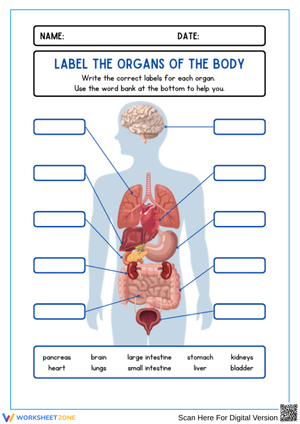
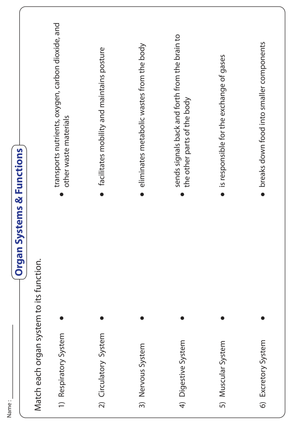
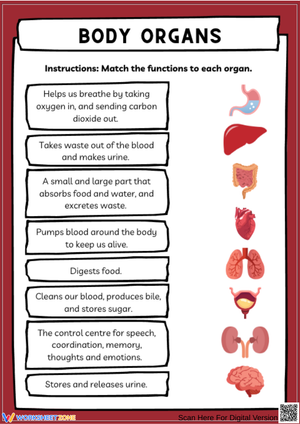
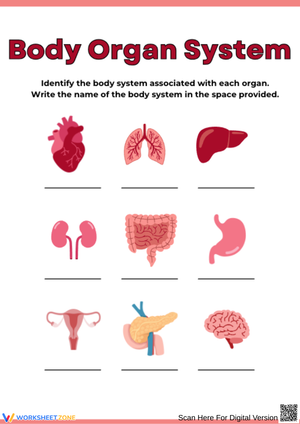
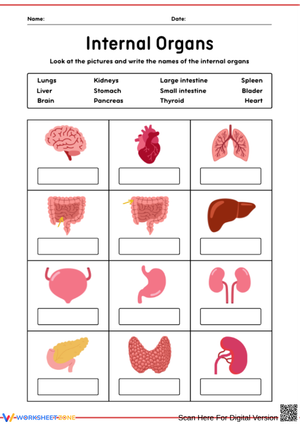
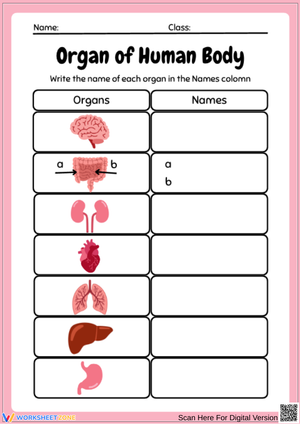
These organ system pdf worksheets for 6th grade give teachers a print-ready set that moves students from basic organ identification toward explaining how body systems function and interact. Each worksheet stays focused on a specific slice of the topic — naming organs, assigning them to the correct system, describing their jobs, or tracing how two systems work together — rather than trying to cover everything in a single sitting. The set addresses the seven systems most commonly taught at this level: circulatory, respiratory, digestive, nervous, muscular, skeletal, and excretory.
What Each Worksheet Targets
Sixth grade is typically the first time students are expected to explain relationships between body parts rather than simply name them. That shift — from identifying to explaining — is the instructional aim of the set, and the task formats reflect it. Students start with concrete, visible things they can point to on a diagram, then move toward function, and finally toward cross-system relationships where actual understanding lives.
- Diagram labeling: Students mark major organs on body outlines and system-specific illustrations. Images are clean and uncluttered, with enough white space for written labels to fit without crowding.
- Organ-to-system matching: Students connect individual structures — the trachea, the diaphragm, the small intestine, the femur — to the system each one belongs to.
- Function identification: Students select or write what each system's primary job is, using accessible language rather than clinical terminology.
- Short constructed responses: Students explain a system's role in two or three sentences, pushing vocabulary into active use rather than passive recognition.
- Cross-system comparison: Students describe how two systems work together — for example, how the respiratory and circulatory systems collaborate to deliver oxygen to body cells.
- Vocabulary review: Students define foundational terms like organ, tissue, function, and system before those words appear in higher-demand tasks.
Frequent Student Errors Worth Watching For
The most reliable mix-up is between the excretory and digestive systems. Both systems "get rid of things," and sixth graders latch onto that surface similarity without grasping the key distinction: the digestive system processes food, the excretory system filters blood. This confusion does not resolve after a single explanation. Worksheets that ask students to sort organ functions by system surface the error quickly — often within the first few minutes of independent work — and give teachers a natural opening for targeted correction before the misconception solidifies.
The diaphragm creates a second consistent problem. Because it sits near the stomach on any body diagram, students routinely assign it to the digestive system. A labeling worksheet that includes the diaphragm — with a follow-up question asking what it actually does — handles this more efficiently than a lecture correction after the fact.
A subtler issue shows up in constructed responses: students describe organs by appearance rather than function. They write things like "the skeleton is the hard white stuff in your body" instead of explaining that the skeletal system supports the body, protects internal organs, and produces blood cells in bone marrow. The short-response prompts across these worksheets push students past visual description and toward functional explanation, which is where the science standard actually lives.
Building These Worksheets Into Your Weekly Planning
The most efficient entry point is the warm-up slot. A labeling or matching task at the start of class — before notes or new instruction — takes two to five minutes and grounds students in the vocabulary they need for the lesson ahead. Running a different worksheet the next day in the same slot creates spaced retrieval without adding planning overhead once the worksheets are printed and sorted by system.
For station rotations, the set divides naturally by task type. One station handles diagram work, another focuses on function questions without any visual support, and a third asks students to write a short explanation connecting two systems. Each station runs about ten minutes, which fits a standard middle school period with time left for a whole-class debrief. Because organ system pdf worksheets for 6th grade are self-explanatory in format, they also work reliably as sub plans — the substitute does not need a life science background to manage the session.
For homework, a focused worksheet with ten to twelve items reinforces the lesson without turning science into a reading-heavy evening task. For end-of-unit review, a mixed worksheet that pulls in several systems gives students a concrete way to organize what they know before a test rather than re-reading notes the night before.
Standard Alignment
These worksheets support the NGSS disciplinary core idea MS-LS1, specifically the expectation that students understand how body systems are made of tissues and organs working together to carry out life functions. At the sixth-grade level, this is typically framed around structure and function — students are expected to connect what an organ is or where it sits to what it actually does. Worksheets that stop at labeling satisfy only part of that expectation; the constructed-response and cross-system prompts in this set address the explanatory reasoning the standard requires.
Adjusting the Worksheets for a Range of Learners
The most straightforward adjustment is the word bank. Adding a word bank to any labeling or matching worksheet shifts the cognitive demand from retrieval to recognition — students are still doing meaningful science work, but the language barrier is lower. Removing it for students who are ready turns the same activity into retrieval practice, which builds longer-term retention than recognition alone.
Organ system pdf worksheets for 6th grade that lead with diagrams adapt particularly well for multilingual learners. A labeled body diagram gives students a concrete visual anchor before they encounter written prompts, and attaching a short glossary or key-term translation keeps the science accessible without lowering the conceptual expectation. The target stays the same — students explain what a system does — but the language entry point adjusts.
For students who have already mastered organ names and basic functions, the cross-system interaction prompts serve as genuine extension rather than busywork. Asking a student to trace what happens, step by step, when a person inhales — from lung expansion through gas exchange into the bloodstream and out to body cells — reaches well past identification and into the systems thinking that middle school science is building toward.
Frequently Asked Questions
Do these worksheets come with answer keys?
Yes. Each worksheet includes an answer key, which matters especially for diagram labeling tasks where label placement and exact terminology need to stay consistent across a class. Answer keys also make it practical to use these as self-check activities during centers or partner review, so students get immediate feedback rather than waiting until the next class period.
How long does each worksheet take to complete?
A focused labeling or matching worksheet takes most sixth graders eight to twelve minutes. A worksheet with a short reading passage and constructed-response questions runs closer to fifteen to twenty minutes. Students reading below grade level may need a few additional minutes on text-heavy formats — worth accounting for when planning station rotations or estimating homework time.
Can these be used for test review?
Yes. Using organ system pdf worksheets for 6th grade as a review tool — specifically the mixed-review worksheets that pull organ names, system functions, and cross-system interactions into one task — gives students a structured way to identify what they actually know versus what they only think they know. Assigning one in the two or three class periods before a unit test is more productive than asking students to re-read their notes.
What if students are at very different levels coming into the unit?
The word bank is the fastest lever. Students who need extra support get recognition practice; students who are ready get retrieval practice. Beyond that, the compare-and-contrast and trace-the-path prompts in the set naturally draw out more from students who are ahead — the prompt is the same, but the depth of explanation varies, and that variation gives teachers something useful to work with during whole-class discussion.












 Interactive Worksheet Maker
 Quiz Maker
 Word Search Maker
 Crossword Puzzle Maker
 Word Scramble Generator
 Sentence Scramble Generator
 Handwriting Worksheet Generator
 Name Tracing Generator
 Fill In The Blank Generator