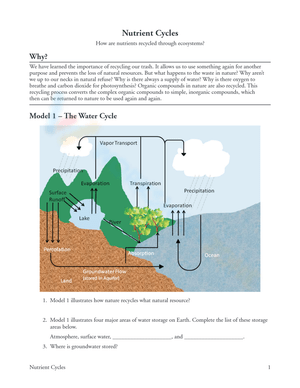
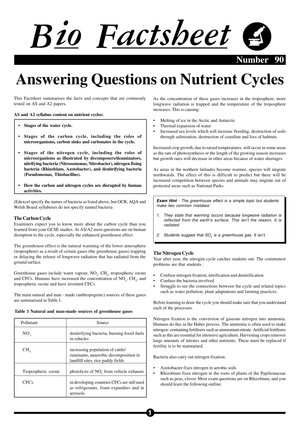
6th Grade Nutrient Cycles PDF Worksheets for Science Class
These 6th grade nutrient cycles pdf worksheets give science teachers a ready set of resources for one of the trickiest conceptual jumps in middle school life science: the distinction between how energy flows through a system and how matter cycles through it. Each worksheet targets that gap through labeling diagrams, reading passage questions, cut-and-sort sequencing tasks, and short constructed response — formats that fit bell work, stations, and independent review without major preparation.
The Specific Skills These Worksheets Target
Each worksheet in the set focuses on one of four biogeochemical cycles — water, carbon, nitrogen, or phosphorus — or asks students to compare cycles side by side. The core skill in every case is matter tracing: students identify where a specific atom or molecule starts, name the organisms or processes that move it, and follow it through soil, air, water, and living things until it returns to its origin. That tracing work is harder than it looks. It requires students to treat soil, atmosphere, and water as active participants in a cycle — not just a backdrop behind the organisms.
Specific tasks across the set include:
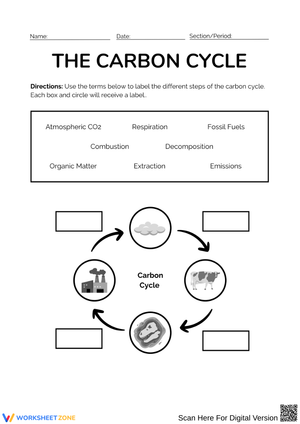
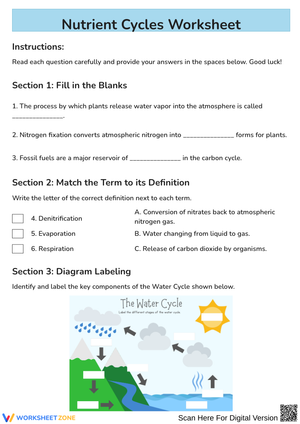
- Labeling blank cycle diagrams with producers, consumers, decomposers, atmosphere, and soil
- Drawing and explaining arrow direction to show how matter moves between ecosystem parts
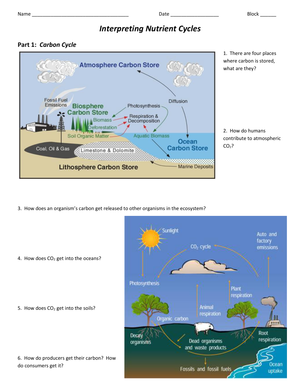
- Answering short passage questions that connect diagram features to real ecosystems — forests, ponds, and garden soil rather than abstract molecular descriptions
- Sorting process cards into the correct sequence of a given cycle
- Comparing two cycles by identifying one similarity and one difference in how matter returns to the nonliving environment
Mistakes Students Make That These Worksheets Help You Catch
The error most worth anticipating is the matter-disappears assumption. Students who can correctly trace energy loss along a food chain will often claim that when an organism dies, its nutrients are "gone." They mean gone from the living parts of the ecosystem — they have not yet extended the picture to include decomposers, soil, and the atmosphere. A labeling worksheet that explicitly requires students to draw an arrow from a dead organism to decomposers, and then a second arrow from decomposers to soil, forces the complete loop onto paper in a way that whole-class discussion alone rarely does.
Decomposer placement is the second predictable trouble spot. Students who correctly identify fungi and bacteria in a vocabulary exercise will still omit them when completing a diagram independently, placing arrows directly from dead animals back to soil and skipping decomposition entirely. Worksheets that break the return pathway into two distinct labeled steps — organism to decomposer, then decomposer to soil — reduce that omission noticeably. Teaching decomposers before assigning a full independent cycle diagram is worth the ten minutes it takes; the accuracy on completed worksheets improves more than adding another vocabulary review ever does.
A third consistent confusion is conflating nutrient cycles with food webs. Students encounter food webs first because feeding relationships are concrete and visible, and that prior knowledge can overwrite the new concept if the worksheet does not directly surface the contrast. When a task asks students to explain specifically why a nutrient cycle diagram looks different from a food web — why arrows loop back to nonliving parts rather than moving only from organism to organism — most students cannot answer without rereading the diagram carefully. That struggle is useful. It shows you exactly who has made the conceptual separation and who hasn't.
Building These Worksheets Into Your Unit Plan
The most effective sequence starts each new cycle with the labeling diagram before assigning a reading passage. Students who encounter the reading first tend to spend their cognitive effort tracking vocabulary rather than following the cycle's movement. Ten minutes on a blank diagram — even if students only get three or four labels correct — primes the key terms and makes the passage more readable when it comes next. That order also gives you immediate formative data: which students are guessing, which are drawing on prior knowledge, and which are conflating a cycle they studied earlier.
Cut-and-sort worksheets work especially well at stations during a review block. Pairs who physically arrange cards and then defend their arrow placement to each other produce more precise science talk than pairs who read in parallel and answer questions side by side. Moving the cards slows the process enough that students catch their own sequencing errors before asking for help — a useful habit to build before the unit assessment.
For the day before a test, or the Friday before a week-long break, the cycle comparison worksheet makes a strong low-prep retrieval activity. Ask students to complete the two-column comparison without referring to notes first, then check and correct with notes. That sequence surfaces vocabulary gaps and, specifically, confusion between carbon and nitrogen cycles — two cycles that look structurally similar and whose roles students reliably blur together by the end of a unit.
Adjusting the Set for Mixed-Readiness Classrooms
The labeling and sequencing worksheets travel well across readiness levels when you make a few targeted changes. For students who struggle with academic reading, removing the passage and providing only a completed diagram with a word bank shifts the task toward visual interpretation rather than text decoding. The science goal stays the same; what changes is the entry point.
Multilingual learners benefit from a sentence frame added to constructed response items: "Carbon moves from ___ to ___ because ___." Without that frame, students who understand the cycle clearly in their home language often freeze at a blank response line. The frame removes a writing-mechanics obstacle that was blocking access to a science idea the student already holds.
For students who complete labeling quickly and accurately, the comparison task is the most productive extension — specifically, asking them to explain what would happen to carbon cycling in a pond ecosystem if all decomposers were removed. That question requires applying cycle logic to a new scenario rather than restating a diagram they have already labeled. It also sets up productive discussion with the whole class once review begins.
Standard Alignment
NGSS MS-LS2-3 asks students to "develop a model to describe the cycling of matter and flow of energy among living and nonliving parts of an ecosystem." The 6th grade nutrient cycles pdf worksheets in this set address that standard directly: cycle diagrams are models, and completing them requires students to represent the relationship between living organisms and nonliving components — soil, water, and atmosphere. The short constructed response questions push into the deeper layer of the standard by asking students to explain why matter cycling matters for ecosystem function, not just name where atoms travel.
This standard typically appears early in a life science unit on ecosystems, after students have built familiarity with food webs and energy flow. These worksheets fit that instructional sequence because they build on the producer-consumer-decomposer vocabulary students already know and extend it toward matter cycling specifically, without requiring a chemistry background students at this level don't yet have.
Frequently Asked Questions
Which cycle should I introduce first — water, carbon, or nitrogen?
Most 6th grade teachers start with the water cycle because students bring the most prior knowledge to it from earlier grades, and it establishes the core framework — matter moving between living things and the nonliving environment — without introducing unfamiliar chemistry. Carbon comes next because it connects directly to photosynthesis and respiration vocabulary students are typically building at the same time. Nitrogen and phosphorus work better after students are confident with carbon, since both involve soil processes that are less intuitive and require a firmer grasp of what decomposers actually do.
Can these worksheets substitute for a hands-on lab activity?
No, and they shouldn't try to. These resources work best alongside direct observation — a closed decomposition container, a simple terrarium, or a soil testing activity. The diagrams and passage questions build the vocabulary students need to describe and explain what they observe during a lab. Without that conceptual language, hands-on time stays at the level of noticing rather than explaining. Think of each worksheet as the before or after around a lab, not a replacement for it.
Do the worksheets include answer keys?
Yes. Each worksheet includes a key that covers correct labels, acceptable arrow directions, sequence order for cut-and-sort cards, and model short answers for constructed response items. For diagram labels with more than one defensible position — depending on how the cycle visual is arranged, "decomposers" can appear in slightly different spots — the key notes acceptable variations so grading stays consistent across a teaching team.
How do I use these worksheets with students who already know food webs well?
Surface the distinction before students open anything. Ask students to write one sentence describing what a food web shows, then tell them a nutrient cycle shows something different. That framing prompt alone sets up the contrast. Then, as students work through the labeling worksheet, have them specifically identify which parts of the cycle would never appear in a food web — soil, atmosphere, water — and explain why those parts matter for cycling matter back through an ecosystem. The comparison anchors the new idea to prior knowledge without letting prior knowledge replace it. The 6th grade nutrient cycles pdf worksheets in this set include at least one food-web comparison prompt per cycle for exactly this reason.
Are these worksheets appropriate for homework, or only for in-class use?
Both work, depending on the task. Labeling diagrams and cut-and-sort activities are better in class where students can ask questions and discuss reasoning with a partner. Reading passage worksheets with 5 to 8 short-answer questions make solid independent homework when the directions are self-contained and the diagrams are clearly printed. The 6th grade nutrient cycles pdf worksheets in this set are formatted so students can print them at home or complete them digitally in most learning management systems — useful for makeup work or flexible instruction days.
Clear All