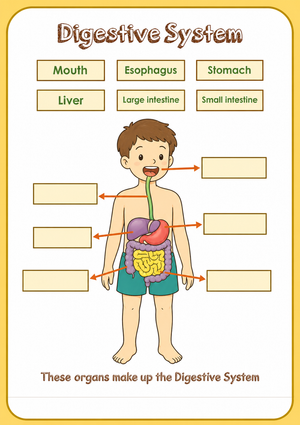
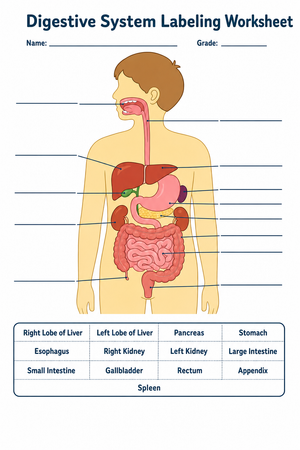
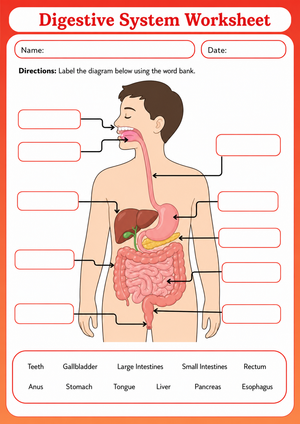
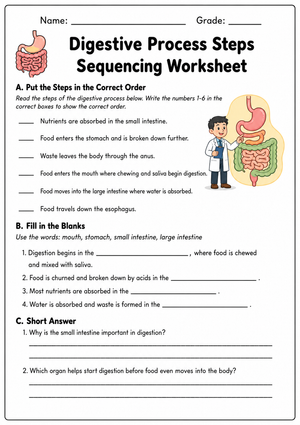
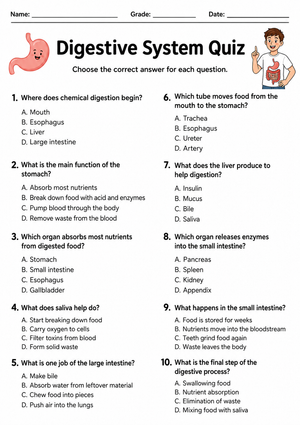
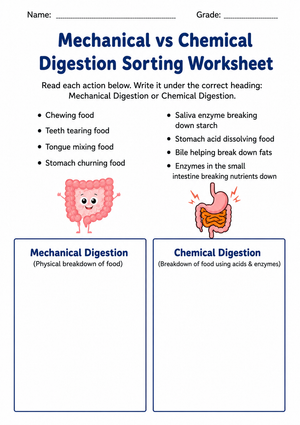
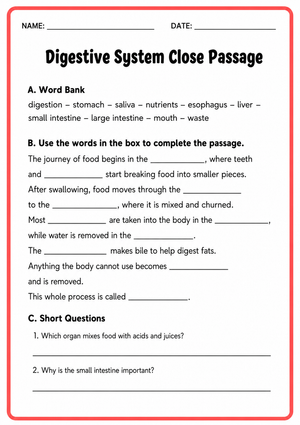
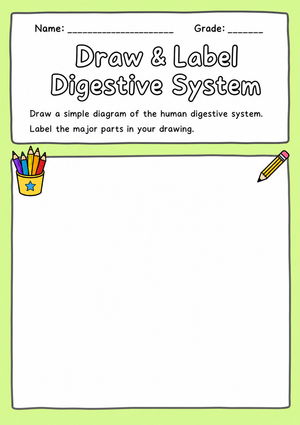
These digestive system printable worksheets for 6th grade give teachers a focused set of resources for one of the most conceptually demanding topics in middle school life science. Organ identification is only the entry point — at this grade level, students need to explain the sequence of digestion, distinguish mechanical from chemical breakdown, and connect each organ's structure to what it actually does. This set is built around that expectation.
The Specific Skills These Worksheets Build
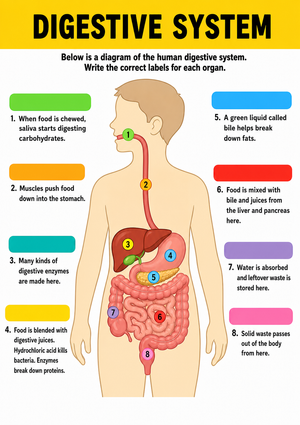
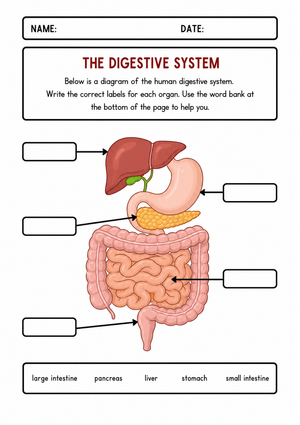
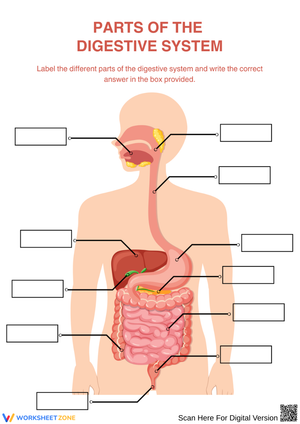
The set covers both the anatomy and the processes of digestion, which is the combination 6th grade standards demand. Students label the major organs in the direct food pathway — mouth, esophagus, stomach, small intestine, large intestine, rectum, and anus — and separately identify the accessory organs: the liver, pancreas, and gallbladder. Treating those two categories as distinct from the start prevents the common misconception that food travels through the liver or pancreas.
Beyond anatomy, each worksheet targets one of these skill areas:
- Mechanical vs. chemical digestion — students identify where each type begins, what drives it (muscle movement versus enzyme activity), and why both are necessary
- Sequencing the food pathway — tracing the route from ingestion through waste removal, with annotations about what changes at each stop
- Nutrient absorption — explaining where absorption primarily occurs, why the small intestine's structure (villi and microvilli) enables it, and what the large intestine handles instead
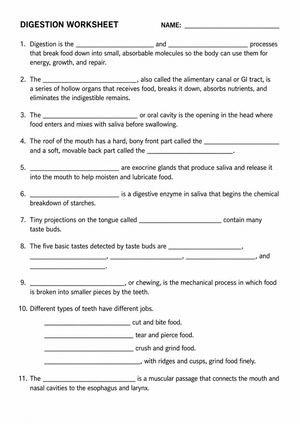
- Academic vocabulary in context — terms like peristalsis, enzyme, bile, and absorption appear in matching, fill-in, and short-response formats so students use the language, not just recognize it
- Short constructed responses — prompts ask students to explain a process or cause-and-effect relationship rather than recall a label
Frequent Student Errors Worth Watching For
The most consistent mistake in 6th grade digestion units is placing the liver, pancreas, or gallbladder inside the food pathway. Students see these organs on a body diagram and assume food passes through them because they appear alongside the other digestive structures. A labeling worksheet that explicitly distinguishes "organs food travels through" from "organs that support digestion" brings this confusion to the surface right away — before students carry it into a quiz.
A second error involves the two intestines. Students routinely flip their roles, assuming the large intestine absorbs the most nutrients because "large" implies more important. In reality, the small intestine handles almost all nutrient uptake, and the large intestine mainly recovers water. The sequencing worksheet addresses this directly by asking students to annotate what is happening at each organ — not just name it — which forces them to confront the distinction rather than glide past it.
A third pattern shows up in constructed responses. Students who can describe chemical digestion in the stomach often write that the stomach completes digestion. They don't yet understand that digestion continues in the small intestine, or that the stomach's acidic environment is more about denaturing proteins than fully breaking them down. A prompt like Explain why digestion is not finished when food leaves the stomach reveals exactly which students hold that gap — and it's a faster diagnostic than any multiple-choice quiz.
How to Work These Worksheets Into Your Teaching Week
A four-day sequence fits cleanly into most 6th grade pacing. Day one: a partially labeled body diagram — not blank, not filled in — so students have enough structure to engage without copying. Day two: a sequencing worksheet that traces the food pathway and asks students to note at each organ whether mechanical digestion, chemical digestion, absorption, or water recovery is occurring. That task alone generates the kind of discussion worth pausing direct instruction for. Day three: vocabulary and reading comprehension, which works well as a quiet independent period or a partner-check routine. Day four: an exit ticket or short assessment.
For bell-ringers during this unit, projecting a blank body diagram and asking students to write everything they remember before opening notes takes fewer than three minutes — and the gaps in their responses give a more honest picture of retention than any verbal check-in. That kind of low-stakes retrieval before instruction strengthens memory of the material without cutting into lesson time.
One classroom technique that holds up in practice: have students use two different colored pencils on the anatomy worksheet, one color for organs in the direct food pathway and one for accessory organs. The act of choosing a color forces a decision about category, and students who reach for the same pencil for both the liver and the small intestine are showing you exactly where instruction needs to return.
Standard Alignment
The primary standard these worksheets address is NGSS MS-LS1-7, which asks students to develop a model describing how food is rearranged through chemical reactions forming new molecules that support growth or release energy as matter moves through an organism. In classroom terms, that means students need to explain what happens to food at each digestive stage — not just identify the organ. The sequencing and constructed-response tasks in this set function as that model: students trace matter through the system and describe the chemical and mechanical changes occurring at each point. The vocabulary work supports the disciplinary core idea by making the language of digestion precise enough to use in an explanation, not just in a matching exercise. Most NGSS-aligned state frameworks place this content in grade 6 or grade 7, depending on local scope and sequence.
Adjusting These Worksheets Across Learner Levels
The labeling worksheet includes a word bank, which gives students who need entry-level support a way to begin without freezing. Removing the word bank — or replacing it with a scrambled list of definitions rather than organ names — raises the retrieval demand for students who are ready for more. Both approaches address the same anatomy; the adjustment is in how much the student must independently recall.
The constructed-response prompts offer the clearest space to tier by level. A student who needs support answers: What does the small intestine do? A student working above grade level answers: Why does most nutrient absorption happen in the small intestine rather than in the stomach or large intestine? That second prompt requires understanding structure, function, and comparison — the same digestive system content at a significantly higher cognitive demand. Both prompt types appear in the set so teachers are not building separate versions from scratch.
For students learning English alongside the science content, the vocabulary worksheet functions as a reference tool during other tasks if teachers allow open-resource use. The academic vocabulary in digestion — peristalsis, enzyme, bile, absorption — is unfamiliar to nearly every incoming 6th grader, which makes targeted vocabulary support a whole-class benefit rather than a remediation measure.
Frequently Asked Questions
What organs should appear on a 6th grade digestive system worksheet?
The core pathway organs — mouth, esophagus, stomach, small intestine, large intestine, rectum, and anus — should always be included. A well-designed worksheet also includes the liver, pancreas, and gallbladder, clearly labeled as accessory organs that contribute to digestion without food passing through them. That distinction is a grade-level expectation, and worksheets that omit it leave a gap students often fill incorrectly on assessments.
How many worksheets are typically needed for a 6th grade digestion unit?
Most teachers find that four to six worksheets cover the full arc: introduction to anatomy, sequencing the food pathway, vocabulary and reading comprehension, and at least one assessment or exit ticket. These digestive system printable worksheets for 6th grade are organized to follow that sequence without redundancy — each worksheet targets a distinct skill set rather than repeating the same format across the unit.
Can these worksheets be used for homework or substitute plans?
The labeling and vocabulary worksheets need no teacher facilitation, which makes them reliable for homework assignments, substitute plans, or early finisher work. The sequencing worksheet works best after some instruction on the food pathway has already occurred, but functions independently if students have access to textbook notes. For substitute plans, the reading comprehension worksheet is the most self-contained resource in the set.
Do these worksheets accommodate students who need additional support?
Each worksheet focuses on one skill area rather than combining multiple demands in a single task, which helps students who become overwhelmed when the work feels crowded. The labeling worksheet includes a word bank, and the sequencing worksheet provides enough visual structure for students who struggle to begin without a reference point. For constructed-response questions, teachers can provide sentence frames or narrow the prompt scope without changing the content target. These digestive system printable worksheets for 6th grade are also formatted to print legibly in black and white, so photocopied versions remain usable in classrooms without regular color access.
Does the digestive system appear on standardized science assessments?
Human body systems — including digestion — appear regularly on middle school science assessments aligned to NGSS or derived state frameworks. The skills this set builds — tracing matter through a system, explaining organ function, connecting structure to process — match the question types found on those assessments. These digestive system printable worksheets for 6th grade are not narrow test-prep materials, but the constructed-response thinking students practice here is exactly what those assessments measure.












 Interactive Worksheet Maker
 Quiz Maker
 Word Search Maker
 Crossword Puzzle Maker
 Word Scramble Generator
 Sentence Scramble Generator
 Handwriting Worksheet Generator
 Name Tracing Generator
 Fill In The Blank Generator