


























Views
Downloads

Grade 7 Enzymes — Printable No-Prep Worksheet
Paste this activity's link or code into your existing LMS (Google Classroom, Canvas, Teams, Schoology, Moodle, etc.).
Students can open and work on the activity right away, with no student login required.
You'll still be able to track student progress and results from your teacher account.
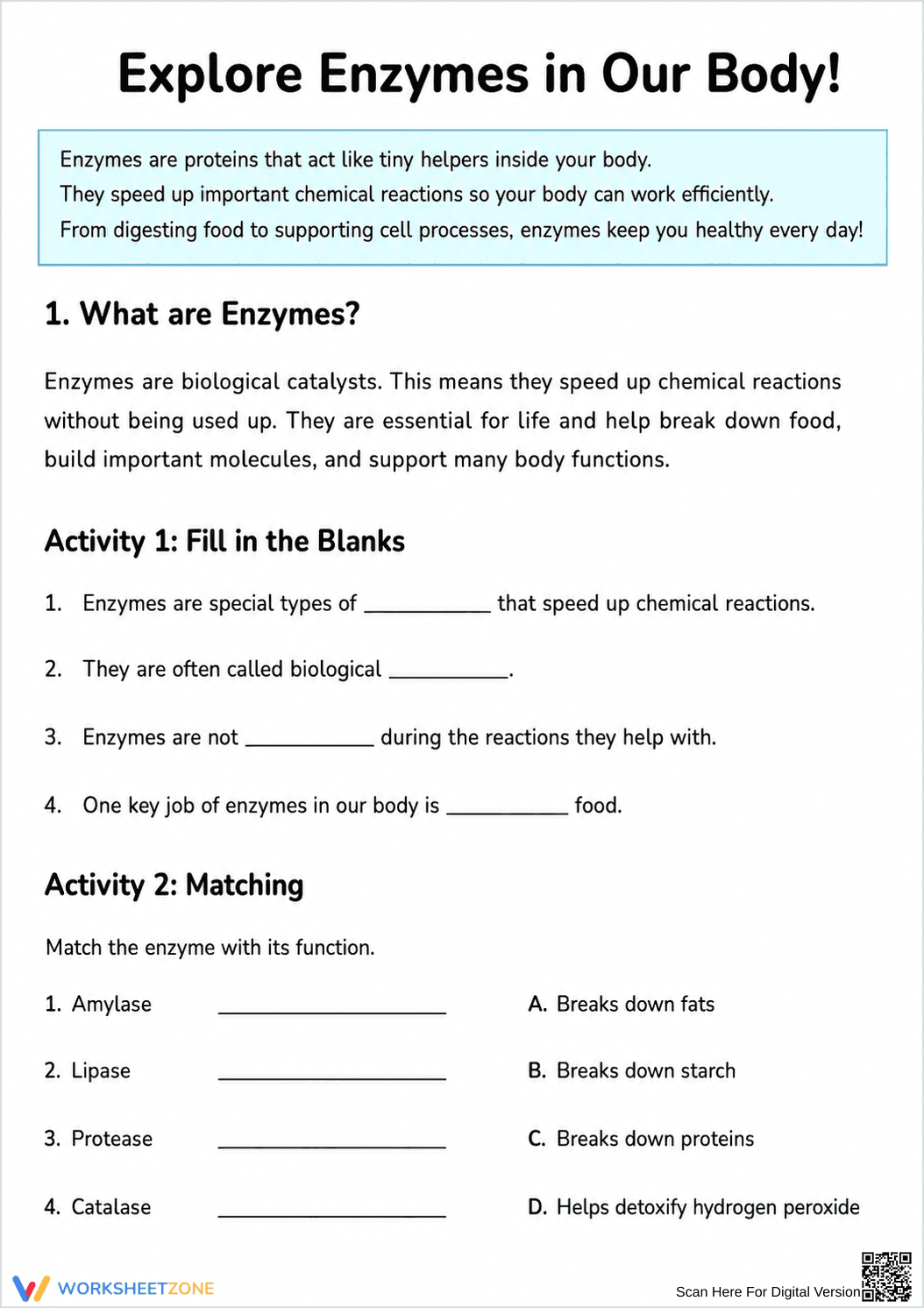
This middle school science worksheet introduces students to the vital role of enzymes in the human body. By combining a short reading passage with targeted questions, learners discover how biological catalysts speed up chemical reactions during digestion. Students directly apply this knowledge to understand cellular processes.
At a Glance
- Grade: 6–8 · Subject: Science
- Standard:
MS-LS1-7— Describe how food is rearranged through chemical reactions- Skill Focus: Identifying enzyme functions and locations
- Format: 3 pages · 18 problems · Answer key included · PDF
- Best For: Independent practice and sub plans
- Time: 25–35 minutes
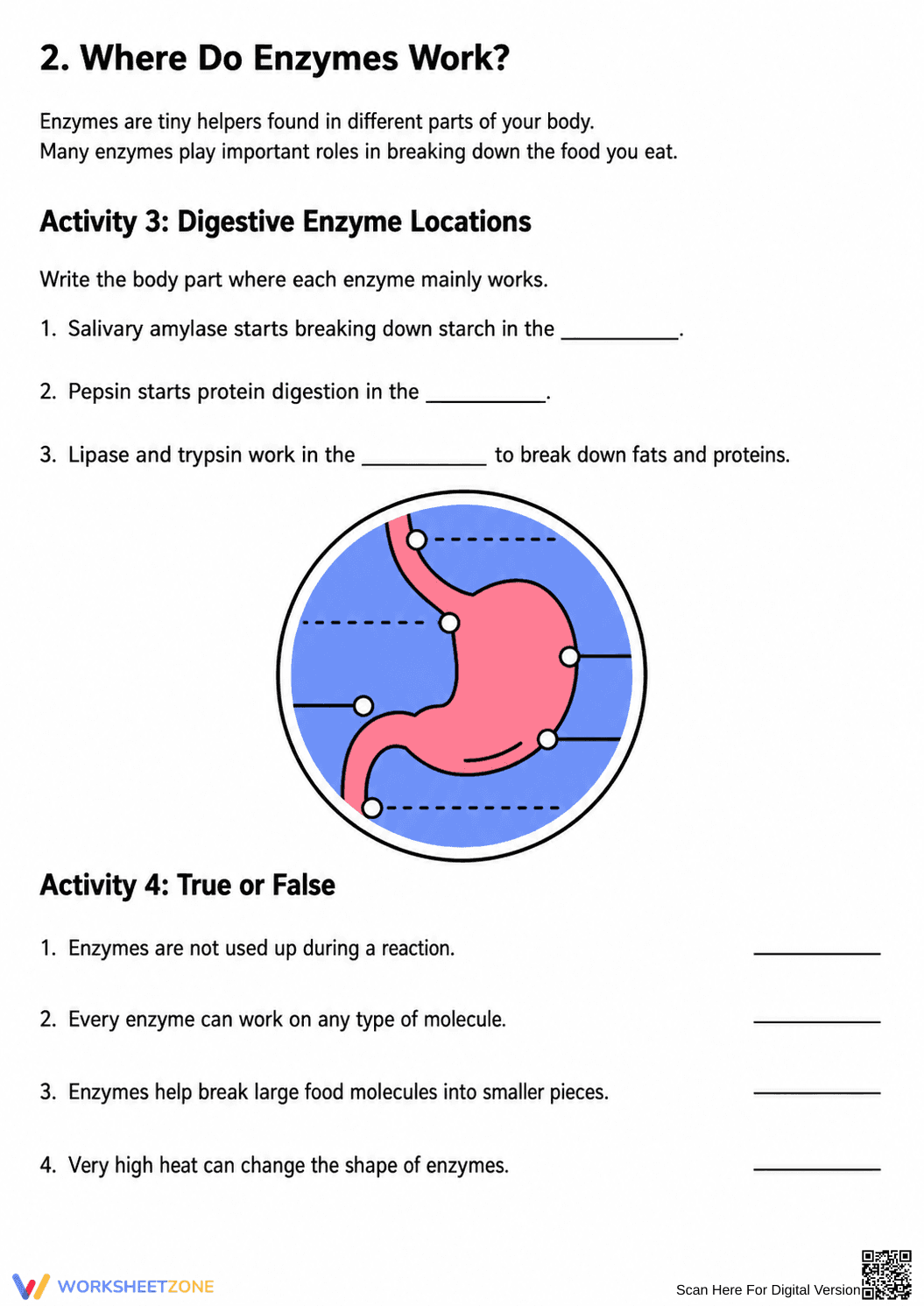
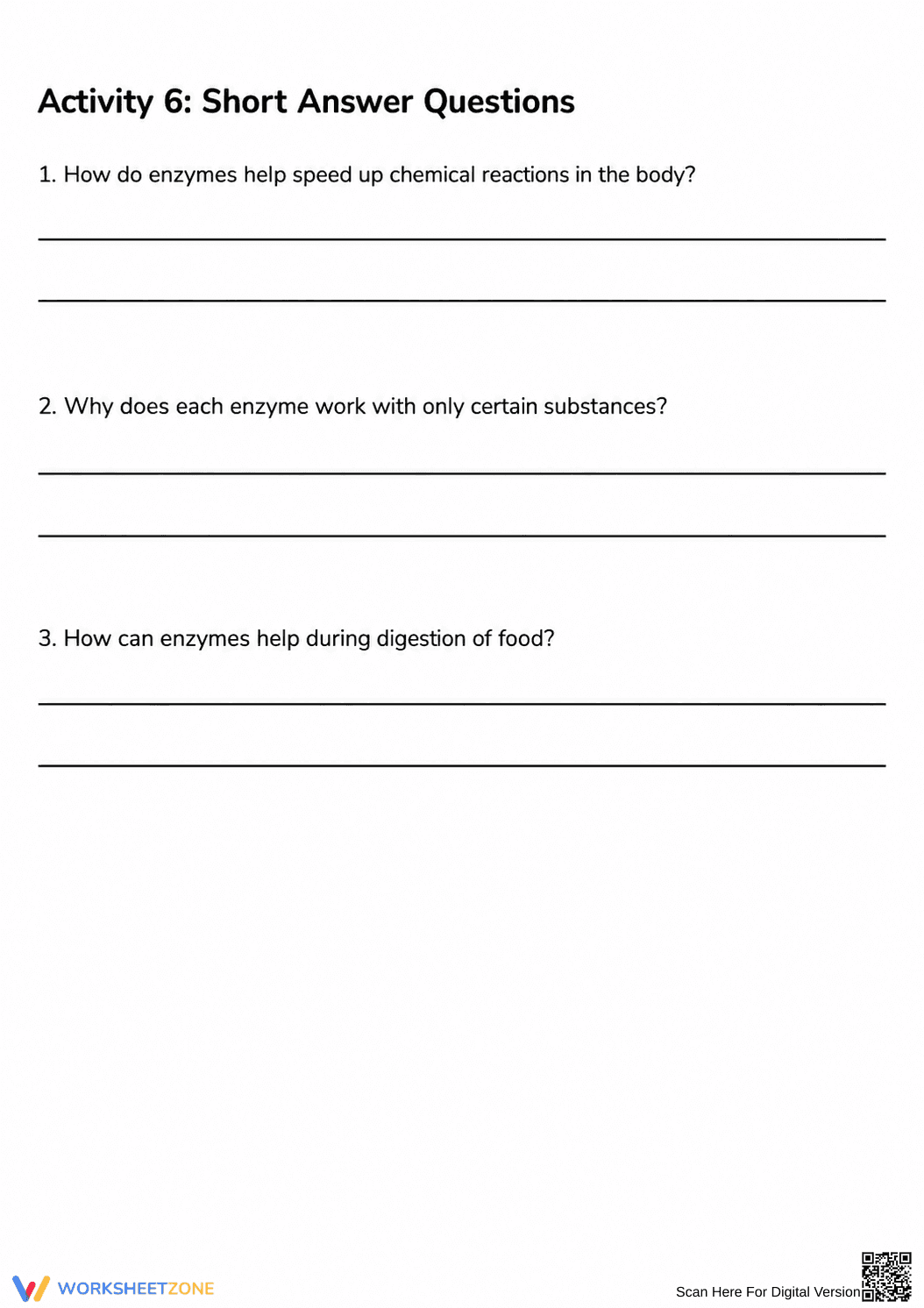
This resource features a built-in informational text explaining biological catalysts, followed by distinct activity types. Across three pages, students tackle fill-in-the-blank vocabulary, a matching section for enzymes like amylase, location identification on a digestive diagram, true/false reasoning, and short answer questions. A complete answer key is provided.
This resource is designed for a zero-prep instructional experience, making it an ideal sub plan.
- Print (1 minute): Generate copies of the PDF. No lab equipment required.
- Distribute (1 minute): Hand out packets. The built-in reading means students begin working immediately.
- Review (5 minutes): Use the answer key to quickly check responses.
Total teacher preparation time is under two minutes, ensuring you can focus entirely on student support.
This worksheet is tightly aligned to MS-LS1-7: Develop a model to describe how food is rearranged through chemical reactions forming new molecules that support growth and/or release energy as this matter moves through an organism. By focusing on enzymes as the catalysts for these reactions, students build a foundational understanding of metabolic processes. Both standard codes can be copied directly into lesson plans, IEP goals, or district curriculum mapping tools.
Deploy this worksheet as an introductory independent activity before a larger unit on the digestive system. Students can read the text and complete the matching sections to build background knowledge. Alternatively, use it as a quiet, focused homework assignment following a lab on chemical reactions. As a formative assessment tip, review the short answer responses to ensure students grasp that enzymes are not consumed during reactions. Expect completion to take between 25 and 35 minutes.
This material is optimized for middle school life science students in grades six through eight. The embedded reading passage provides natural scaffolding for learners who struggle with complex textbook chapters, offering clear, accessible definitions of abstract concepts. Pair this worksheet with a visual anchor chart detailing the digestive tract to further support visual learners and English language learners.
Effectively teaching metabolic processes requires resources that connect abstract cellular functions to concrete physiological systems. This worksheet targets MS-LS1-7, helping students describe how food is rearranged through chemical reactions by focusing on the specific biological catalysts involved in digestion. According to a ScienceDirect TpT Analysis, integrating informational text directly with structured practice significantly reduces cognitive overload, allowing students to process new scientific vocabulary more efficiently. By combining reading comprehension with varied recall tasks—such as matching and diagram labeling—this resource ensures learners can accurately identify enzyme functions and locations without requiring extensive prior knowledge. Structured repetition of key terms like amylase and catalyst builds the academic language necessary for advanced life science coursework, providing a reliable framework for independent student mastery and long-term retention of core biological concepts.


