


























Views
Downloads
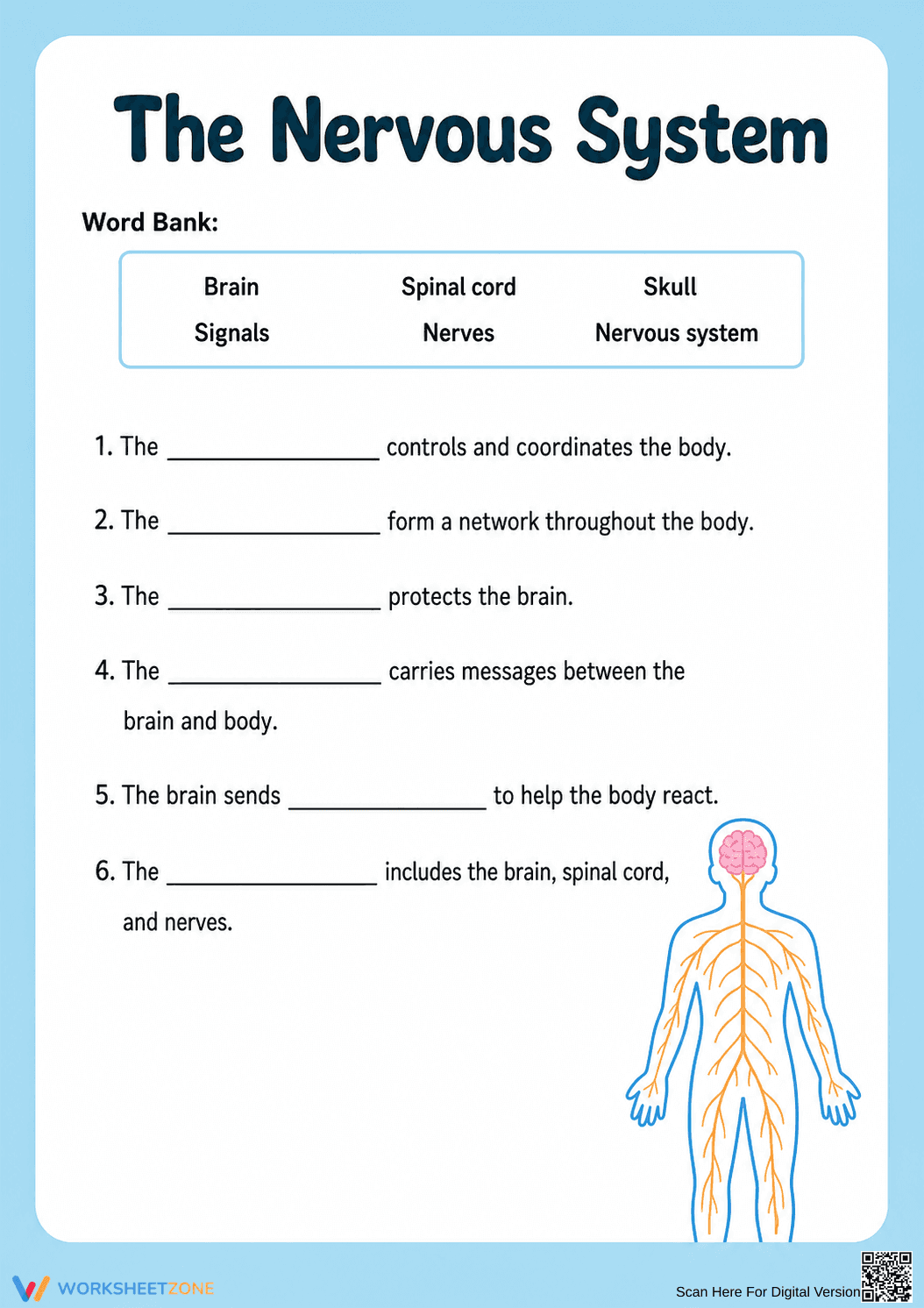

Grade 4 Nervous System — Printable No-Prep Worksheet
Paste this activity's link or code into your existing LMS (Google Classroom, Canvas, Teams, Schoology, Moodle, etc.).
Students can open and work on the activity right away, with no student login required.
You'll still be able to track student progress and results from your teacher account.
This ready-to-use science worksheet helps students identify the core components and functions of the human nervous system. By completing targeted fill-in-the-blank sentences, learners will solidify their understanding of how the brain, spinal cord, and nerves work together to control the body and process signals.
At a Glance
- Grade: 4 · Subject: Science
- Standard:
4-LS1-1— Identify internal structures that support survival and behavior- Skill Focus: Nervous system anatomy and function
- Format: 1 page · 6 problems · Answer key included · PDF
- Best For: Independent practice or review
- Time: 10–15 minutes
This single-page resource features six fill-in-the-blank questions supported by a clear, six-word vocabulary bank. Students will use terms like "brain," "spinal cord," and "nerves" to complete factual statements about human anatomy. A simple, color-coded diagram of the human body is included alongside the text to provide visual context for the nervous system's network. A complete answer key is provided for quick grading.
Designed for immediate classroom use, this worksheet requires absolutely no teacher setup:
- Print (1 minute): Simply download the PDF and print a class set. The clean layout uses minimal ink.
- Distribute (1 minute): Hand out to students as a warm-up, exit ticket, or independent assignment. The included word bank makes it entirely self-explanatory.
- Review (3 minutes): Use the provided answer key to quickly check student comprehension or project it on the board for self-grading.
With a total teacher prep time of under two minutes, this activity is an excellent addition to any emergency sub plan or busy instructional day.
This activity aligns with Next Generation Science Standard 4-LS1-1: Construct an argument that plants and animals have internal and external structures that function to support survival, growth, behavior, and reproduction. It specifically targets the internal structures of the human body that process information and direct behavior. Both standard codes can be copied directly into lesson plans, IEP goals, or district curriculum mapping tools.
Deploy this worksheet immediately after a direct instruction lesson on human body systems to reinforce new vocabulary. Alternatively, use it as a formative assessment at the beginning of a unit to gauge prior knowledge. While students work, teachers can circulate and observe which vocabulary terms require more explanation, particularly distinguishing between the functions of the spinal cord versus individual nerves. Most students will complete this task within 10 to 15 minutes.
This resource is primarily designed for fourth through sixth-grade science students. The built-in word bank provides essential scaffolding for English Language Learners and students who struggle with spelling complex anatomical terms. It pairs perfectly with an introductory reading passage on the human brain or a whole-class anchor chart detailing the central and peripheral nervous systems.
Understanding the specific roles of internal structures is a critical component of elementary science education. Aligned with 4-LS1-1, this resource helps students identify internal structures that support survival and behavior, specifically focusing on the nervous system. According to a ScienceDirect TpT Analysis, providing explicit vocabulary support, such as a targeted word bank, significantly reduces cognitive load and allows young learners to focus on conceptual relationships rather than rote memorization or spelling mechanics. By isolating six key terms—brain, spinal cord, nerves, skull, signals, and nervous system—this worksheet ensures that foundational anatomical concepts are firmly established before students progress to more complex biological systems in middle school. This targeted approach to vocabulary acquisition in the content areas is absolutely essential for long-term scientific literacy and continued academic success.


