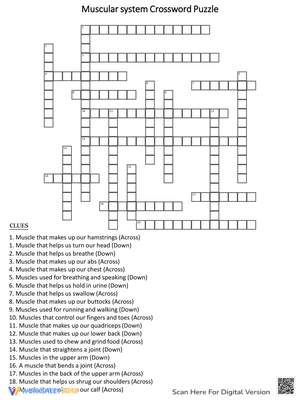
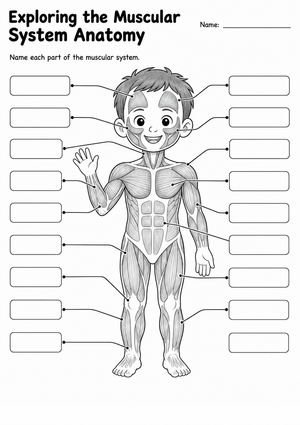
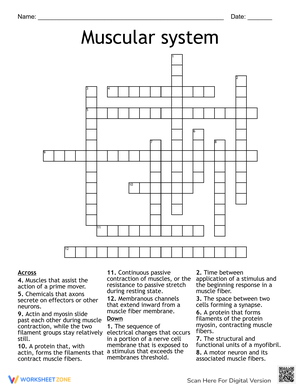
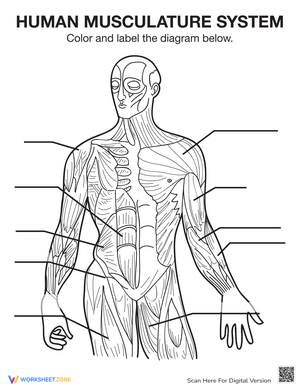
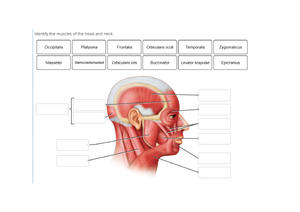
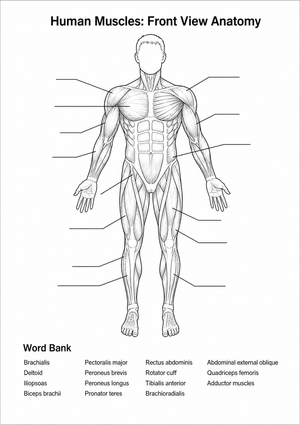
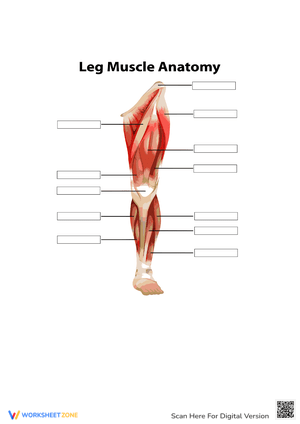
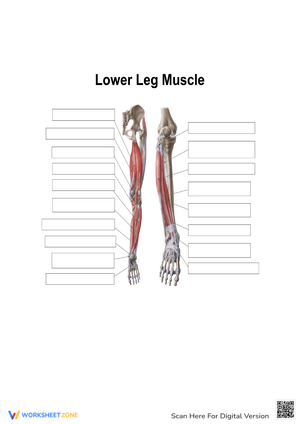
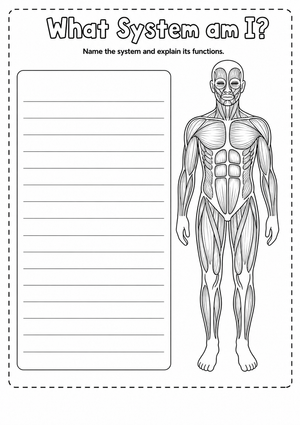
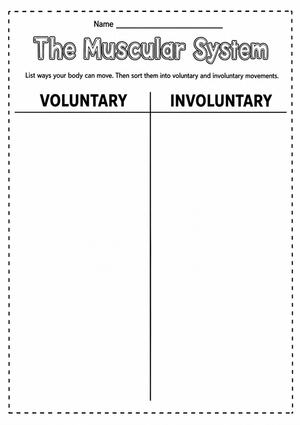
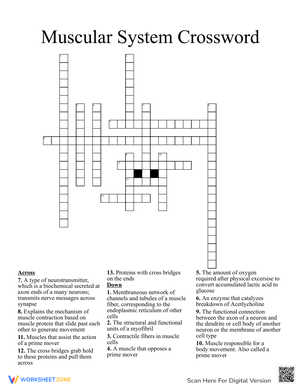
These 6th grade muscular system printable worksheets give life science teachers a direct route from vocabulary introduction to concept application — covering muscle types, muscle pairs, voluntary versus involuntary control, and the structural links between the muscular and skeletal systems that anchor any human body unit.
The muscular system sits at a useful instructional moment in the 6th grade life science sequence. Students this age already have strong intuitions about how their bodies move — they've played sports, felt a cramp, noticed their heart rate climb during exercise. That prior experience makes the topic immediately accessible, but it also means students arrive with confident misconceptions that surface the first time they label a diagram or sort muscle types by function. The worksheets in this set are built around those friction points.
What Students Practice Across the Set
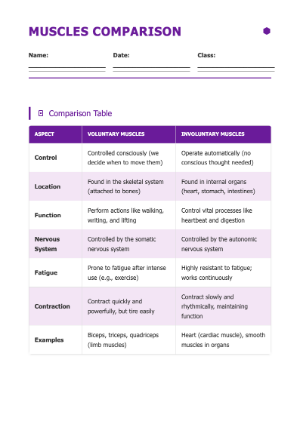
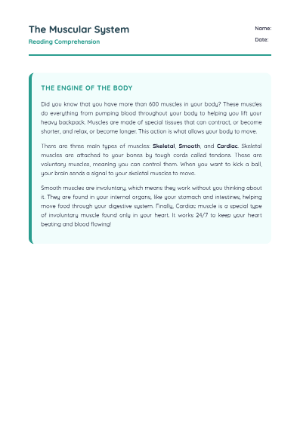
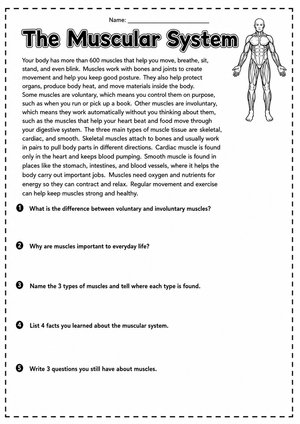
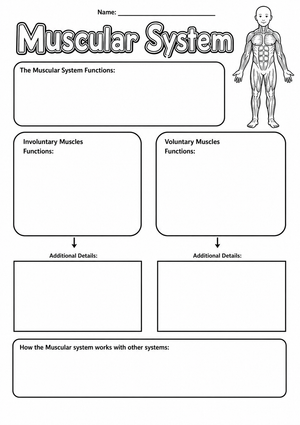
- Muscle type identification: Distinguishing skeletal, smooth, and cardiac muscle by location, function, and control type — voluntary or involuntary.
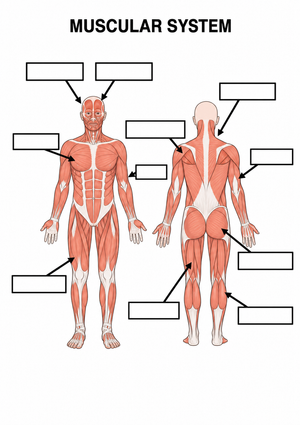
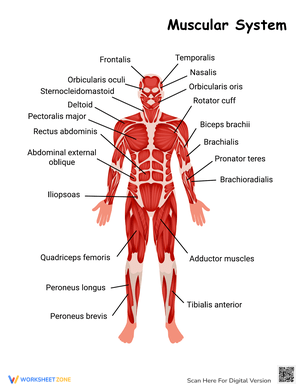
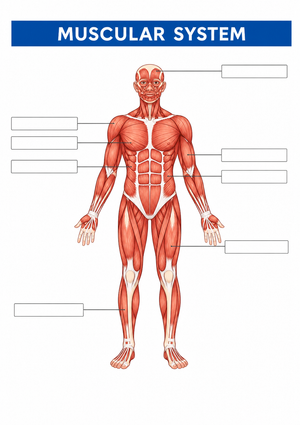
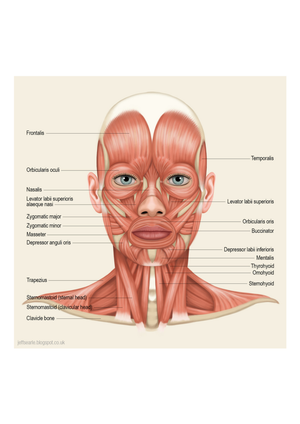
- Diagram labeling: Placing muscle group names on simplified body outlines. The goal at this grade is spatial orientation and broad recognition, not clinical anatomy.
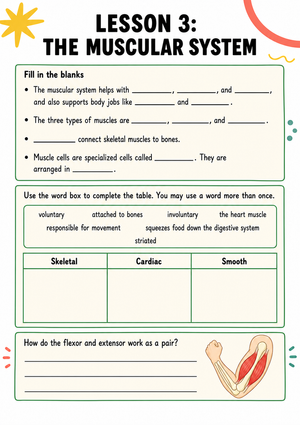
- Muscle pair mechanics: Tracing how contraction and relaxation operate across opposing muscles during flexion and extension.
- Function sorting: Matching specific body actions — digesting food, pumping blood, throwing a ball — to the correct muscle type.
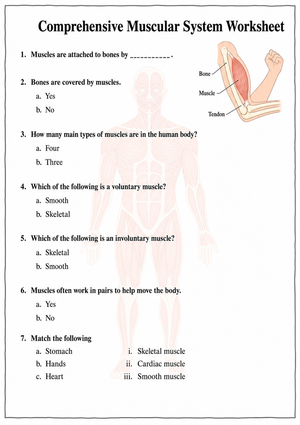
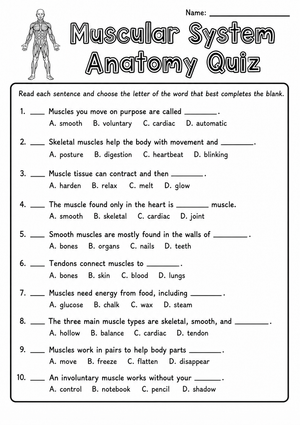
- Vocabulary in context: Working with terms like tendon, contract, voluntary, and posture in fill-in-the-blank, sentence completion, and short written response tasks.
- Cross-system connections: Written prompts asking students to explain what happens when muscles, bones, and joints work together during movements like standing, lifting, or walking.
The set moves from identification toward explanation — students first sort and label, then apply those categories to describe what actually happens when the body moves.
Student Errors Worth Catching Before They Harden
The most persistent error at this level involves muscle pairs. Students learn quickly that the bicep contracts to bend the arm. But then they write that "the bicep relaxes to straighten the arm" — as if extension is just a spring releasing. They're missing that the tricep actively contracts to produce the opposite movement. Left uncorrected, this half-formed understanding gets carried into high school biology intact. Every worksheet that addresses antagonistic pairs gives you a natural moment to press on that gap during class discussion.
A second error appears reliably on sorting tasks: students classify cardiac muscle as skeletal because "the heart moves the body." The reasoning follows from what they've absorbed about skeletal muscle and motion, but it collapses the distinction between voluntary movement and any movement at all. Sorting activities that present specific examples — rather than asking students to apply a memorized definition — bring that edge case into the open where it can be addressed directly.
Vocabulary mix-ups are also common. Students frequently treat tendon and ligament as interchangeable, and many interpret voluntary as meaning something like "easy" rather than "consciously controlled." A brief class conversation before a vocabulary worksheet helps establish those distinctions, but the classification tasks in this set do much of that correction work on their own.
Sequencing These Worksheets Into a Body Systems Unit
The most effective order runs from visible to internal. Begin with skeletal muscles — the ones students can see moving and feel contracting — before introducing smooth and cardiac muscle. Students who understand bicep-tricep mechanics have a concrete reference point when they encounter the concept of involuntary control. Presenting all three muscle types simultaneously, without that anchor, tends to produce surface-level memorization rather than genuine understanding.
For a single class period, a workable structure looks like this: a five-to-eight-minute direct instruction segment on muscle types, followed by a guided labeling worksheet completed alongside the class, then a sorting or matching task done in pairs. Close with an exit prompt asking students to explain, in two sentences, how a specific muscle pair produces a familiar movement. That sequence ends with written evidence you can scan before the next day's lesson.
These 6th grade muscular system printable worksheets also work well as anchor tasks during stations-based instruction. Place the diagram labeling worksheet at one station, a reading-and-response sheet at another, and a muscle pair comparison chart at a third. Students rotate through in roughly ten minutes each, and the format keeps them on task without requiring a teacher-led center for every rotation.
When you pair a worksheet with a brief physical demonstration — ask students to place a hand on their bicep, then slowly bend and extend the arm and note what they feel — the paper task that follows lands differently than it does in isolation. Students annotate something they just observed in their own body, which removes a layer of abstraction from what can otherwise feel like memorizing labels on a page.
Standard Alignment
These worksheets connect to NGSS standard MS-LS1-3, which asks students to construct arguments supported by evidence for how the body functions as a system of interacting subsystems. The muscular system fits that framework directly: students build a claim about how skeletal muscle works with bone and joint to produce movement, support it with diagram evidence, and extend it by distinguishing voluntary subsystems from involuntary ones. In classrooms that have adopted NGSS, this standard typically appears in 6th or 7th grade as part of a broader unit on body organization — from cells to tissues to organ systems — making the muscular system a natural anchor point in that progression.
Tailoring These Worksheets for Mixed-Readiness Classes
For students who need additional support, the labeling worksheets function best when paired with a word bank and a reference diagram on the same page. Removing the retrieval demand lets those students concentrate on placement and categorization — the actual conceptual work — rather than spending effort on recall. Narrowing the vocabulary list to five or six essential terms also reduces the load for students who struggle with dense scientific language.
Students who move quickly through the material benefit from response prompts that push toward comparison and reasoning. Rather than "identify which muscle type is voluntary," ask them to "explain why voluntary control over skeletal muscles is advantageous for survival, while cardiac muscle operates automatically." Same content, a meaningfully higher cognitive demand.
The 6th grade muscular system printable worksheets in this set include tasks across multiple complexity levels — identification, classification, explanation, and cross-system comparison — which means a single lesson can serve students at different readiness points without requiring entirely separate materials for each group.
Frequently Asked Questions
What muscle content is appropriate for 6th grade specifically?
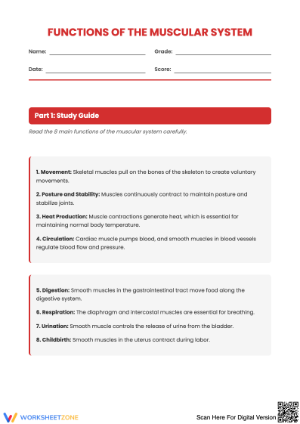
Sixth graders work at the level of function, type, and system connection — not detailed anatomy. They should know that skeletal muscles are voluntary and connect to bones via tendons, that smooth muscle operates automatically inside organs, and that cardiac muscle is the specialized tissue of the heart. They should also understand that muscles work in pairs and that the muscular system contributes to posture, movement, and heat production. Advanced detail — individual muscle origins and insertions, fiber composition — falls outside the scope of most 6th grade life science standards.
Can these worksheets replace textbook instruction?
Each worksheet reinforces and extends direct instruction — it doesn't replace it. Students who arrive at a labeling task without prior teaching on muscle types will guess rather than apply knowledge. Use each worksheet after a brief lesson, reading, or demonstration so students are working from actual understanding rather than filling in blanks by process of elimination.
How long does each worksheet take to complete?
Most tasks in this set take between ten and twenty minutes for a typical 6th grade class. Labeling and sorting worksheets run closer to ten minutes; reading-with-response and written comparison tasks extend toward fifteen to twenty. That range fits bell work, review stations, and end-of-class assessments without spilling into the next lesson.
Where do these worksheets fit in a larger body systems unit?
Teach the muscular system after the skeletal system and before circulatory system instruction — that order lets you build on bone-and-joint concepts when explaining how muscles attach and pull, then transition naturally into how working muscles demand the oxygen and nutrients the circulatory system delivers. The 6th grade muscular system printable worksheets collected here include a cross-system comparison activity that bridges both transitions and gives students a reference point they can return to throughout the unit.












 Interactive Worksheet Maker
 Quiz Maker
 Word Search Maker
 Crossword Puzzle Maker
 Word Scramble Generator
 Sentence Scramble Generator
 Handwriting Worksheet Generator
 Name Tracing Generator
 Fill In The Blank Generator