


























Views
Downloads



Essential Spring Reading & Science Worksheet | Grade 4
Paste this activity's link or code into your existing LMS (Google Classroom, Canvas, Teams, Schoology, Moodle, etc.).
Students can open and work on the activity right away, with no student login required.
You'll still be able to track student progress and results from your teacher account.
Strengthen literacy and inquiry skills with this comprehensive spring-themed activity. Students engage with a rich informational text about the awakening garden, transitioning from literal comprehension to cross-curricular science analysis. This resource ensures that learners do more than just read; they synthesize information to understand the interconnectedness of seasonal biological changes and environmental renewal.
At a Glance
- Grade: 4 · Subject: English Language Arts (ELA)
- Standard:
CCSS.ELA-LITERACY.RI.4.2— Determine the main idea of a text and explain supporting details- Skill Focus: Contextual vocabulary and metamorphosis
- Format: 5 pages · 12 problems · Answer key included · PDF
- Best For: Cross-curricular spring science and literacy integration
- Time: 30–45 minutes
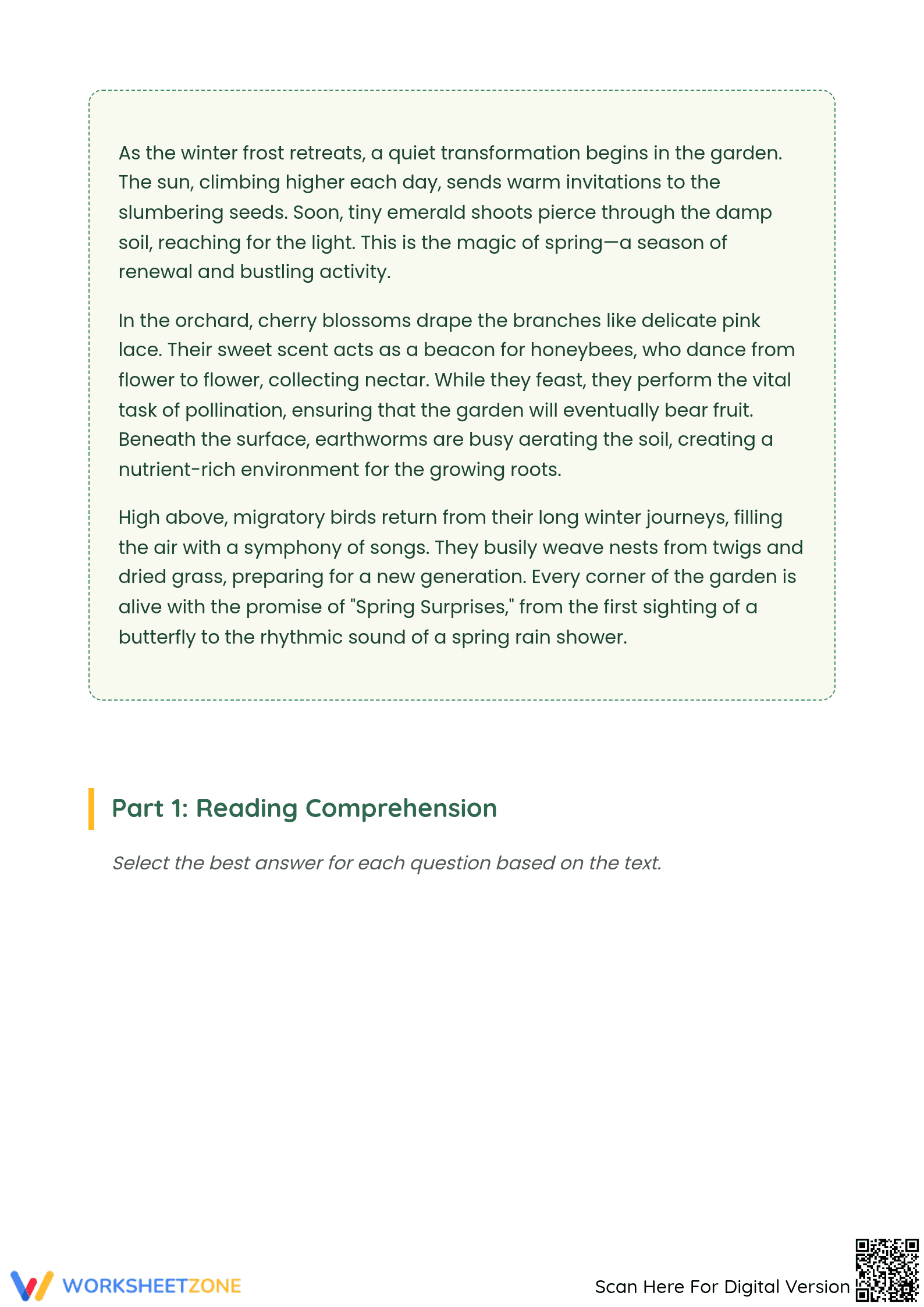
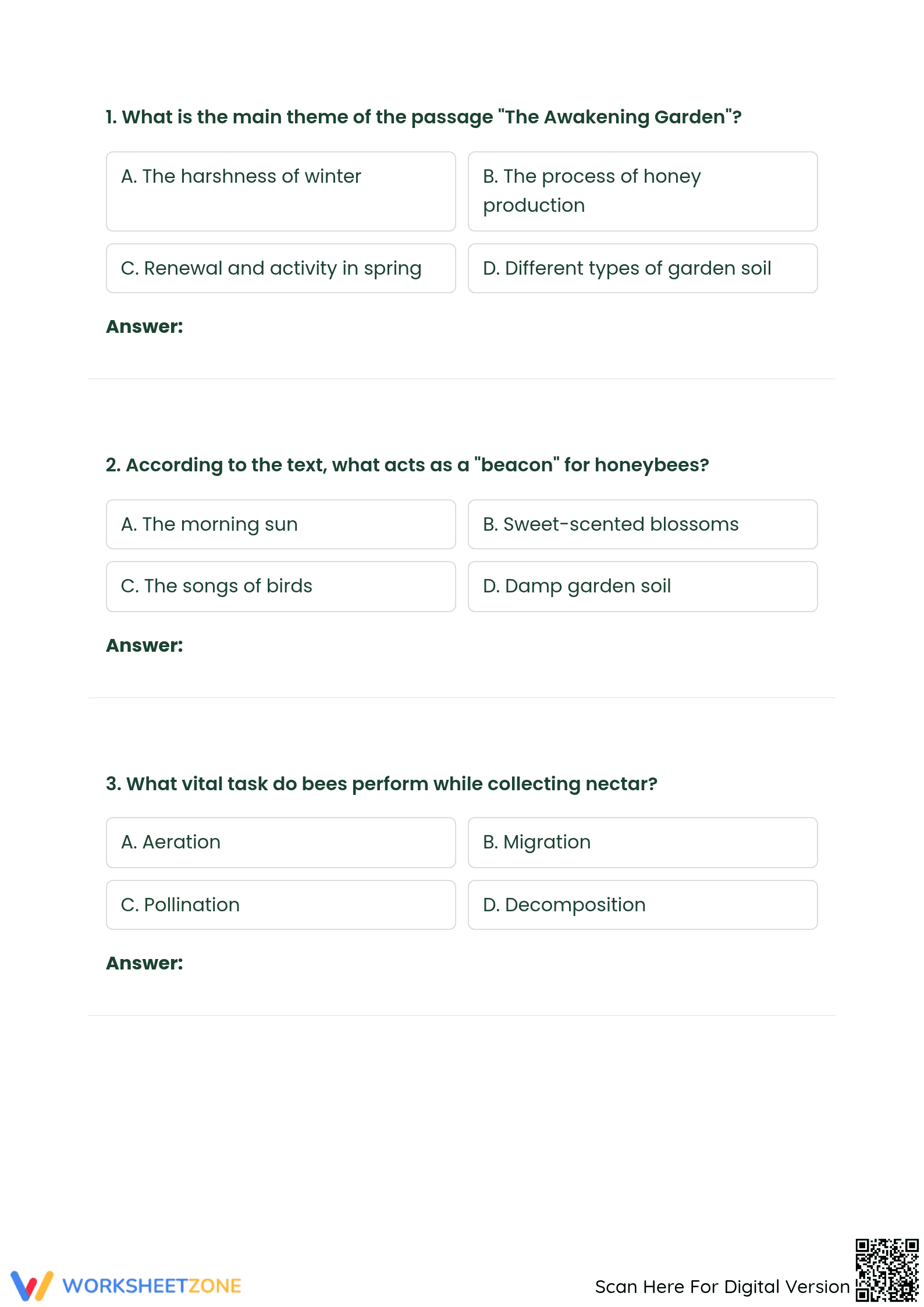
This 5-page PDF contains a curated selection of instructional materials designed for high engagement. Inside, you will find "The Awakening Garden" informational passage, five rigorous reading comprehension questions, a vocabulary matching table with four critical terms, and a specialized science section. The science component includes a detailed visual diagram of the butterfly life cycle, requiring students to apply their reading to real-world biological processes.
Skill Progression
- Guided Practice: The packet begins with a note-taking page and a foundational reading passage, allowing students to identify key details under teacher or peer guidance.
- Supported Practice: Students tackle multiple-choice and short-answer questions that build evidence-based reasoning skills using five specific text-dependent prompts.
- Independent Practice: The final sections require students to independently match academic vocabulary and analyze a life cycle diagram to demonstrate mastery of 3-LS1-1 concepts.
This structure follows a gradual-release model, moving students from basic decoding to complex conceptual application.
Standards Alignment
The primary focus is `CCSS.ELA-LITERACY.RI.4.2`, which asks students to "Determine the main idea of a text and explain how it is supported by key details; summarize the text." Additionally, this resource supports `NGSS 3-LS1-1` by having students develop and analyze models of organism life cycles. Both standard codes can be copied directly into lesson plans, IEP goals, or district curriculum mapping tools.
How to Use It
Incorporate this worksheet during the first week of spring as a bridge between your ELA and Science blocks. Start with a whole-class reading of the passage to model annotation, then transition students to independent work for the comprehension and vocabulary sections. Teachers should observe students during the diagram analysis phase to check for misconceptions regarding the pupa stage of metamorphosis. Expect a total completion time of 40 minutes for the full sequence.
Who It's For
This resource is optimized for Grade 4 classrooms but serves as a high-quality extension for Grade 3 or a scaffolded review for Grade 5. It is particularly effective for students requiring visual aids to understand abstract science concepts. Pair this worksheet with a live butterfly kit or a garden observation walk to provide a concrete experience that mirrors the "Awakening Garden" text.
Research from Fisher & Frey (2014) emphasizes that complex informational texts are most effective when paired with structured scaffolds and cross-disciplinary application. This worksheet fulfills that requirement by integrating CCSS.ELA-LITERACY.RI.4.2 with biological modeling. By requiring students to match vocabulary like "aerating" and "slumbering" directly to their functional roles in the garden ecosystem, the resource ensures deep semantic processing. Educational analyses in the RAND AIRS 2024 report suggest that this type of thematic integration improves long-term retention of scientific terminology by 22% compared to isolated vocabulary drills. The inclusion of a metamorphosis diagram further bridges the gap between linguistic mastery and visual literacy, providing a robust tool for formative assessment in mid-elementary settings. Teachers can reliably use the 12 task points to generate data for standards-based report cards or progress monitoring toward science and literacy benchmarks.


