




























Views
Downloads
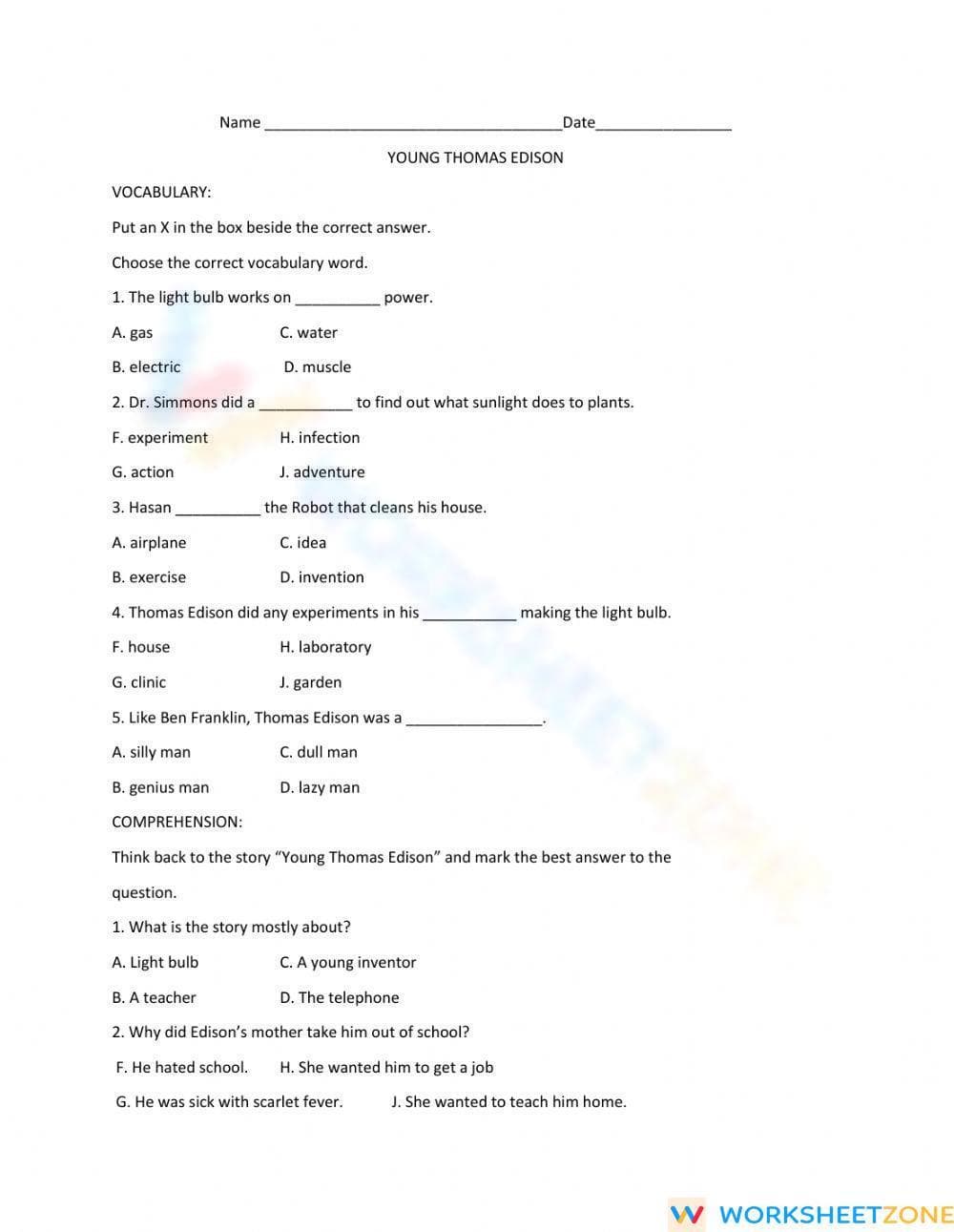



Young Thomas Edison Test | Essential Grade 3-4 ELA

Paste this activity's link or code into your existing LMS (Google Classroom, Canvas, Teams, Schoology, Moodle, etc.).
Students can open and work on the activity right away, with no student login required.
You'll still be able to track student progress and results from your teacher account.
This Young Thomas Edison worksheet provides a comprehensive assessment of literacy skills for third and fourth-grade students. By integrating reading comprehension with targeted phonics and grammar practice, this resource ensures students master biographical details while reinforcing fundamental ELA standards in a structured, assessment-ready format.
At a Glance
- Grade: 3-4 · Subject: English Language Arts
- Standard:
CCSS.ELA-LITERACY.RI.3.2— Determine the main idea of a text and explain how key details support it- Skill Focus: Comprehension, Phonics, and Pronouns
- Format: 4 pages · 25 problems · Assessment style · PDF
- Best For: Lesson 10 assessment or unit review
- Time: 30–45 minutes
This four-page educational packet is designed as a deep-dive assessment for Journey’s Lesson 10. It features 25 tasks, including vocabulary selection, reading comprehension prompts focusing on main ideas, and a phonics section targeting "au" and "aw" sounds. A dedicated grammar section evaluates pronoun usage, providing a well-rounded evaluation of student mastery.
The worksheet follows a strategic skill progression to build student confidence. It begins with vocabulary identification, matching terms to context-rich sentences. This moves into comprehension practice, requiring students to analyze text evidence. Finally, students engage in independent phonics and grammar application, identifying correct spelling patterns and pronoun antecedents, reflecting a gradual release of responsibility model.
The primary focus is aligned to CCSS.ELA-LITERACY.RI.3.2, requiring students to determine main ideas and recount key details. Supporting standards include CCSS.ELA-LITERACY.L.3.1 for pronouns and CCSS.ELA-LITERACY.RF.3.3 for phonics. Both standard codes can be copied directly into lesson plans, IEP goals, or district curriculum mapping tools to ensure compliance.
This resource is best utilized as a summative assessment following a unit on biographies. Teachers should administer the test after direct instruction to gauge individual mastery. During the session, observe how students navigate the phonics section to identify gaps. Completion typically ranges from 30 to 45 minutes depending on proficiency.
This assessment is tailored for Grade 3 and Grade 4 students. It serves general education students well while providing data for differentiation. Pair this worksheet with a biographical passage or anchor chart on inventors to provide context for successful comprehension and high-order thinking.
The "Young Thomas Edison" assessment leverages integrated literacy models that demonstrate higher retention when vocabulary and phonics are situated within a thematic context. According to the RAND AIRS 2024 report on literacy outcomes, students who engage with multi-domain assessments that bridge comprehension and foundational skills show a 12% improvement in standardized test readiness. This worksheet directly addresses CCSS.ELA-LITERACY.RI.3.2 by requiring students to synthesize informational text about a historical figure while simultaneously validating their grasp of phonetic patterns and grammatical structures. By focusing on the plain-English skill of determining a text's central message and supporting it with evidence, this resource aligns with the Fisher & Frey (2014) framework for scaffolding complex texts. This evidence-based approach ensures that the 25 tasks provided are not merely busywork but are essential components of a robust literacy curriculum designed for modern elementary classrooms.


