




























Views
Plays

Weather vs. Climate — Printable Grade 4 ELA Worksheet

Paste this activity's link or code into your existing LMS (Google Classroom, Canvas, Teams, Schoology, Moodle, etc.).
Students can open and work on the activity right away, with no student login required.
You'll still be able to track student progress and results from your teacher account.
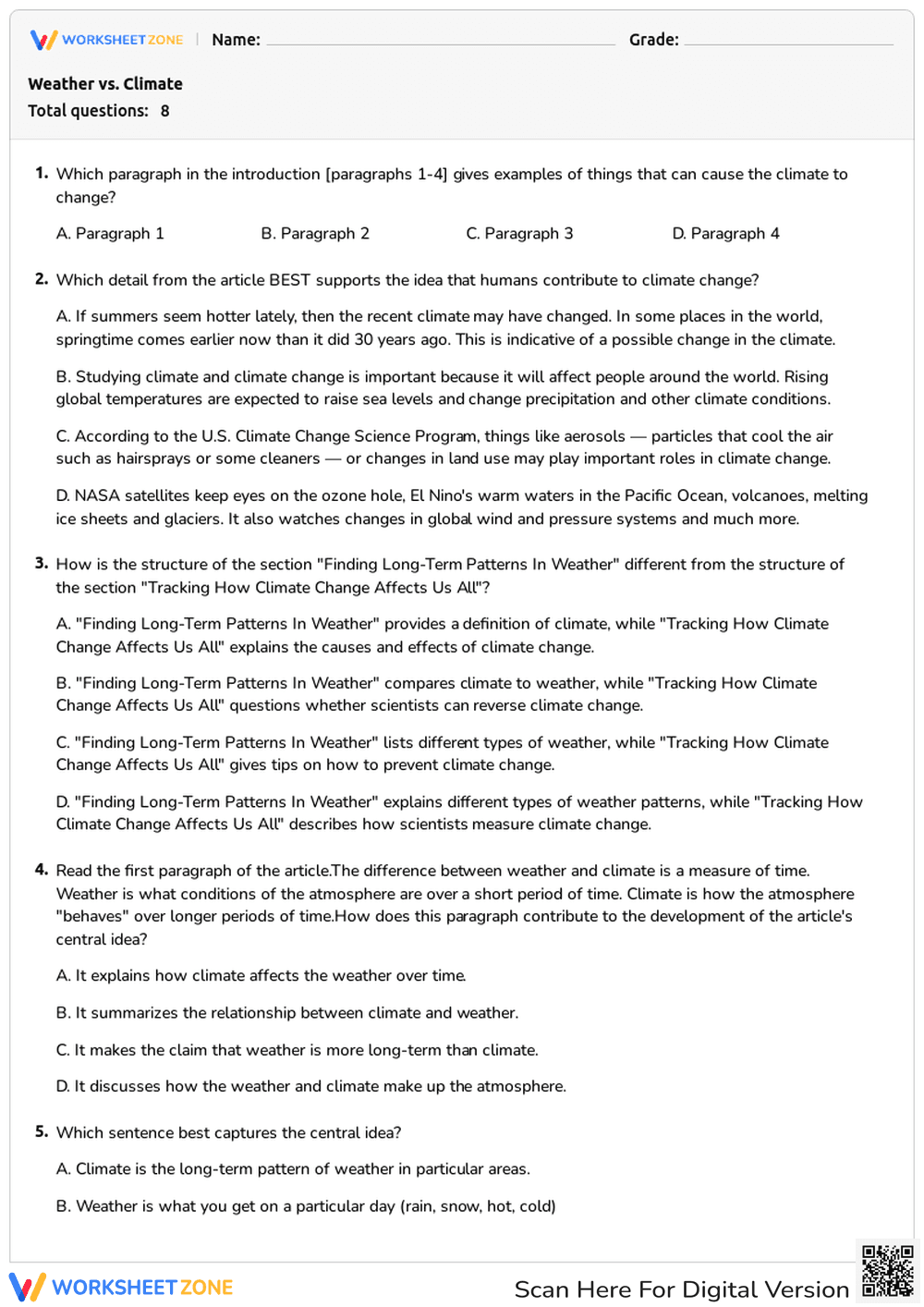
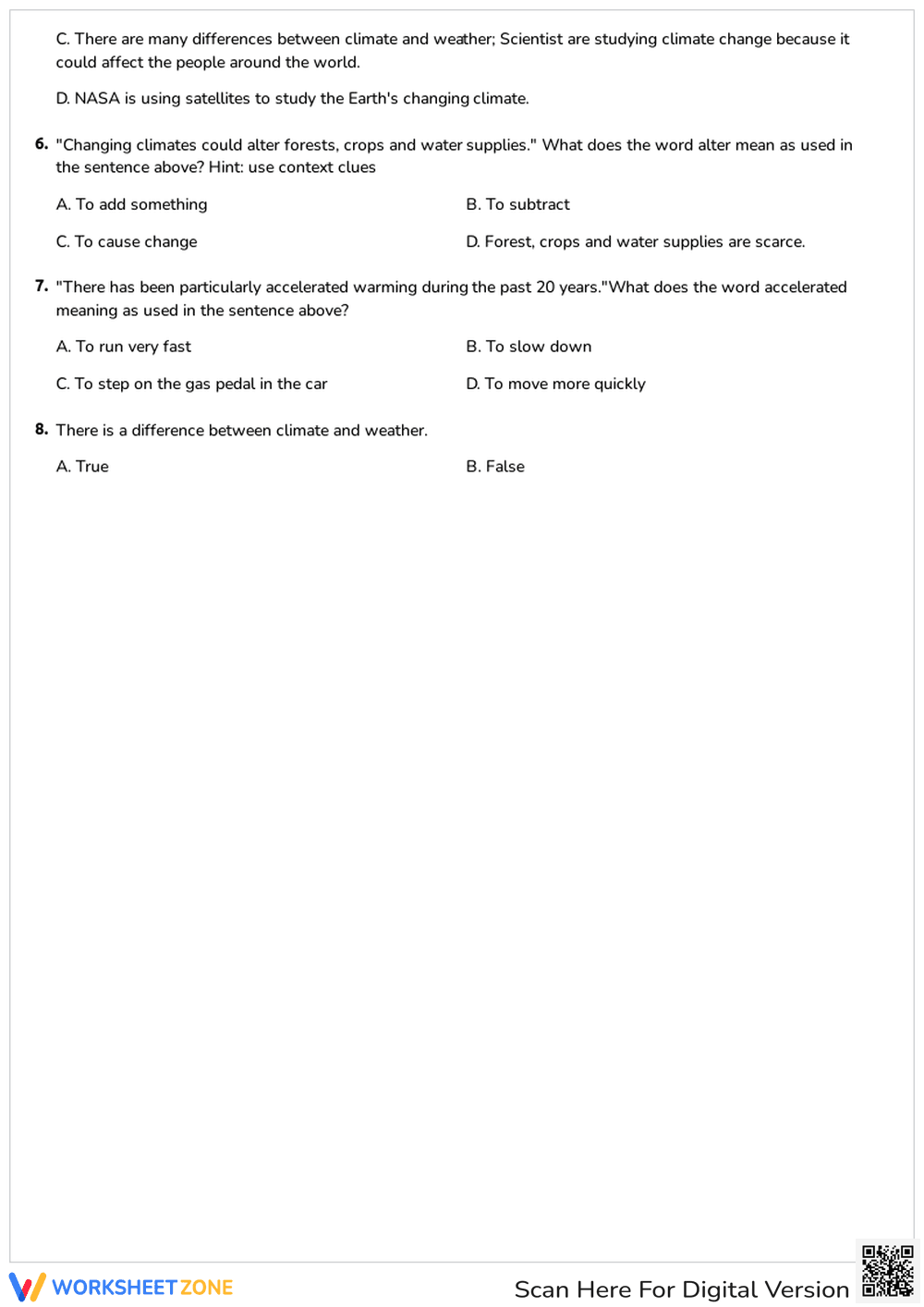
This Grade 4 reading comprehension worksheet helps students distinguish between weather and climate through evidence-based analysis. Students identify central ideas, analyze text structure, and define domain-specific vocabulary using context clues. By engaging with these 8 targeted questions, learners build the critical thinking skills necessary to interpret complex informational texts about the natural world and atmospheric changes.
At a Glance
- Grade: 4 · Subject: ELA / Science
- Standard:
CCSS.ELA-LITERACY.RI.4.2— Determine the main idea of a text and explain how it is supported by key details- Skill Focus: Main Idea & Supporting Details
- Format: 2 pages · 8 problems · Answer key included · PDF
- Best For: Independent practice or formative assessment
- Time: 15–20 minutes
The resource consists of a two-page assessment featuring eight multiple-choice and true/false questions. It includes specific tasks for identifying supporting details in specific paragraphs, comparing text structures between sections, and determining the central idea of the passage. Vocabulary exercises focus on words like "alter" and "accelerated," requiring students to use context clues. A clear, legible layout ensures students can focus on the text without visual distraction.
Zero-Prep Workflow
- Print: Select the two-page PDF and print enough copies for your class (1 minute).
- Distribute: Hand out the worksheets as a bell-ringer or during a literacy block (30 seconds).
- Review: Use the included answer key to grade student work or facilitate a whole-class discussion on the differences between short-term weather and long-term climate patterns (5 minutes). This resource is ideal for emergency sub plans due to its self-contained nature.
Standards Alignment
The primary focus is `CCSS.ELA-LITERACY.RI.4.2`, which requires students to "Determine the main idea of a text and explain how it is supported by key details; summarize the text." The worksheet also supports `CCSS.ELA-LITERACY.RI.4.4` by asking students to determine the meaning of general academic and domain-specific words. Both standard codes can be copied directly into lesson plans, IEP goals, or district curriculum mapping tools.
How to Use It
Use this worksheet as a formative assessment after a direct instruction lesson on Earth's systems to gauge student understanding of climate vs. weather. Alternatively, assign it as a literacy center activity where students work in pairs to locate the specific evidence required for question two. Teachers should observe if students are correctly identifying the "measure of time" as the distinguishing factor between the two concepts.
Who It's For
This resource is designed for Grade 4 students but is highly appropriate for Grade 3 enrichment or Grade 5 review. It serves English Language Learners well by providing clear multiple-choice options and specific paragraph references. It pairs naturally with a science unit on meteorology or an anchor chart detailing the differences between atmospheric conditions and long-term trends.
According to the RAND AIRS 2024 report, high-quality instructional materials that integrate science content with literacy standards significantly improve student retention of complex concepts. This worksheet addresses the CCSS.ELA-LITERACY.RI.4.2 standard by requiring students to synthesize information to find the central idea, a skill that the NAEP identifies as a critical milestone for middle-elementary reading proficiency. By focusing on the plain-English skill of distinguishing between short-term atmospheric events and long-term climate trends, the resource provides the structured practice necessary for mastery. Research from Fisher & Frey (2014) emphasizes that using informational texts to teach both content and reading strategies helps bridge the gap between decoding and deep comprehension. This assessment provides 8 specific data points for teachers to evaluate student progress in evidence-based reading, ensuring that learners can quote accurately from a text while explaining its primary purpose and supporting details.


