


























Views
Downloads
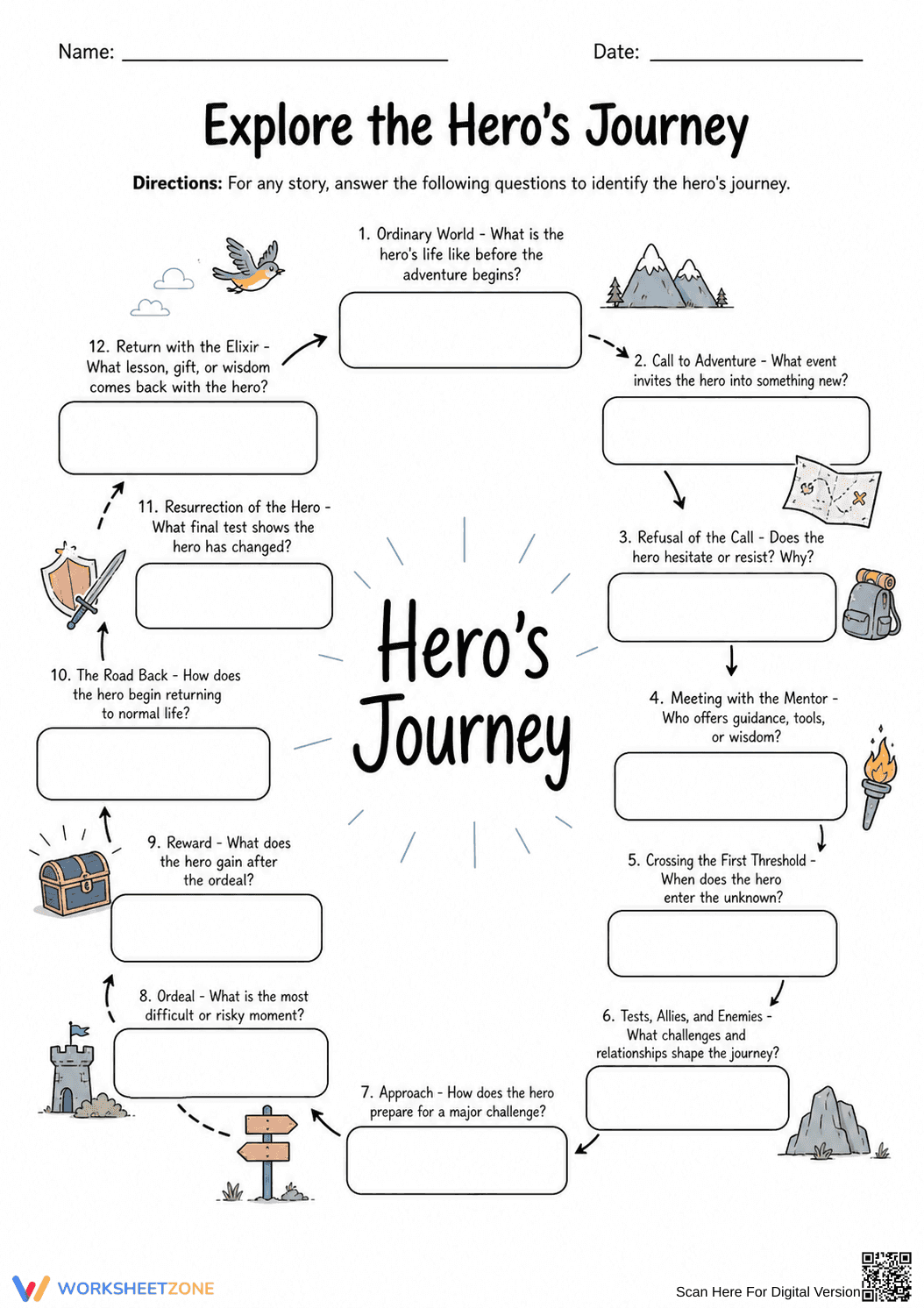

Grade 8 Hero's Journey — Printable No-Prep Worksheet
Paste this activity's link or code into your existing LMS (Google Classroom, Canvas, Teams, Schoology, Moodle, etc.).
Students can open and work on the activity right away, with no student login required.
You'll still be able to track student progress and results from your teacher account.
This Grade 8 English Language Arts worksheet provides students with a structured graphic organizer to analyze the classic Hero's Journey narrative arc. By applying this twelve-stage framework to any chosen story, novel, or film, students will deepen their reading comprehension and recognize universal patterns in character development and plot progression.
At a Glance
- Grade: 8 · Subject: English
- Standard:
CCSS.ELA-LITERACY.RL.8.3— Analyze how incidents in a story propel the action.- Skill Focus: Narrative Structure Analysis
- Format: 1 page · 12 problems · PDF
- Best For: Independent reading response
- Time: 30–45 minutes
Inside this single-page resource, educators will find a comprehensive circular diagram detailing the twelve distinct stages of the archetypal monomyth. From the "Ordinary World" through the "Return with the Elixir," each phase includes a targeted guiding question. These prompts provide built-in scaffolding, ensuring students know exactly what evidence to look for. Blank response boxes are strategically placed around the cycle for concise student writing.
This resource is designed for immediate classroom implementation. First, print the single-page PDF (under one minute). Next, distribute the graphic organizer to students alongside their current reading book (one minute). Finally, review the twelve stages briefly before releasing students to work independently (five minutes). Total teacher preparation requires less than two minutes, making this an ideal option for emergency substitute plans.
This graphic organizer is directly aligned to CCSS.ELA-LITERACY.RL.8.3: Analyze how particular lines of dialogue or incidents in a story or drama propel the action, reveal aspects of a character, or provoke a decision. By breaking down the narrative into specific stages, students can clearly see how each plot point drives the protagonist forward. Both standard codes can be copied directly into lesson plans, IEP goals, or district curriculum mapping tools.
Teachers can utilize this versatile tool during a whole-class novel study by having students fill in the stages as they progress through the chapters. Alternatively, it serves as an excellent culminating assessment after finishing a text, allowing students to synthesize the entire plot retroactively. As a formative assessment tip, circulate the room while students complete the "Ordeal" and "Reward" sections to ensure they accurately identify the narrative climax rather than minor conflicts. Expect students to spend 30 to 45 minutes completing the full cycle depending on text complexity.
This resource is primarily designed for middle school English students developing their literary analysis skills. The visual nature of the circular diagram offers excellent differentiation for visual learners and students who benefit from spatial organization of abstract concepts. It pairs perfectly with an introductory direct instruction lesson on Joseph Campbell's monomyth or alongside classic texts.
Mastering narrative structure through frameworks like the monomyth significantly improves overall reading comprehension and analytical writing. When students engage with CCSS.ELA-LITERACY.RL.8.3 to analyze how incidents in a story propel the action, they move beyond basic recall to understand the mechanics of storytelling. According to Fisher & Frey (2014), providing students with visual graphic organizers to map complex textual relationships increases their ability to synthesize information and retain core concepts. This twelve-stage diagram operationalizes that research by giving learners a concrete visual anchor for abstract literary theories. By repeatedly applying this structure to various texts, students build a robust mental model for narrative arcs that they can transfer to their own creative writing and advanced literary critiques across different genres.


