


























Views
Downloads

RL.9-10.3 Worksheet: Hero's Journey — Grade 9 Aligned
Paste this activity's link or code into your existing LMS (Google Classroom, Canvas, Teams, Schoology, Moodle, etc.).
Students can open and work on the activity right away, with no student login required.
You'll still be able to track student progress and results from your teacher account.
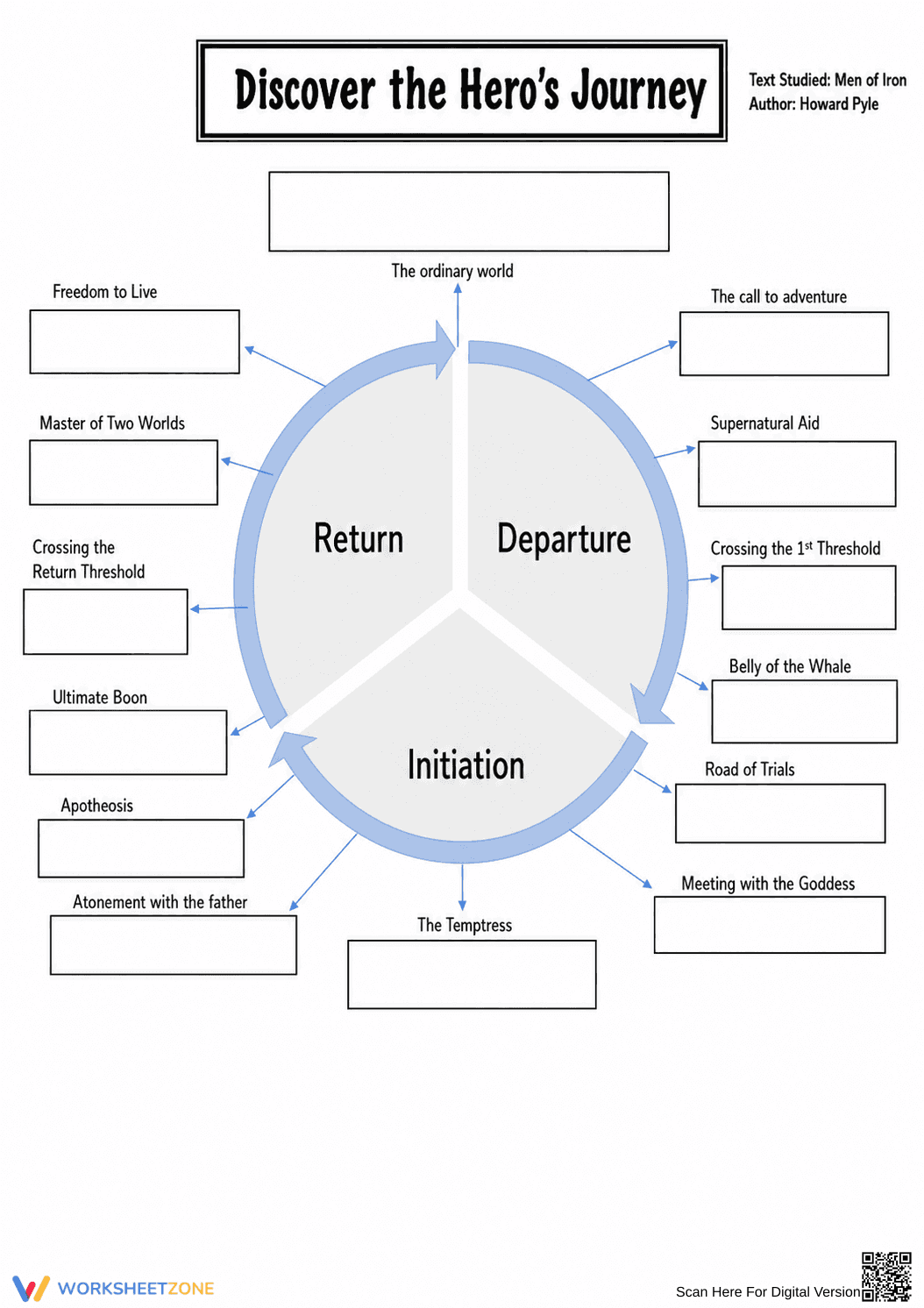
This Grade 9 literary analysis worksheet facilitates a comprehensive breakdown of the Hero's Journey archetype within Howard Pyle's "Men of Iron." Students identify and document specific textual evidence for each of the twelve stages of the Monomyth. By mapping the narrative arc, learners gain a deeper understanding of how structural choices influence character development and thematic resonance.
At a Glance
- Grade: 9 · Subject: English
- Standard:
RL.9-10.3— Analyze how complex characters develop over the course of a text- Skill Focus: Archetypal Narrative Structure
- Format: 1 page · 12 problems · Answer key not included · PDF
- Best For: Mid-unit literary analysis and character mapping
- Time: 35–45 minutes
The resource features a high-quality visual diagram divided into the three primary phases of Joseph Campbell’s Monomyth: Departure, Initiation, and Return. Within these phases, 12 distinct graphic organizers provide space for students to cite evidence from the text. The layout includes specific prompts for "The Call to Adventure," "The Road of Trials," and "The Ultimate Boon," ensuring students track the protagonist's growth across the entire narrative.
This worksheet serves as a concrete artifact for assessing student mastery of narrative archetypes. Tasks are structured to move from basic identification (Approaching) to complex textual synthesis (Meeting). Teachers can evaluate the depth of the "Atonement with the Father" or "Apotheosis" entries to determine if students are Exceeding the standard by connecting character internal shifts to external plot points. Scores can be entered directly into gradebooks or used to inform IEP progress notes regarding reading comprehension and analytical writing goals.
This resource is primarily aligned with `CCSS.ELA-LITERACY.RL.9-10.3`, focusing on how an author's structural choices and character interactions drive the plot. It also supports RL.9-10.5 by requiring students to analyze how specific parts of the text contribute to the overall structure. Both standard codes can be copied directly into lesson plans, IEP goals, or district curriculum mapping tools.
Use this worksheet during the "Initiation" phase of a novel study to help students track the rising action. It works best after direct instruction on the Hero's Journey framework. As a formative assessment, observe if students struggle with the "Belly of the Whale" section, which often indicates a need for further discussion on the protagonist's point of no return. Expect completion within 45 minutes.
This activity is designed for Grade 9 ELA students but is adaptable for Grade 10 or advanced middle schoolers. It is particularly effective for visual learners who benefit from seeing the cyclical nature of the narrative. Pair this worksheet with a character trait anchor chart or a short video summary of the Monomyth to provide additional scaffolding for struggling readers.
According to the RAND AIRS 2024 report on secondary literacy, the use of graphic organizers to map archetypal structures significantly improves a student's ability to synthesize complex narrative arcs. This worksheet targets `CCSS.ELA-LITERACY.RL.9-10.3` by requiring students to perform the plain-English skill of identifying how a character's journey follows a predictable yet complex structural pattern. Research from Fisher & Frey (2014) suggests that scaffolded tools like this diagram facilitate the gradual release of responsibility, moving students from teacher-led identification to independent textual analysis. By isolating twelve specific stages of the Monomyth, the resource provides a structured environment for students to practice evidence-based writing. This alignment ensures that the instructional time spent on "Men of Iron" directly contributes to measurable growth in literary analysis skills as defined by national standards and contemporary educational research.


