


























Views
Downloads
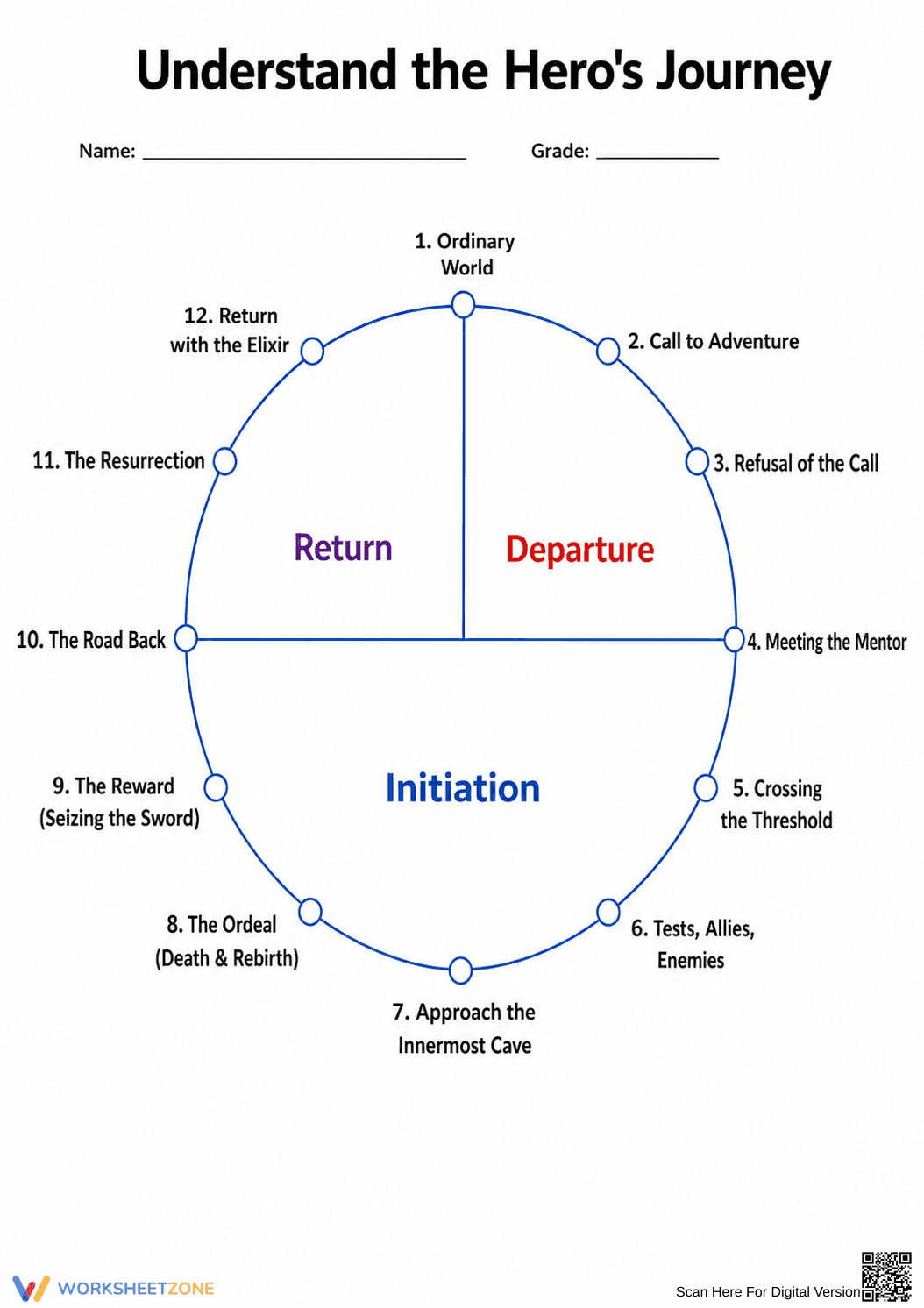

Grade 8 Hero's Journey — Printable No-Prep Worksheet
Paste this activity's link or code into your existing LMS (Google Classroom, Canvas, Teams, Schoology, Moodle, etc.).
Students can open and work on the activity right away, with no student login required.
You'll still be able to track student progress and results from your teacher account.
This Grade 8 English worksheet provides a visual framework to analyze narrative structure using the Hero's Journey archetype. By mapping the twelve stages of a protagonist's adventure, learners successfully deconstruct plots and understand how character development drives a story.
At a Glance
- Grade: 8 · Subject: English
- Standard:
CCSS.ELA-LITERACY.RL.8.3— Analyze how incidents in a story propel the action.- Skill Focus: Narrative Structure
- Format: 1 page · 1 graphic organizer · No answer key · PDF
- Best For: Plot analysis and pre-writing
- Time: 15–30 minutes
This single-page resource features a circular diagram detailing the twelve stages of the monomyth. The organizer is divided into three phases: Departure, Initiation, and Return. Each step, from the Ordinary World to the Return with the Elixir, is clearly labeled. As a reference tool and template, no answer key is required.
This resource is designed for immediate classroom implementation:
- Print (1 minute): Generate copies of the PDF.
- Distribute (1 minute): Hand out the diagram as students transition to literature circles.
- Review (3 minutes): Briefly explain the three main phases before students apply the framework.
Total teacher preparation requires under two minutes. The self-explanatory diagram makes it an excellent addition to any substitute plan.
This material aligns with CCSS.ELA-LITERACY.RL.8.3: Analyze how particular lines of dialogue or incidents in a story or drama propel the action, reveal aspects of a character, or provoke a decision. By categorizing plot points, students connect specific incidents to the broader arc. Both standard codes can be copied directly into lesson plans, IEP goals, or district curriculum mapping tools.
Teachers can deploy this diagram during novel studies to track a protagonist's progression. Alternatively, it serves as a pre-writing organizer for students drafting original narratives. As a formative assessment tip, observe students mapping a familiar story onto the cycle; check if they accurately identify the "Crossing the Threshold" moment to gauge their grasp of the inciting incident. Expect completion in 15 to 30 minutes.
This tool is primarily designed for middle school English students analyzing fiction, mythology, or film. To differentiate for learners who need extra support, teachers can pre-fill three or four of the stages based on a recently read text, leaving the rest blank for the student to complete. It pairs perfectly with a direct instruction lesson on archetypes or a short, high-interest mythological passage.
Understanding narrative frameworks is a critical component of middle grades literacy. When students analyze how incidents in a story propel the action, they move beyond basic recall and begin to recognize the underlying architecture of storytelling. According to Fisher & Frey (2014), providing students with structured visual organizers significantly improves their ability to comprehend complex texts and synthesize information across multiple chapters. The CCSS.ELA-LITERACY.RL.8.3 standard emphasizes this exact analytical skill, requiring learners to trace character development and plot progression systematically. By utilizing a standardized monomyth diagram, educators give students a reliable cognitive scaffold that applies to both classic literature and contemporary media. This explicit instruction in story structure not only enhances reading comprehension but also provides a clear blueprint for students' own creative writing endeavors, ensuring they understand how individual scenes contribute to a cohesive narrative arc.


