


























Views
Downloads

Grade 8 Hero's Journey — Printable No-Prep Worksheet
Paste this activity's link or code into your existing LMS (Google Classroom, Canvas, Teams, Schoology, Moodle, etc.).
Students can open and work on the activity right away, with no student login required.
You'll still be able to track student progress and results from your teacher account.
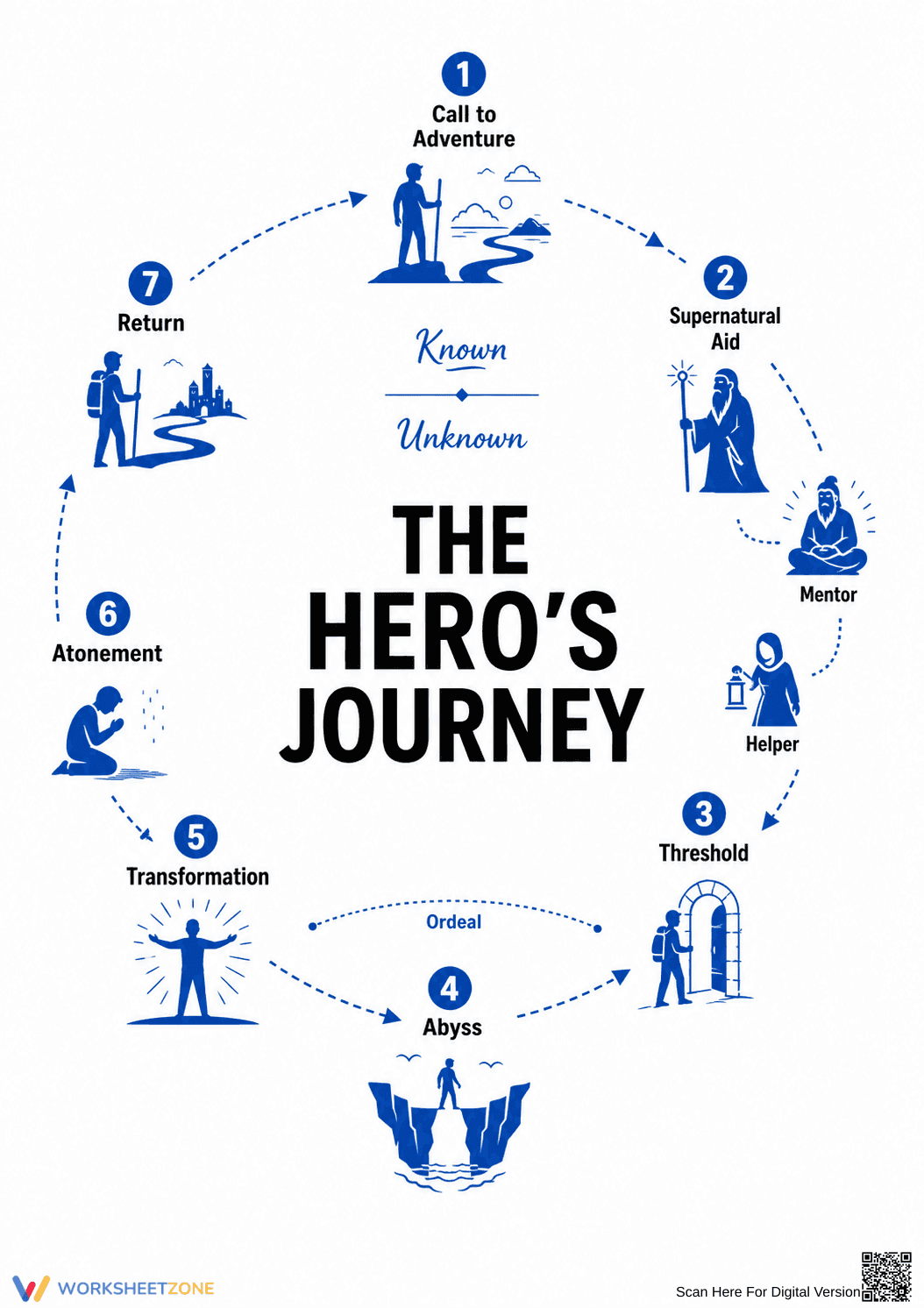
This visual reference chart introduces students to the archetypal narrative structure of the Hero's Journey. By mapping out the cyclical stages of a protagonist's quest, this resource helps learners analyze complex plots, track character development, and understand the universal patterns that shape classic and contemporary storytelling.
At a Glance
- Grade: 8 · Subject: English
- Standard:
CCSS.ELA-LITERACY.RL.8.3— Analyze how incidents in a story propel the action.- Skill Focus: Narrative Structure
- Format: 1 page · 0 problems · No answer key · PDF
- Best For: Anchor chart or reference
- Time: 5–10 minutes
This single-page PDF features a circular diagram detailing the Hero's Journey. It separates the "Known" and "Unknown" worlds while highlighting seven stages: Call to Adventure, Supernatural Aid, Threshold, Abyss, Transformation, Atonement, and Return. Archetypal figures like the Mentor are marked to support comprehension of character roles.
This resource requires zero teacher preparation:
- Print (1 minute): Simply print the single-page diagram or post it to your digital learning management system.
- Distribute (1 minute): Hand out copies to students as a reference guide before beginning a new novel or film study.
- Review (3 minutes): Briefly walk through the cycle, pointing out the transition from the known world to the unknown world.
With a total prep time of under two minutes, this chart is an excellent addition to any literature unit or emergency sub plan.
This resource is aligned to CCSS.ELA-LITERACY.RL.8.3: "Analyze how particular lines of dialogue or incidents in a story or drama propel the action, reveal aspects of a character, or provoke a decision." It also supports broader comprehension of text structure and thematic development. Both standard codes can be copied directly into lesson plans, IEP goals, or district curriculum mapping tools.
Introduce this diagram before reading a core text to give students a framework for predicting plot developments. During reading, students can annotate which chapters correspond to stages like the "Abyss." As a formative assessment observation tip, listen to discussions to ensure they can justify why a plot point qualifies as the "Threshold." Expect students to reference this chart continuously.
This reference tool is ideal for middle and high school English students, particularly those in Grade 8 literature or creative writing classes. The visual nature of the diagram provides excellent differentiation for visual learners and English Language Learners who benefit from seeing abstract narrative concepts mapped out spatially. Pair this chart with a classic short story or a popular film clip to demonstrate the cycle in action before asking students to apply it to more complex independent reading.
Understanding narrative archetypes is a critical component of advanced reading comprehension. Aligned with CCSS.ELA-LITERACY.RL.8.3, this resource helps students analyze how incidents in a story propel the action by providing a clear, visual framework of the Hero's Journey. According to Fisher & Frey (2014), utilizing visual anchors and graphic organizers significantly improves students' ability to track complex textual structures and retain abstract literary concepts. When learners can visually map a protagonist's progression from the known world through the abyss and back to atonement, they develop a deeper appreciation for authorial intent and character development. This foundational knowledge not only enhances their analytical reading skills but also strengthens their own creative writing abilities by giving them a proven structural blueprint to follow. By internalizing these universal patterns, students become more critical consumers of literature and media.


