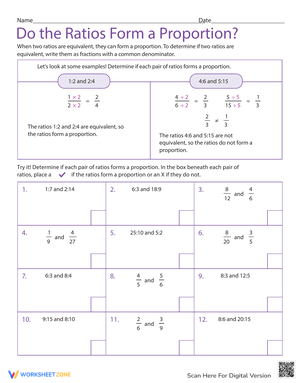
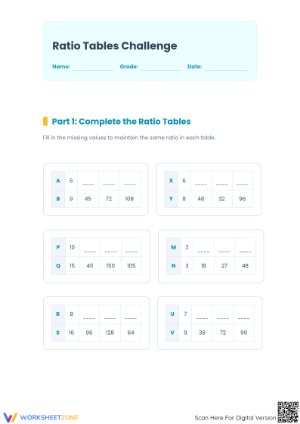
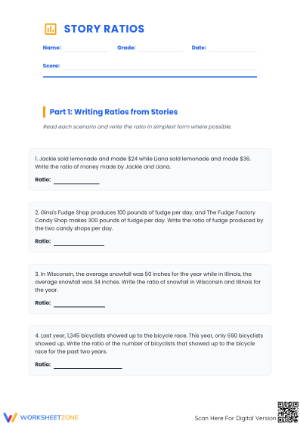
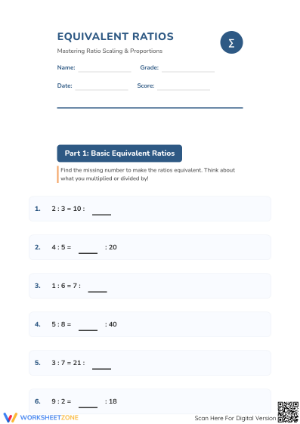
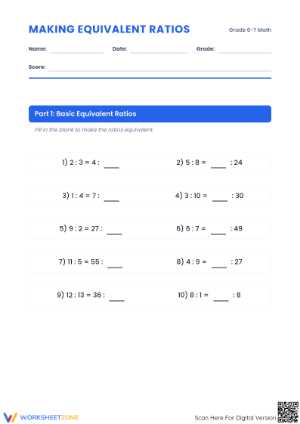
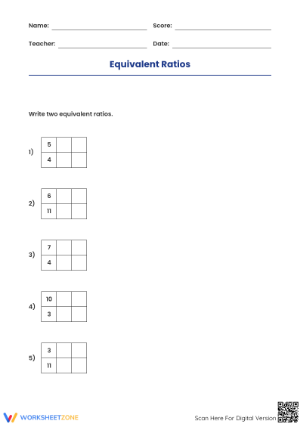
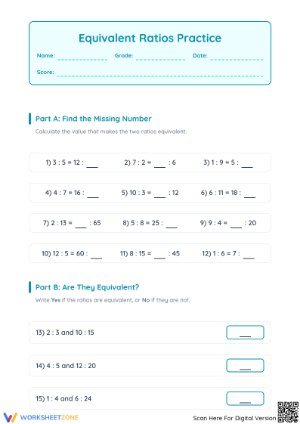
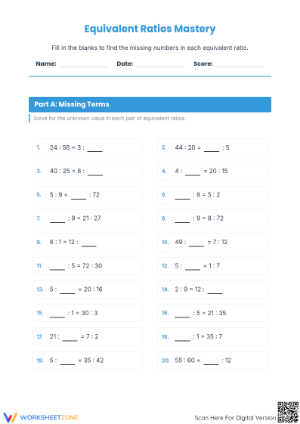
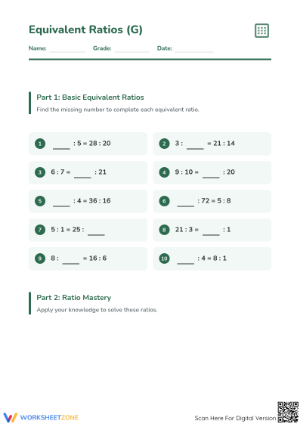
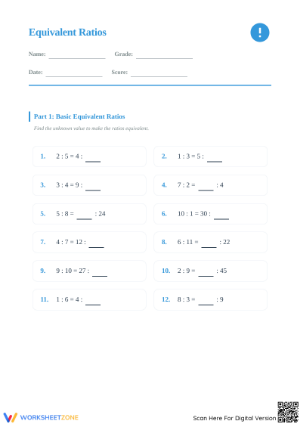
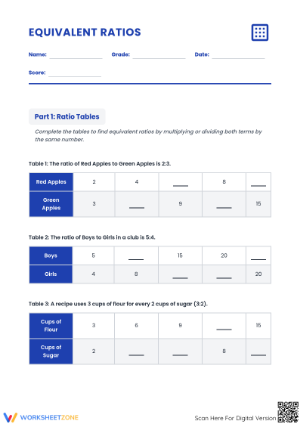
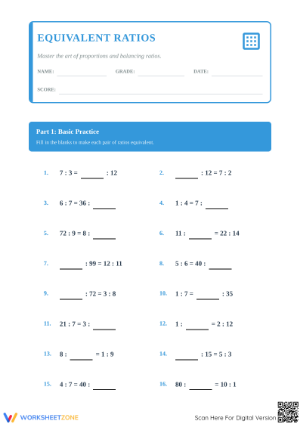
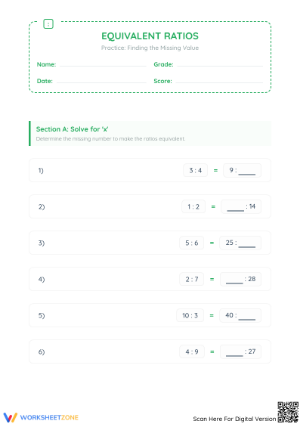
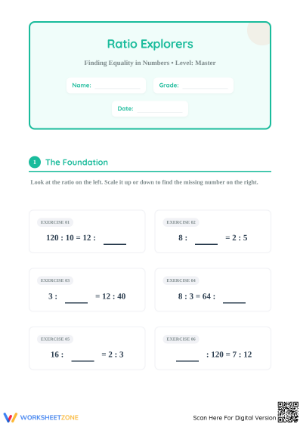
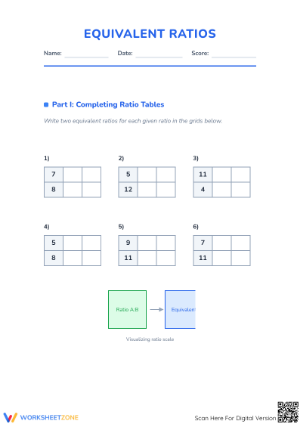
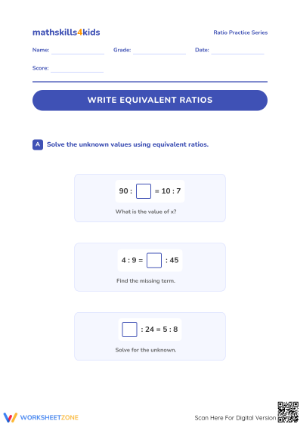
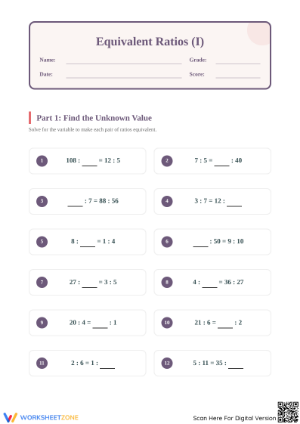
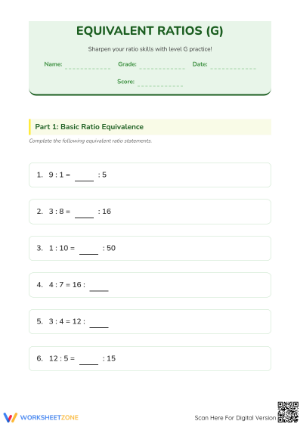
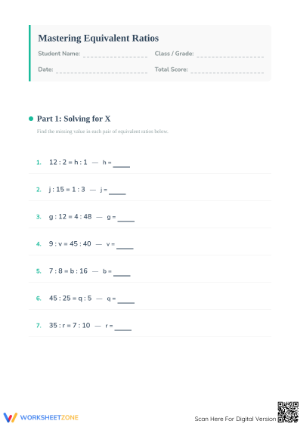
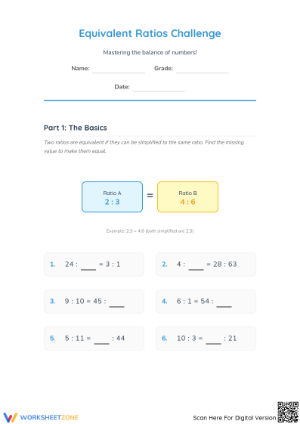
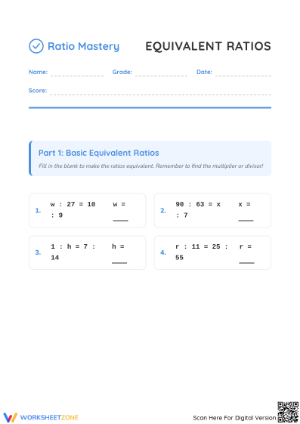
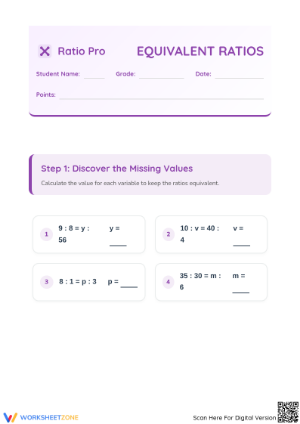
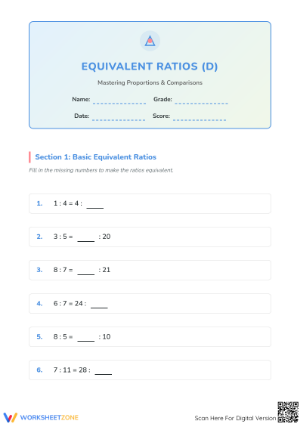
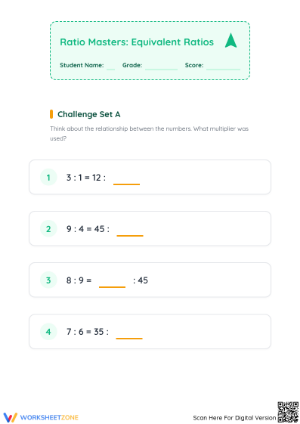
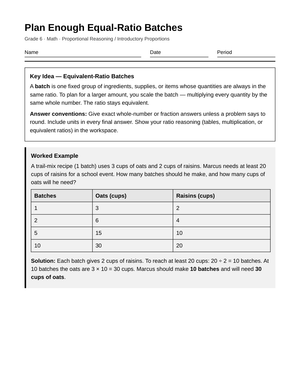
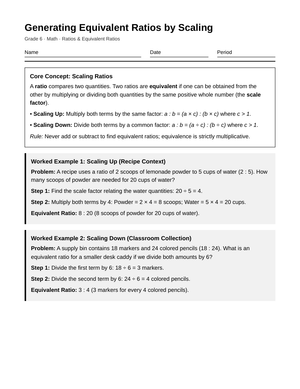
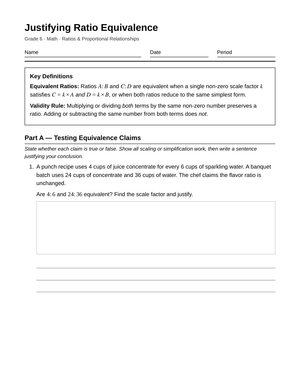
Ratios and Proportional Relationships shows up as a brand-new formal domain in sixth grade math, and it asks students to reason about relationships between quantities in ways that feel unfamiliar at first. Equivalent ratios worksheets give teachers a structured way to introduce that reasoning before students are asked to apply it to real-world problems. Instead of jumping straight into abstract proportion equations, these worksheets let students build understanding through tables, diagrams, and repeated scaling practice tied directly to the worksheet linked above.
For a curriculum lead planning a six-week ratios unit, or a classroom teacher building out a single lesson, the goal is the same: give students multiple representations of the same relationship so equivalence stops feeling like a rule to memorize and starts feeling like something they can see and check themselves.
Aligning Equivalent Ratio Worksheets to CCSS 6.RP.A.3.a
CCSS 6.RP.A.3.a requires students to make tables of equivalent ratios relating whole-number quantities, find missing values in those tables, and plot the resulting pairs on the coordinate plane. That single standard packs in three distinct skills, which is exactly why a worksheet sequence works better than a single practice sheet. Start students with tables that are mostly filled in, move to tables with several missing values, and finish with a coordinate plane task that asks them to plot the pairs they just generated.
The broader standard, CCSS 6.RP.A.3, calls for using ratio and rate reasoning to solve real-world and mathematical problems through tables of equivalent ratios, tape diagrams, double number line diagrams, or equations. Worksheets that only test the table method leave students without a fallback strategy when a word problem does not lend itself neatly to a table. Rotating between representations across a worksheet set builds that flexibility.
One instructional pattern worth flagging for lesson planning: students who only practice equivalent ratios in table form tend to default to additive reasoning (adding the same number to both terms) instead of multiplicative reasoning (multiplying both terms by the same scale factor). Worksheets that pair a table task with a tape diagram task on the same page make the multiplicative relationship visually obvious, because the diagram forces students to show the scale factor rather than just filling in a blank.
Using Tape Diagrams and Double Number Lines as Visual Scaffolds
Tape diagrams and double number lines are two of the most reliable scaffolds for students who are not yet ready for symbolic ratio notation. A tape diagram breaks a ratio like 3 to 2 into three equal parts for one quantity and two equal parts for the other, letting students see the relationship as a proportion of lengths rather than a pair of numbers. Double number lines extend that same idea across a continuous scale, which works especially well for ratios involving rates, like miles per hour or cups of flour per batch of cookies.
When you are building a worksheet packet, sequence these visual models before introducing cross-multiplication as a verification shortcut. Students who see the visual reasoning first are far less likely to treat cross-multiplication as a magic trick, and far more likely to explain why it works when asked on a formative check.
Common Student Misconceptions and How Worksheets Can Target Them
Three misconceptions show up repeatedly in equivalent ratio work. First, students often confuse a ratio with a fraction and try to simplify 4 to 6 down to 2 to 3 without understanding that both forms describe the same relationship, not a smaller quantity. Second, students frequently apply additive reasoning, assuming that adding 2 to both terms of a ratio preserves equivalence the way it does for some fraction operations. Third, students sometimes struggle to recognize equivalent ratios written in different formats, such as a:b, a to b, and a/b, treating them as three separate skills instead of three notations for one idea.
Worksheets that explicitly mix notation formats within the same set of problems force students to practice translating between them, which surfaces the third misconception quickly. A single worksheet with one problem in each of the three notations, followed by a question asking whether all three represent the same ratio, is a fast way to check for this gap.
Classroom Implementation
For a 45-minute lesson block, a workable structure is: 10 minutes of guided practice with a ratio table on the board, 15 minutes of partner work using a tape diagram worksheet, 10 minutes of independent practice mixing notations, and a 5-question exit ticket. This sequence moves students from teacher-modeled reasoning to independent application within a single period, which fits most district pacing guides for this standard.
For small-group intervention blocks, pull students who missed the justification item on the exit ticket and spend 15 minutes rebuilding the tape diagram model with concrete manipulatives before returning to the worksheet notation. Students who can physically build the diagram before writing it tend to retain the reasoning longer than those who only see it drawn on paper.
Frequently Asked Questions
1. What grade level is best suited for equivalent ratios worksheets?
Equivalent ratios worksheets are built for Grade 6, since Ratios and Proportional Relationships is introduced as a formal domain starting in sixth grade under CCSS, ahead of the proportional reasoning work students take on in Grade 7.
2. How do equivalent ratio worksheets align with CCSS 6.RP.A.3.a?
CCSS 6.RP.A.3.a specifically requires students to make tables of equivalent ratios relating whole-number quantities, find missing values in those tables, and plot the resulting pairs on the coordinate plane, which is the core skill sequence most equivalent ratio worksheets are designed around.
3. What visual models help students understand equivalent ratios?
Ratio tables, tape diagrams, and double number line diagrams are the standard visual models, and CCSS 6.RP.A.3 explicitly calls for using these representations alongside equations to reason about real-world ratio and rate problems.
4. How can teachers use these worksheets for small-group intervention?
Use scaffolded versions with pre-drawn tape diagrams and simpler whole numbers for intervention groups, then pair the worksheet with a short concrete manipulative activity for students who need to rebuild the visual model before working independently.
5. How do equivalent ratios connect to later proportional reasoning standards?
Equivalent ratios are the foundational skill for proportional relationships, since students who can fluently generate and verify equivalent ratios in Grade 6 are better prepared for the proportional reasoning and unit rate work that follows in Grade 7.












 Interactive Worksheet Maker
 Quiz Maker
 Word Search Maker
 Crossword Puzzle Maker
 Word Scramble Generator
 Sentence Scramble Generator
 Handwriting Worksheet Generator
 Name Tracing Generator
 Fill In The Blank Generator