


























Views
Downloads

Printable Equivalent Ratios Worksheet | Grade 6 Math
Paste this activity's link or code into your existing LMS (Google Classroom, Canvas, Teams, Schoology, Moodle, etc.).
Students can open and work on the activity right away, with no student login required.
You'll still be able to track student progress and results from your teacher account.
This comprehensive equivalent ratios worksheet provides students with targeted practice to master proportional relationships through five distinct instructional phases. By moving from concrete ratio tables to abstract patterns and real-world applications, learners develop a deep conceptual understanding of how to maintain ratio equality through multiplication and division. This resource ensures students can confidently identify and generate equivalent ratios in multiple formats.
At a Glance
- Grade: 6 · Subject: Math
- Standard:
6.RP.A.3— Use ratio and rate reasoning to solve real-world and mathematical problems- Skill Focus: Generating and identifying equivalent ratios
- Format: 3 pages · 31 problems · Answer key included · PDF
- Best For: Independent practice and formative assessment
- Time: 35–45 minutes
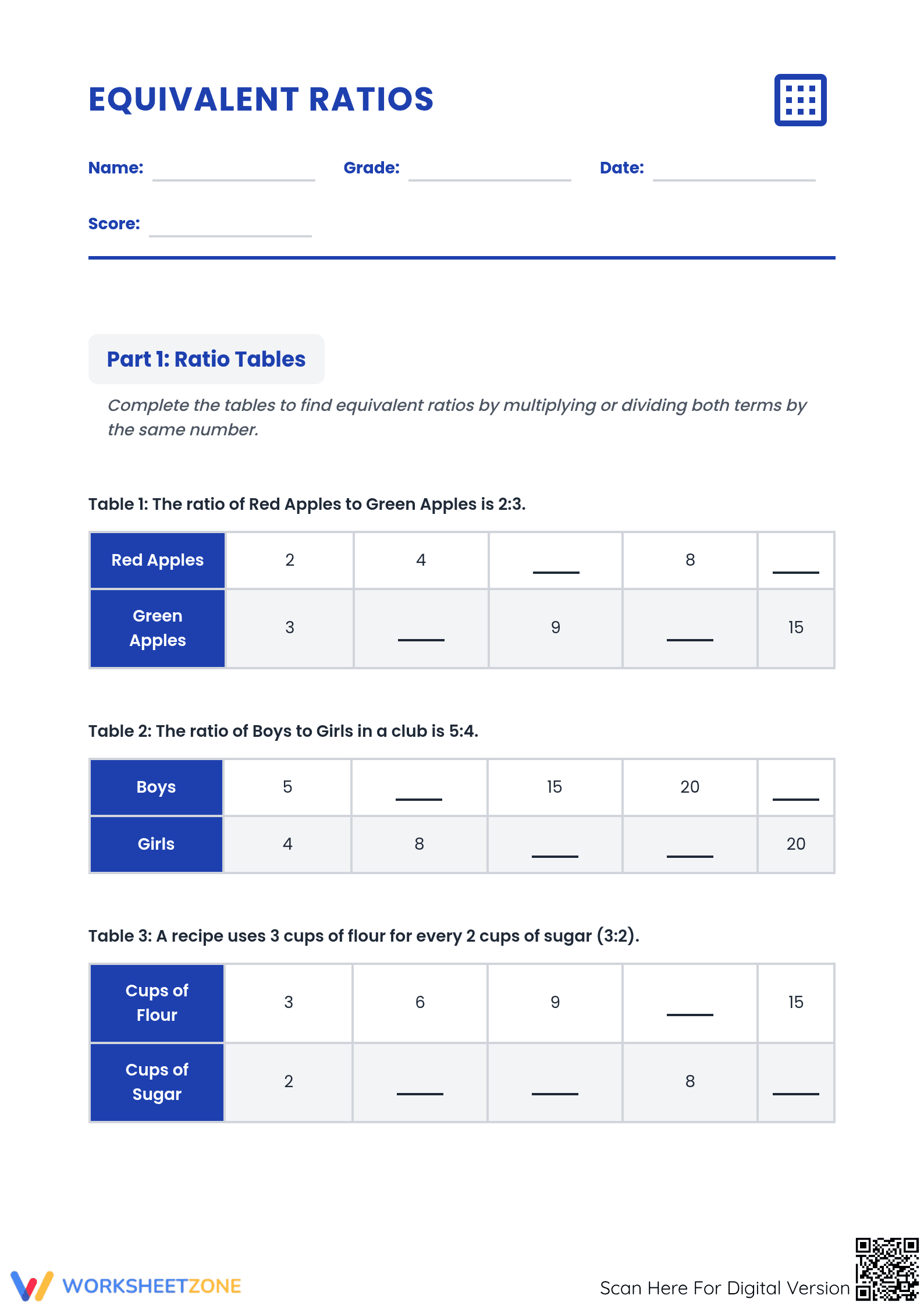
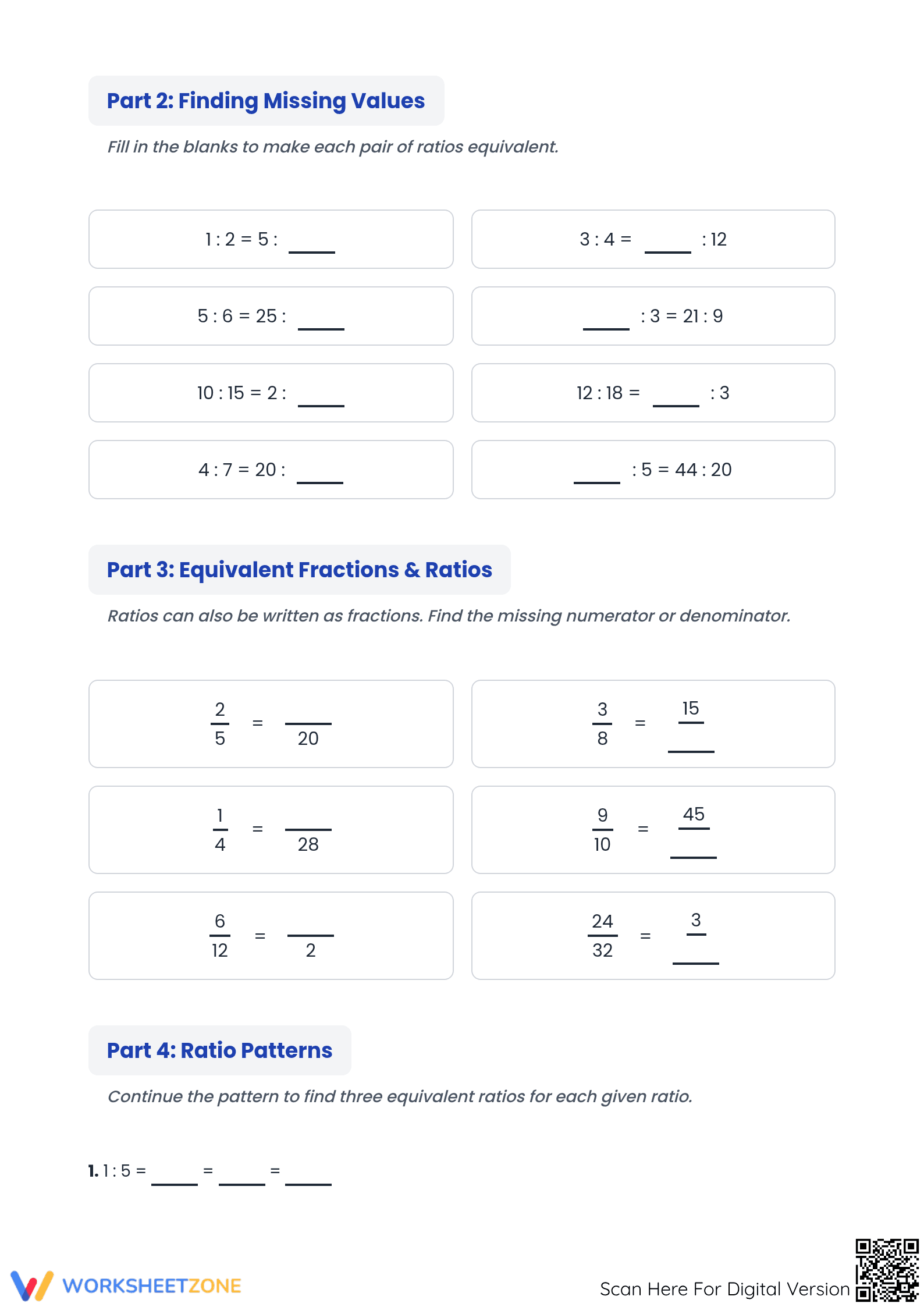
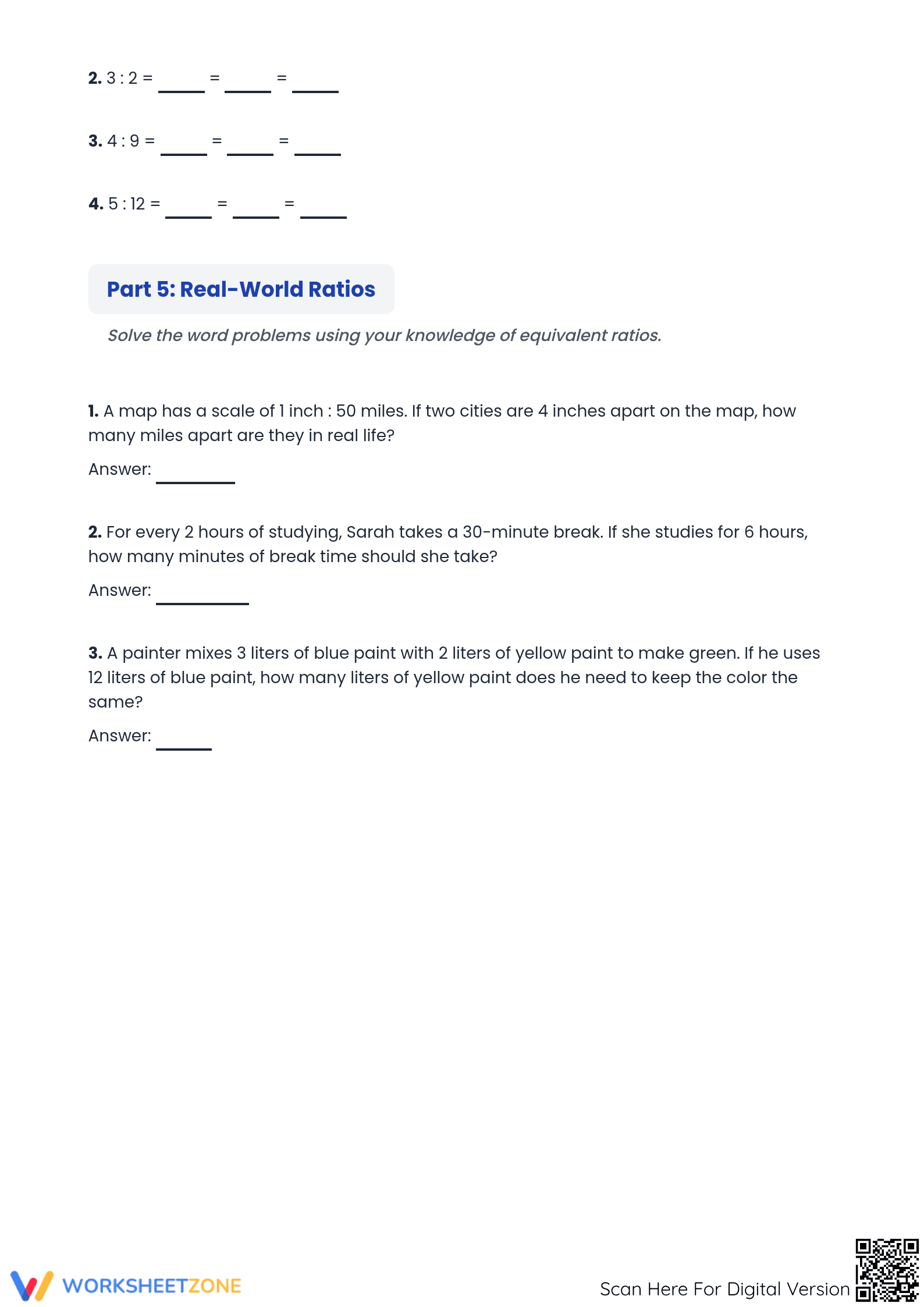
What's Inside: This three-page PDF features 31 structured problems divided into five parts. It includes three detailed ratio tables, eight missing value equations, six fraction-style ratio comparisons, four pattern-completion sequences, and three complex real-world word problems. A full answer key is provided to facilitate rapid grading and student self-correction.
Skill Progression
- Guided Practice: Part 1 uses three structured ratio tables (apples, students, and recipes) to provide a visual scaffold for multiplying and dividing terms.
- Supported Practice: Parts 2 and 3 transition to symbolic representation with 14 problems focused on finding missing values in ratio and fraction formats.
- Independent Practice: Parts 4 and 5 challenge students with 7 open-ended pattern and word problems requiring them to apply ratio logic to novel contexts.
This sequence follows a gradual-release model, moving from high-support visuals to independent application.
Standards Alignment
The primary focus is CCSS.MATH.CONTENT.6.RP.A.3: "Use ratio and rate reasoning to solve real-world and mathematical problems, e.g., by testing for equivalent ratios in a table or coordinate plane." It also supports 6.RP.A.3.A regarding making tables of equivalent ratios relating quantities with whole-number measurements. Both standard codes can be copied directly into lesson plans, IEP goals, or district curriculum mapping tools.
How to Use It
This worksheet is ideal for the "You Do" phase of a lesson on proportional reasoning. Assign it after direct instruction on ratio tables to reinforce the multiplicative identity. For a formative assessment, review Part 5 (Word Problems) to identify students who can translate verbal scenarios into mathematical ratios. Expected completion time is approximately 40 minutes for most sixth-grade learners.
Who It's For
While designed for Grade 6 general education classrooms, this resource is an excellent intervention tool for Grade 7 students requiring a refresher on proportions. It pairs naturally with an anchor chart demonstrating that ratios remain equivalent when both terms are multiplied by the same non-zero number.
According to research by Fisher & Frey (2014) on the gradual release of responsibility, students who engage in scaffolded practice—like the transition from tables to word problems seen here—show significantly higher retention of mathematical concepts. This worksheet addresses the core demand of CCSS.MATH.CONTENT.6.RP.A.3 by requiring students to demonstrate ratio equivalence across multiple representations including colon notation, fractional forms, and tabular data. The inclusion of real-world scenarios, such as map scales and mixing paint, aligns with NAEP recommendations for increasing mathematical literacy through contextual application. By solving these 31 targeted problems, students move beyond rote calculation to develop a functional understanding of scale and proportionality. This resource provides the rigorous practice necessary for students to achieve mastery in middle school algebraic thinking.


