


























Views
Downloads

Essential Equivalent Ratios Worksheet | Grade 6-7 Math
Paste this activity's link or code into your existing LMS (Google Classroom, Canvas, Teams, Schoology, Moodle, etc.).
Students can open and work on the activity right away, with no student login required.
You'll still be able to track student progress and results from your teacher account.
Mastering equivalent ratios is a foundational milestone for middle school mathematicians. This comprehensive worksheet provides a structured path for students to recognize, calculate, and apply ratio relationships across various formats. By engaging with these scaffolded exercises, learners develop the proportional reasoning necessary for advanced algebra and real-world problem-solving outcomes.
At a Glance
- Grade: 6–7 · Subject: Math
- Standard:
6.RP.A.3— Use ratio reasoning to solve mathematical problems using tables and equations- Skill Focus: Making Equivalent Ratios
- Format: 3 pages · 26 problems · Answer key included · PDF
- Best For: Independent practice and formative assessment
- Time: 30–45 minutes
What's Inside
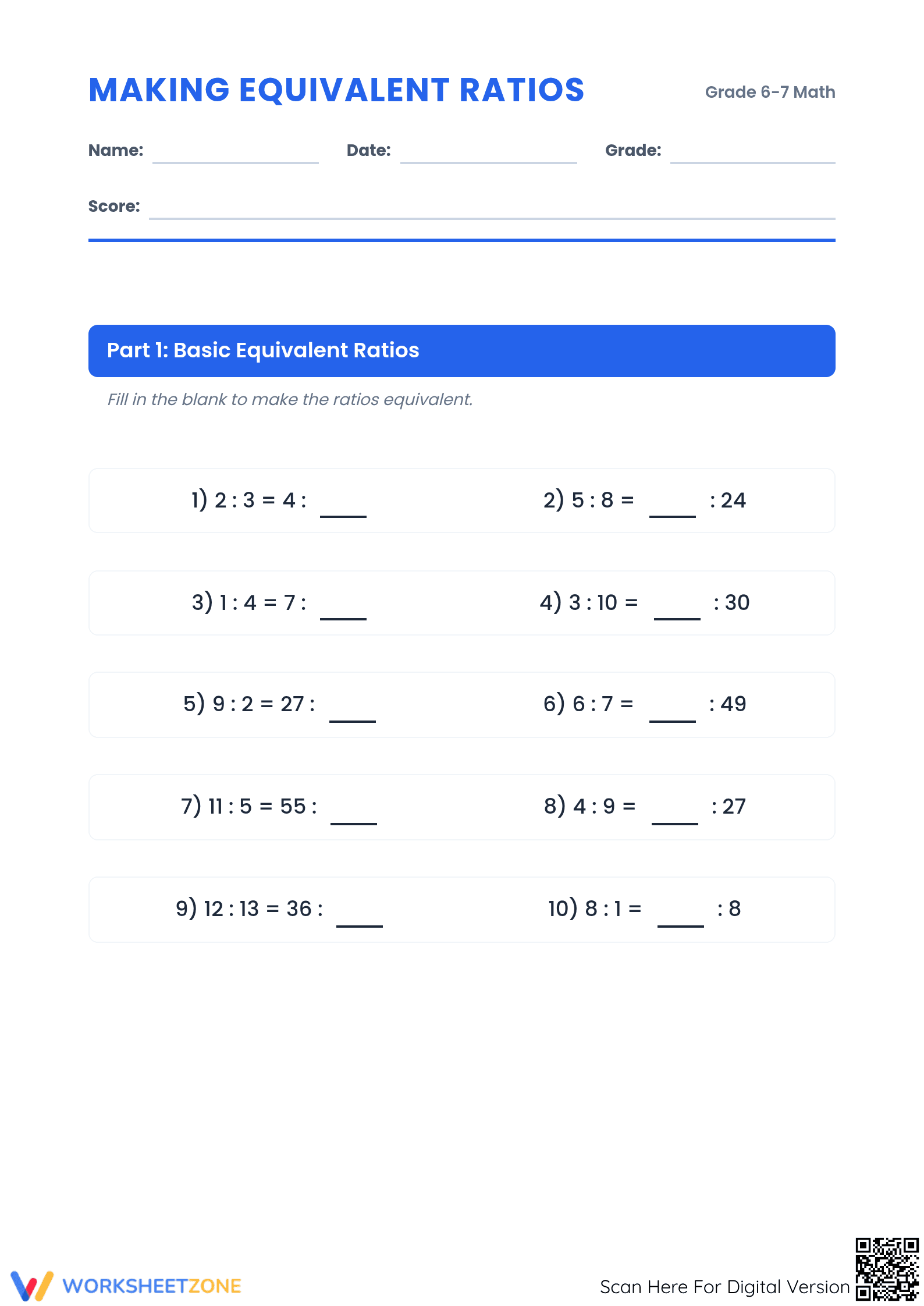
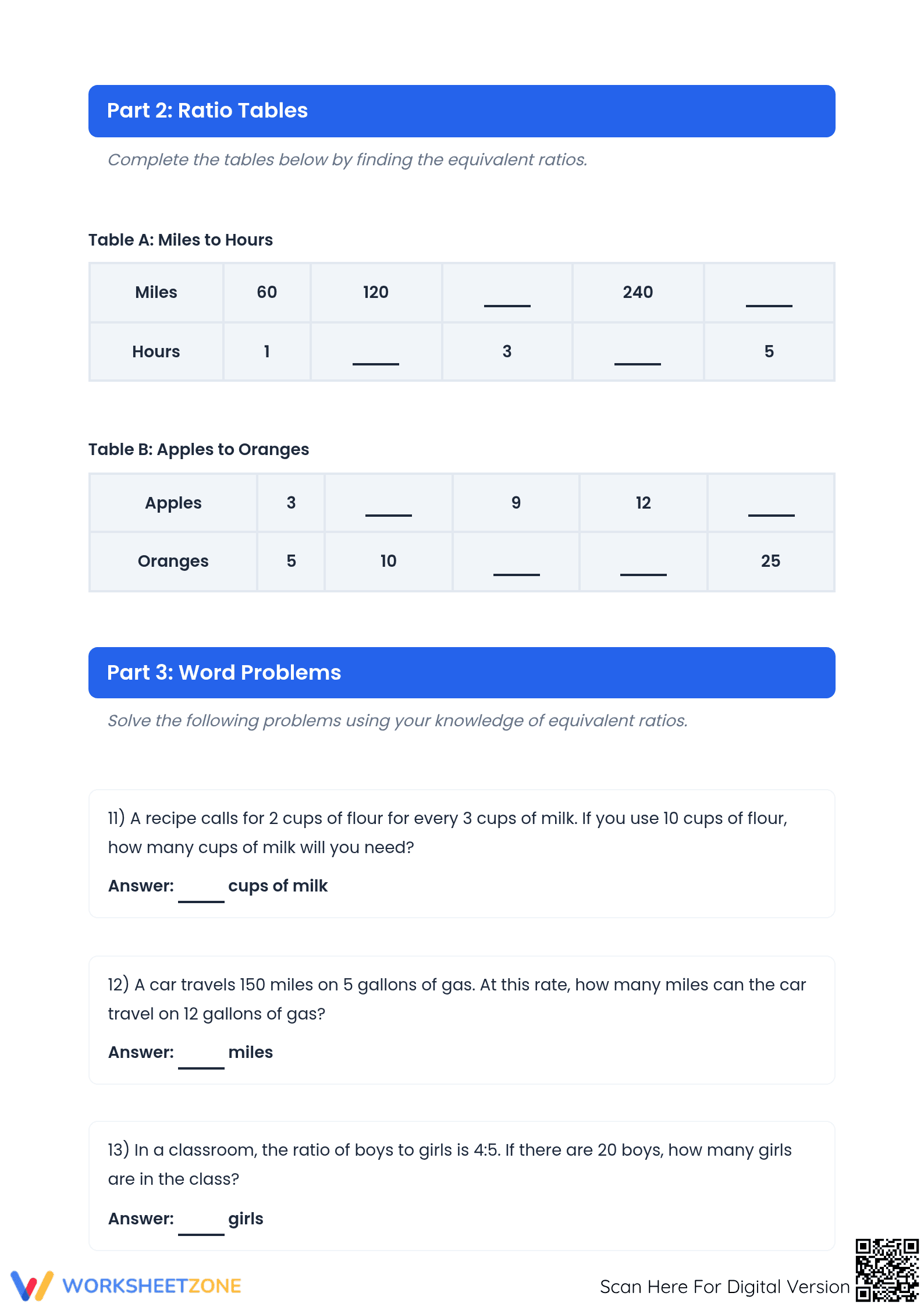
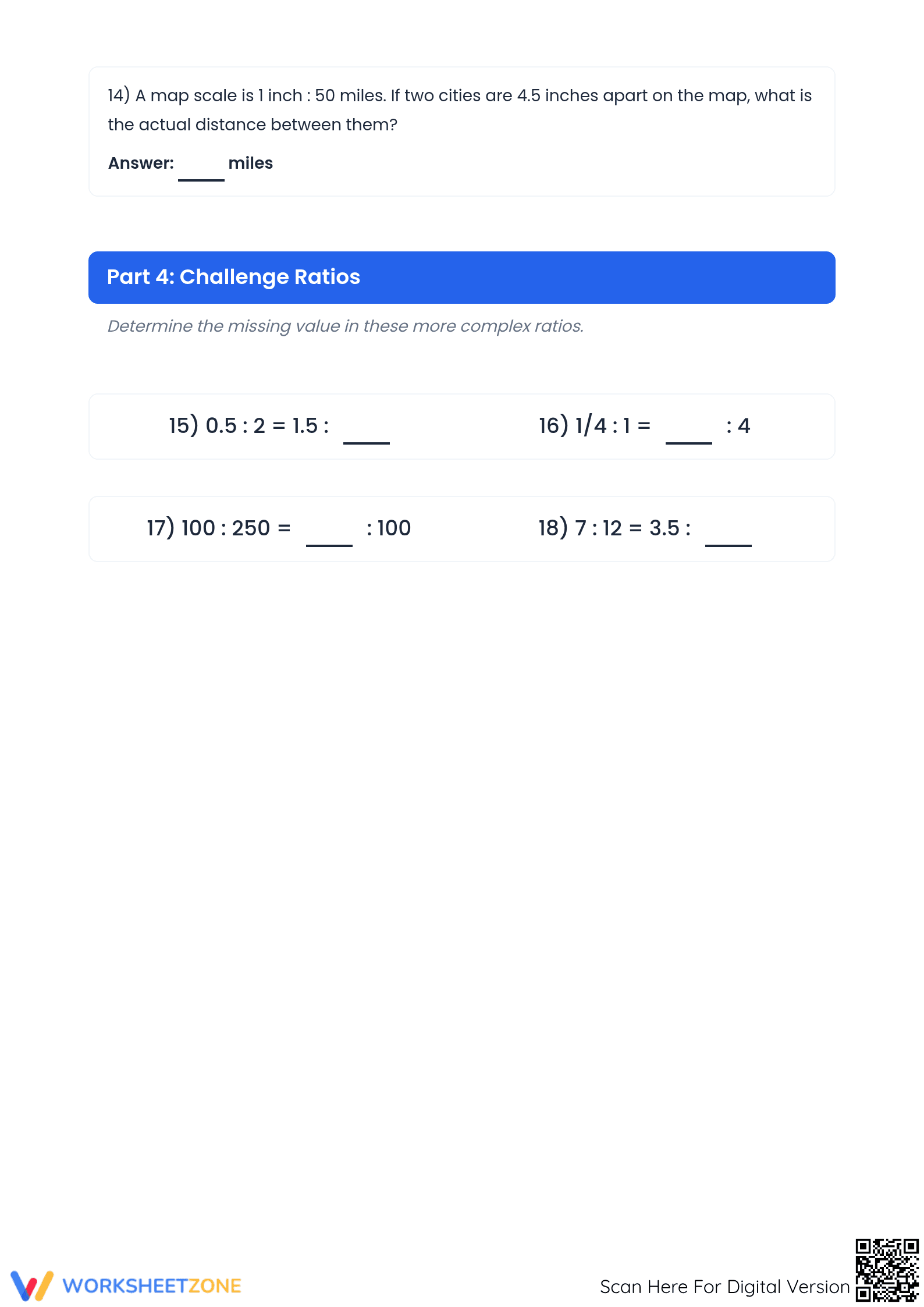
This three-page instructional packet contains 26 targeted problems designed to build mastery. It begins with ten basic ratio completion tasks, followed by two detailed ratio tables requiring students to find multiple missing values. The final pages introduce four contextual word problems and four challenge ratios involving decimals, ensuring a rigorous workout for all learners.
Skill Progression
- Guided Practice: Students complete ten initial problems by filling in missing terms to make ratios equivalent, establishing the core calculation logic.
- Supported Practice: Two ratio tables and four word problems transition learners to applying proportional reasoning within structured data and narrative contexts.
- Independent Practice: The challenge section requires students to solve complex ratios featuring decimals and fractions, testing the limits of their fluency.
This sequence follows a gradual-release model, moving from I Do/We Do to independent student mastery.
Standards Alignment
The primary alignment is CCSS.MATH.CONTENT.6.RP.A.3, which requires students to use ratio reasoning to solve mathematical problems. Specifically, it addresses sub-standard 3a, focusing on making tables of equivalent ratios and finding missing values. This code can be copied directly into lesson plans, IEP goals, or district curriculum mapping tools to ensure standards-based instruction.
How to Use It
This worksheet is most effective during the independent practice phase of a proportions lesson. After introducing scaling methods, distribute the packet to check for understanding. For a formative assessment, observe students as they tackle the ratio tables; those struggling to identify the constant of proportionality may need a quick intervention with an anchor chart before the word problems. The expected completion time is 30 to 45 minutes.
Who It's For
This resource is tailored for sixth and seventh-grade students studying Ratios and Proportional Relationships. It is an excellent tool for general education classrooms, providing depth for advanced learners via the challenge section while remaining accessible for others. Pair this worksheet with a visual ratio passage or double-number-line for a complete, multi-sensory learning experience.
The RAND AIRS 2024 report on mathematics instructional materials emphasizes that integrating multiple representations—tables, equations, and word problems—is critical for deepening student understanding of proportional reasoning. This equivalent ratios worksheet exemplifies this high-leverage practice by requiring learners to navigate between abstract numerical patterns and concrete real-world applications. Research suggests that students who practice making equivalent ratios through structured tables, as seen in this 3-page packet, develop a more robust internal schema for 6.RP.A.3 standards compared to those using isolated drill methods. By providing 26 varied tasks that range from basic computation to complex challenge problems, the resource supports the Cognitive Rigor framework cited in recent mathematics education analysis. This ensures that Grade 6 and 7 students are not merely performing rote calculations but are actively constructing the mathematical fluency required for success in higher-level algebraic coursework.


