


























Views
Downloads

Printable Equivalent Ratio Worksheet | Grade 5 Essential
Paste this activity's link or code into your existing LMS (Google Classroom, Canvas, Teams, Schoology, Moodle, etc.).
Students can open and work on the activity right away, with no student login required.
You'll still be able to track student progress and results from your teacher account.
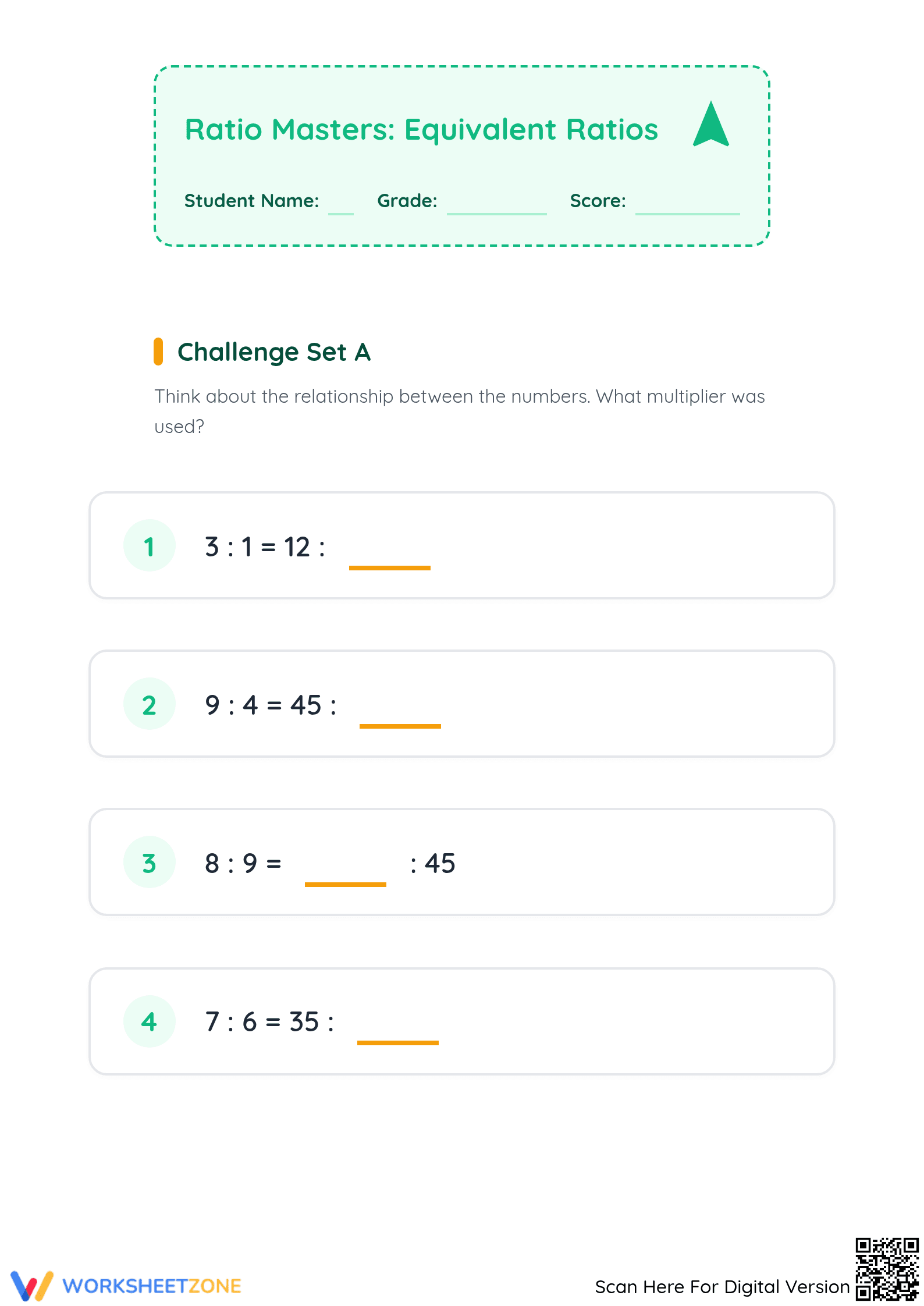
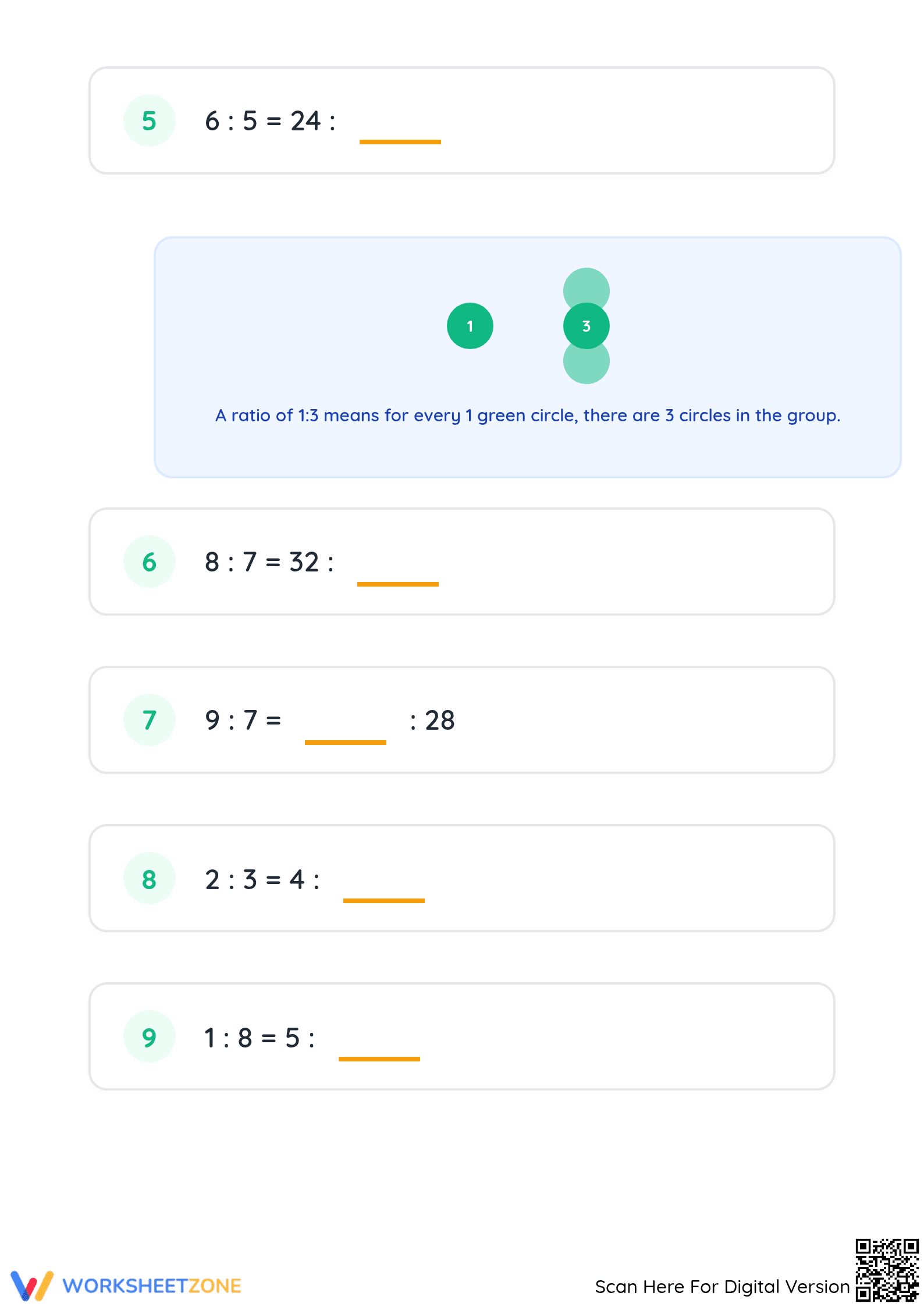
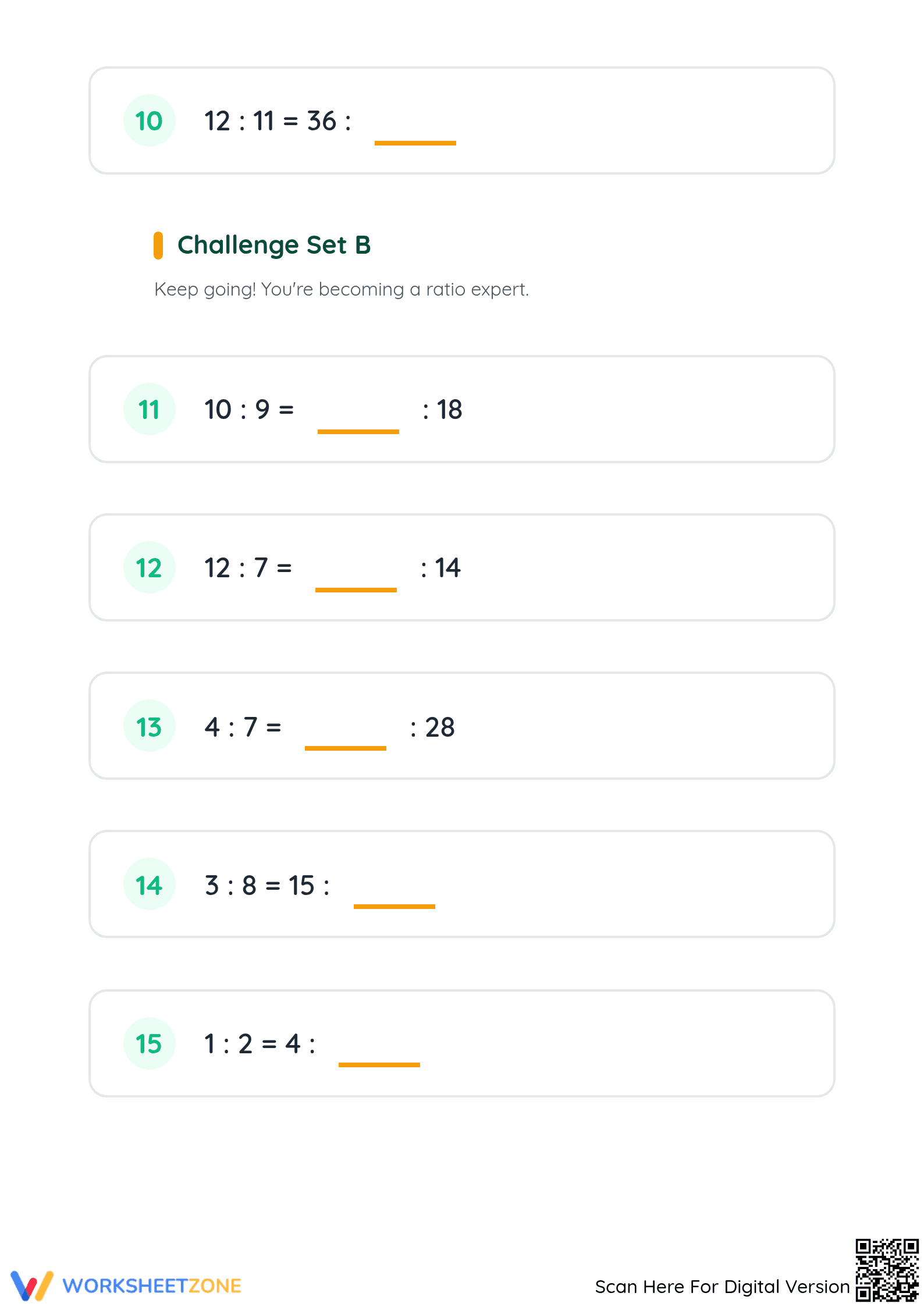
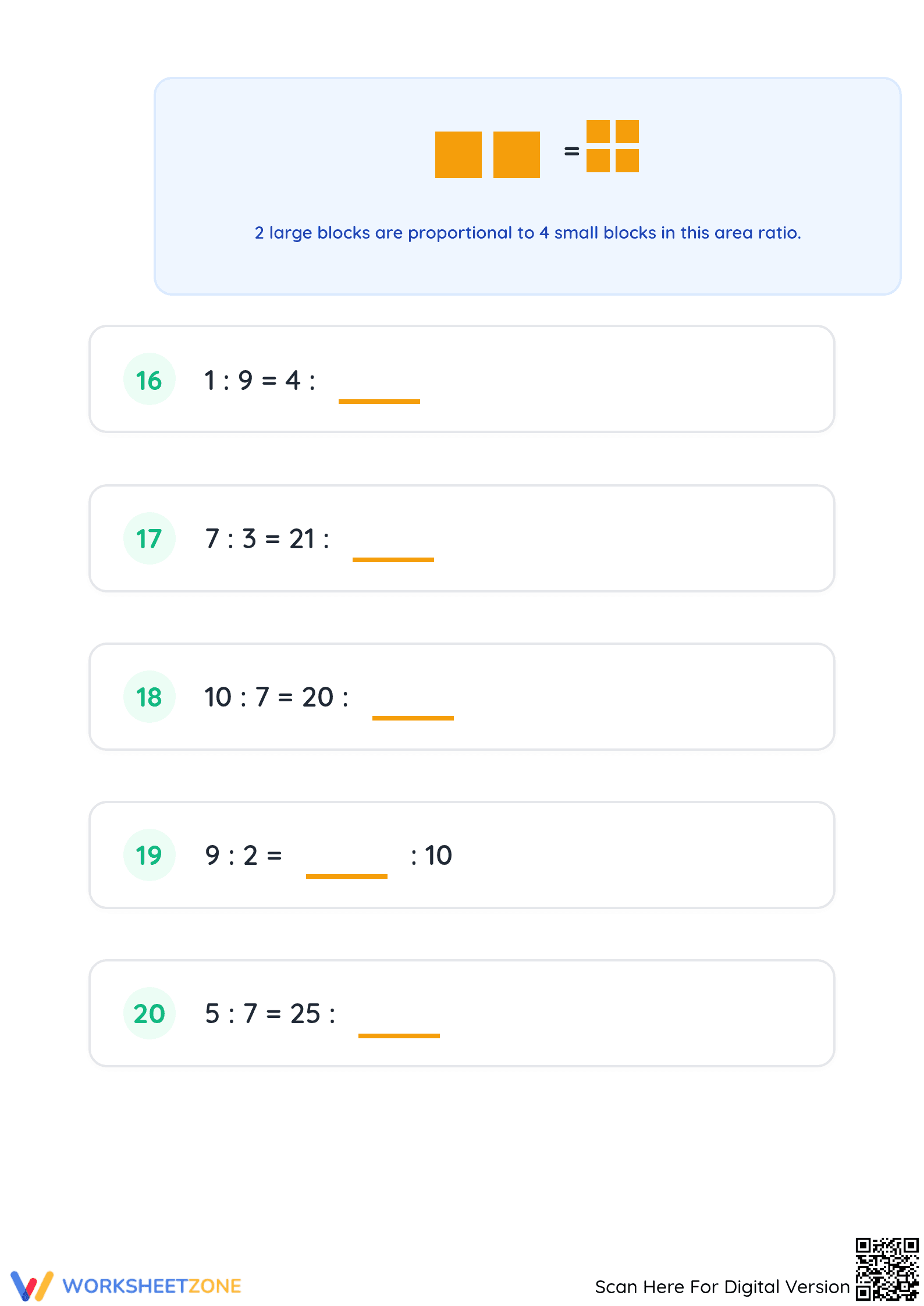
This comprehensive Grade 5 math worksheet focuses on the fundamental concept of equivalent ratios. Students will solve 25 problems requiring them to identify the missing number in a ratio pair. By applying multiplication and division strategies, learners develop a robust understanding of proportional relationships and numerical patterns necessary for higher-level algebra.
At a Glance
- Grade: 5 · Subject: Math
- Standard:
6.RP.A.3— Use ratio reasoning to solve real-world and mathematical problems- Skill Focus: Equivalent Ratios
- Format: 5 pages · 25 problems · Answer key included · PDF
- Best For: Small group instruction and independent practice
- Time: 25–35 minutes
What's Inside
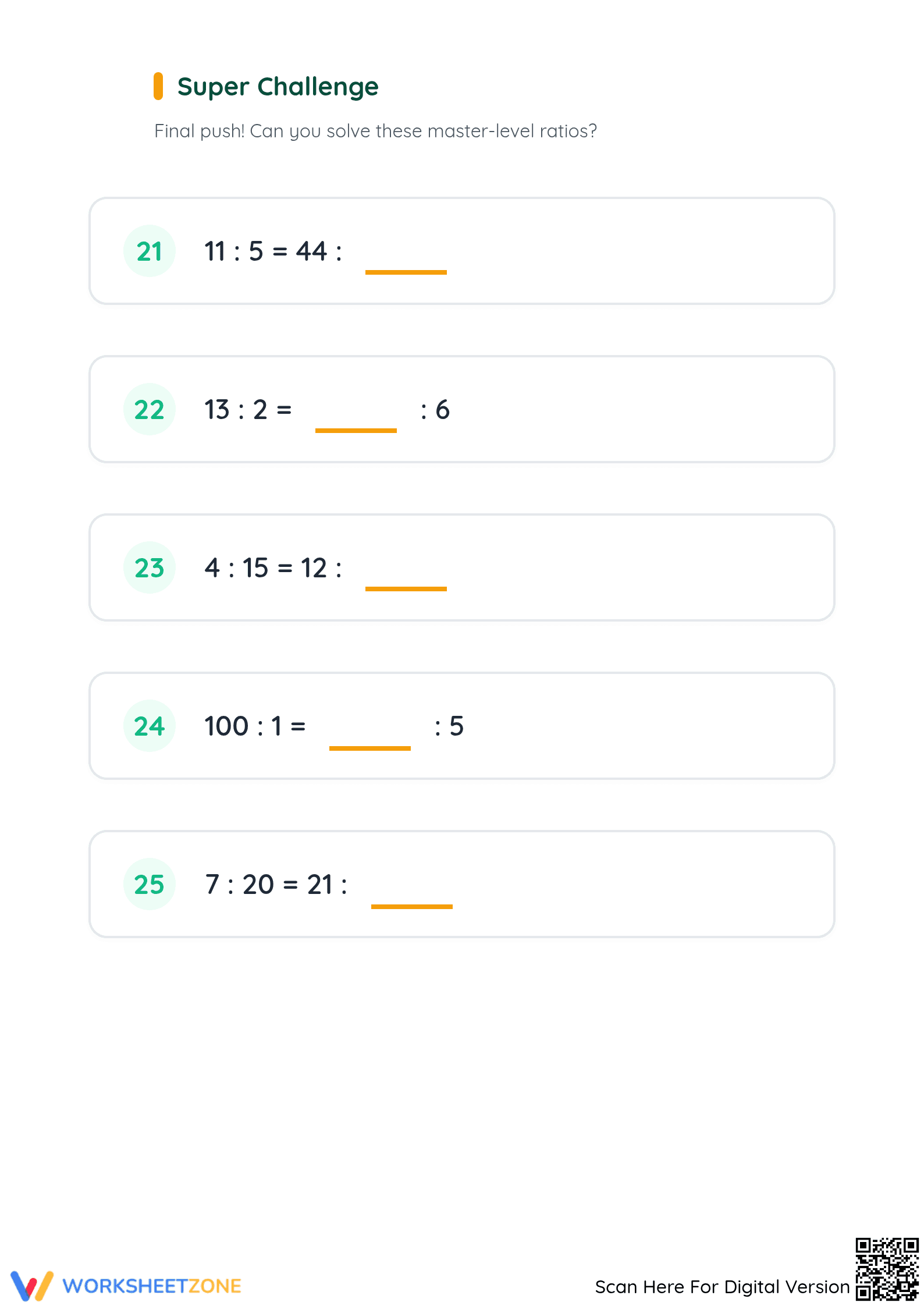
This five-page PDF collection features three distinct challenge sets designed to scaffold learning. Each page presents clear, spaced problems using the standard colon notation for ratios. The worksheet includes two helpful instructional boxes: one illustrating visual circles for a 1:3 ratio and another using proportional blocks to demonstrate area ratios. A complete five-page answer key provides immediate feedback and simplifies grading.
Skill Progression
- Guided Practice: Challenge Set A presents simple multipliers to build initial confidence across the first four problems.
- Supported Practice: Challenge Set B increases numerical complexity with 11 additional problems requiring deeper mental math.
- Independent Practice: The Super Challenge tests mastery with five advanced problems involving larger numbers and abstract comparisons.
This progression follows the gradual-release model, moving from scaffolded examples to independent mastery.
Standards Alignment
The primary focus is 6.RP.A.3: "Use ratio and rate reasoning to solve real-world and mathematical problems, e.g., by reasoning about tables of equivalent ratios, tape diagrams, double number line diagrams, or equations." While technically a middle school standard, these exercises directly support the development of equivalent fraction skills found in elementary standards. Standard codes can be copied directly into lesson plans or district curriculum mapping tools.
How to Use It
Use this resource during the independent practice phase of a lesson on proportional reasoning. For a formative assessment, observe students during Challenge Set A to ensure they correctly identify the multiplier before they proceed to more complex sets. This worksheet is ideal for morning work or as a structured homework assignment that takes approximately 30 minutes to complete.
Who It's For
This resource is designed for Grade 5 students ready for ratio concepts and Grade 6 students requiring remedial support. The visual aids make it accessible for English Language Learners and students with IEP goals focused on numerical patterns. It pairs naturally with direct instruction on fractions or a hands-on lesson using manipulatives like pattern blocks.
According to the RAND AIRS 2024 analysis, structured practice with proportional reasoning is a critical predictor of future success in algebraic coursework. This worksheet implements these findings by providing a high volume of targeted repetitions that transition students from concrete visual representations to abstract numerical manipulation. By isolating the variable of the "missing number" within an equivalent ratio, the material reduces cognitive load, allowing learners to focus exclusively on the relational properties of numbers. This approach aligns with the NAEP framework for mathematical complexity, ensuring that students do not just memorize procedures but understand the underlying multiplicative relationships. The inclusion of visual models and scaffolded challenge sets supports the gradual release model, facilitating a smooth transition from teacher-led modeling to independent mastery. This resource serves as an essential component for any curriculum aiming to bridge the gap between elementary arithmetic and middle school ratios.


