Where Trigonometric Ratios Fit in the Geometry Sequence
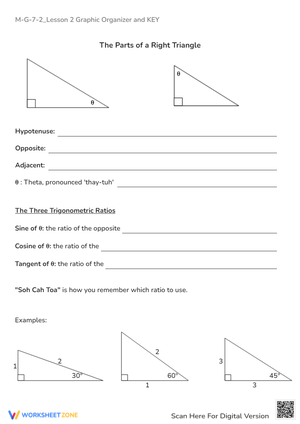
Right-triangle trigonometry usually lands in the middle of a high school geometry course, right after similarity, and it trips up more students than almost any other unit. Trigonometric ratios worksheets give teachers a structured way to move students from labeling triangle sides to computing sine, cosine, and tangent with confidence. Instead of front-loading theory, well-built practice sets let students see the pattern behind SOH-CAH-TOA before they ever touch an application problem.
For most US teachers, this topic shows up in grades 9-10, then resurfaces in Algebra 2 and Precalculus. A focused worksheet sequence at the geometry stage pays off later, because students who can reliably identify the opposite, adjacent, and hypotenuse relative to a reference angle are far readier for the Law of Sines and Law of Cosines down the line.
What a Strong SOH-CAH-TOA Worksheet Covers
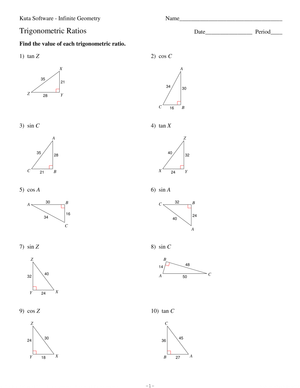
The three core ratios are simple to state and easy to confuse: sine equals opposite over hypotenuse, cosine equals adjacent over hypotenuse, and tangent equals opposite over adjacent. A quality trigonometric ratios worksheet isolates each of these steps so students build fluency in order rather than juggling everything at once.
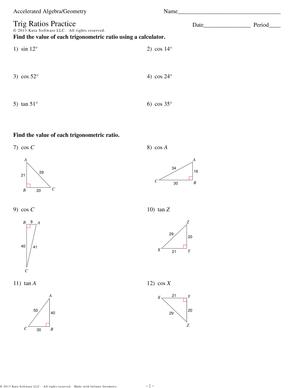
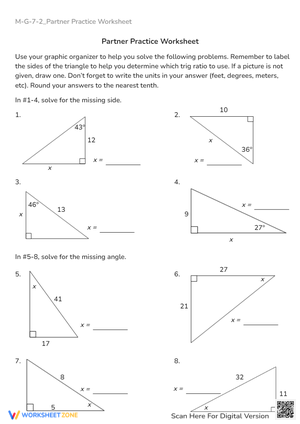
Look for practice sets that include side-labeling exercises, ratio-identification items, problems that solve for a missing side, and problems that solve for a missing angle using inverse trig. When all four skills appear in one packet, you can assign only the rows a given student needs and skip the rest.
- Label the opposite, adjacent, and hypotenuse for a marked reference angle.
- Write the correct ratio for a requested value.
- Solve for an unknown side length using a calculator.
- Use inverse sine, cosine, or tangent to find a missing angle.
Answer keys matter more than teachers expect here. Because a single labeling slip cascades into a wrong ratio and a wrong final answer, a worked key lets students trace exactly which step failed rather than just seeing a red mark. Self-checking pages turn a worksheet into a feedback loop instead of a grading chore.
Aligning Worksheets to Right-Triangle Standards
Trigonometric ratios are not a stand-alone topic; they sit inside the Similarity, Right Triangles, and Trigonometry cluster of the Common Core. Matching your worksheets to specific standards makes it easier to defend your pacing and to report progress to students and families.
According to the Common Core State Standards (HSG-SRT.C.8), students must use trigonometric ratios and the Pythagorean Theorem to solve right triangles in applied problems. That single standard connects all three ratios—sine, cosine, and tangent—and makes it the anchor for the entire right-triangle cluster taught across grades 9 and 10.
Two companion standards round out the unit: HSG-SRT.C.6 establishes that side ratios in right triangles are properties of the angles, and HSG-SRT.C.7 covers the relationship between the sine and cosine of complementary angles. A complete worksheet set should touch all three.
Classroom Implementation
Use these worksheets as a spine for a two-week unit rather than as one-off busywork. Open each class with a short side-labeling warm-up, then release students into the ratio-identification page while you pull a small group that struggled the day before. Because the pages are skill-isolated, your intervention group can work on labeling while the rest of the class solves for missing angles.
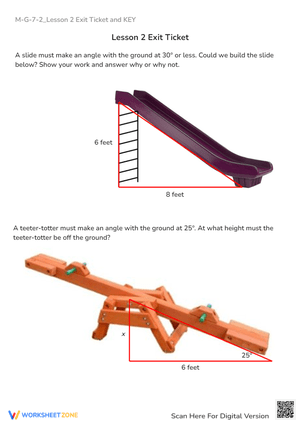
Exit tickets are a natural fit here. Pull two or three problems from the current worksheet and use them as a quick formative check before you move the class from solving sides to solving angles. If most of the room misses the inverse-trig item, that is your signal to reteach before assigning the next set.
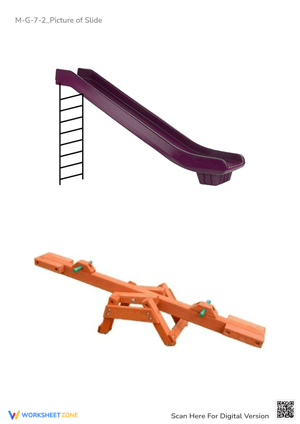
Pair the pure-practice pages with real-world right-triangle tasks—ramps, ladders leaning on walls, and angle of elevation or depression—so students see why the ratios matter. These application problems map directly to HSG-SRT.C.8 and give the unit a purpose beyond calculation.
Frequently Asked Questions
1. What grade level typically learns trigonometric ratios?
In the standard US sequence, right-triangle trigonometry appears in high school geometry, usually grades 9-10, and is revisited in Algebra 2 and Precalculus. Some accelerated tracks introduce it a year earlier.
2. How are these worksheets different from Law of Sines and Cosines worksheets?
Trigonometric ratios worksheets focus on right triangles and SOH-CAH-TOA. Law of Sines and Law of Cosines worksheets extend to non-right triangles and usually come later, in Algebra 2 or Precalculus, once the core ratios are solid.
3. How should teachers introduce SOH-CAH-TOA before assigning practice?
Introduce side labeling first, then connect each ratio to its acronym with a few worked examples. Once students can label opposite, adjacent, and hypotenuse for a marked angle, the worksheets reinforce the pattern through repetition.
4. Can these worksheets work for both intervention and enrichment?
Yes. Calculator-based, clearly labeled problems support intervention, while special right triangle and exact-value problems stretch advanced students. Because the skills are isolated, one worksheet set can be assigned selectively across readiness levels.













 Interactive Worksheet Maker
 Quiz Maker
 Word Search Maker
 Crossword Puzzle Maker
 Word Scramble Generator
 Sentence Scramble Generator
 Handwriting Worksheet Generator
 Name Tracing Generator
 Fill In The Blank Generator