


























Views
Downloads

Equivalent Ratio Worksheet: Grade 5 Essential Practice
Paste this activity's link or code into your existing LMS (Google Classroom, Canvas, Teams, Schoology, Moodle, etc.).
Students can open and work on the activity right away, with no student login required.
You'll still be able to track student progress and results from your teacher account.
Building proportional reasoning is essential for math success. This equivalent ratio missing number worksheet offers 31 problems to help students identify and apply ratio logic. Mastering these foundations prepares learners for advanced algebra and statistics.
At a Glance
- Grade: 4–5 · Subject: Math
- Standard:
6.RP.A.3— Use ratio and rate reasoning to solve real-world and mathematical problems through equivalent ratio identification- Skill Focus: Equivalent Ratio Identification
- Format: 5 pages · 31 problems · Answer key included · PDF
- Best For: Proportional reasoning reinforcement, skill building, homework, small group work, or classroom assessments
- Time: 40–50 minutes
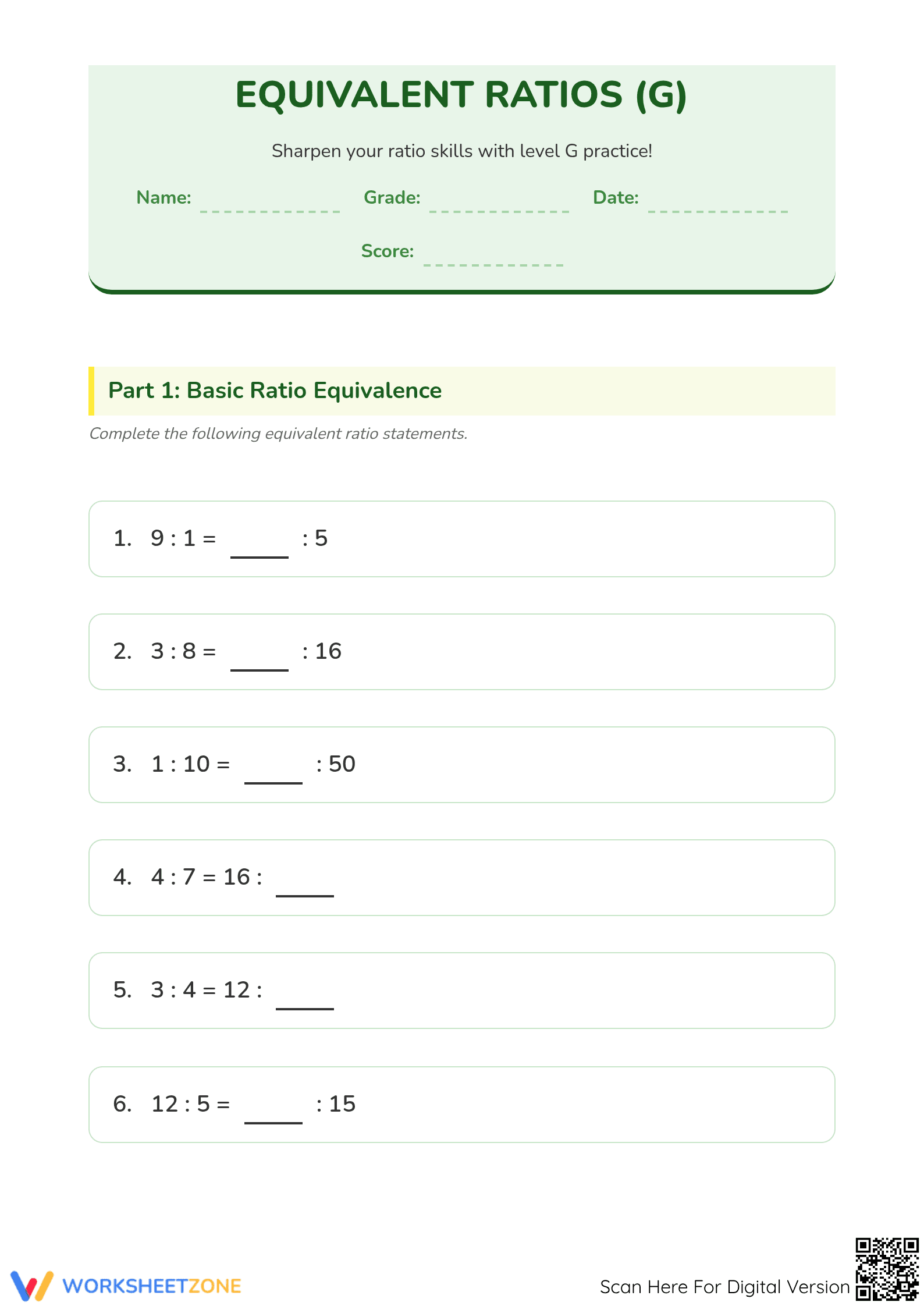
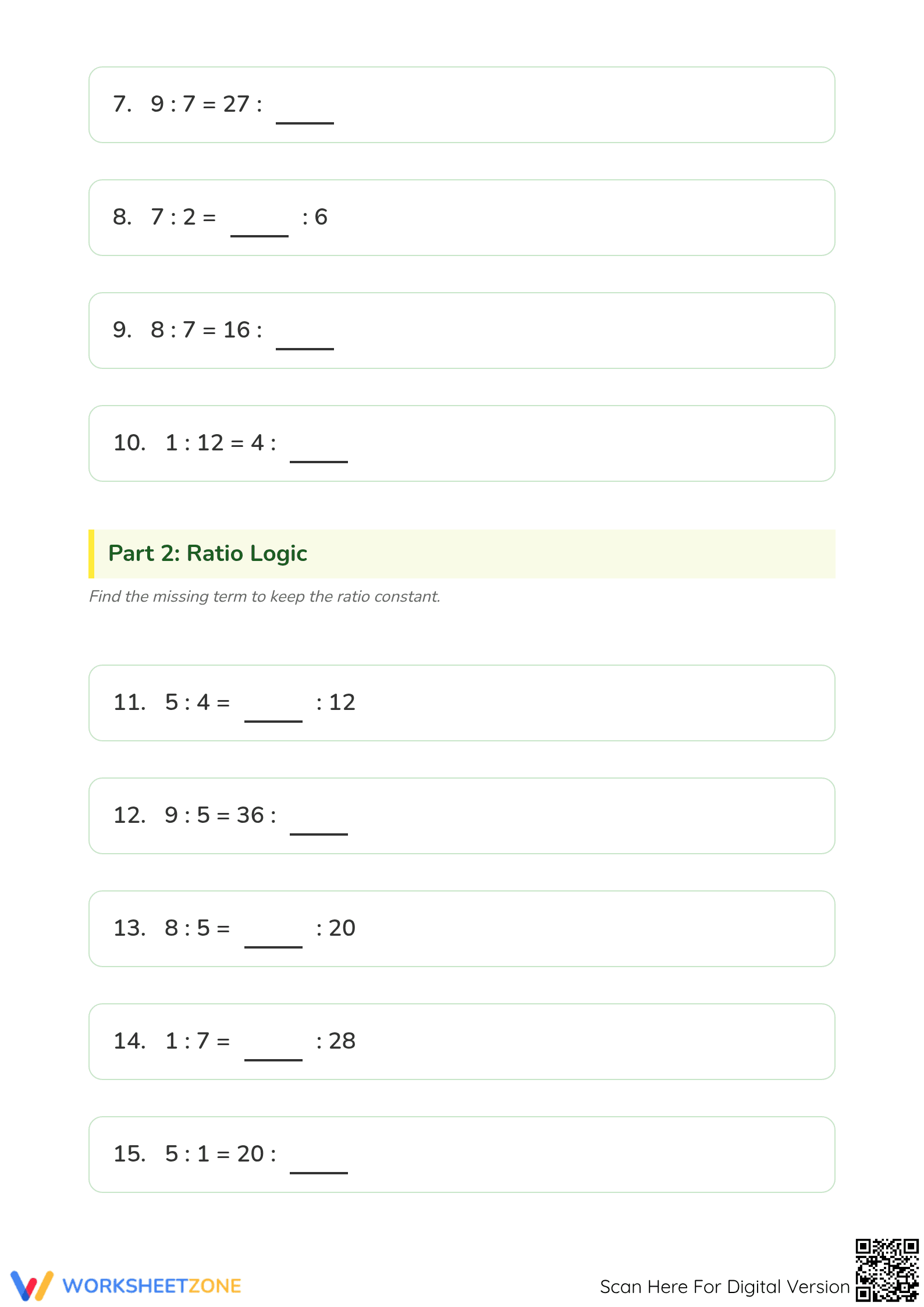
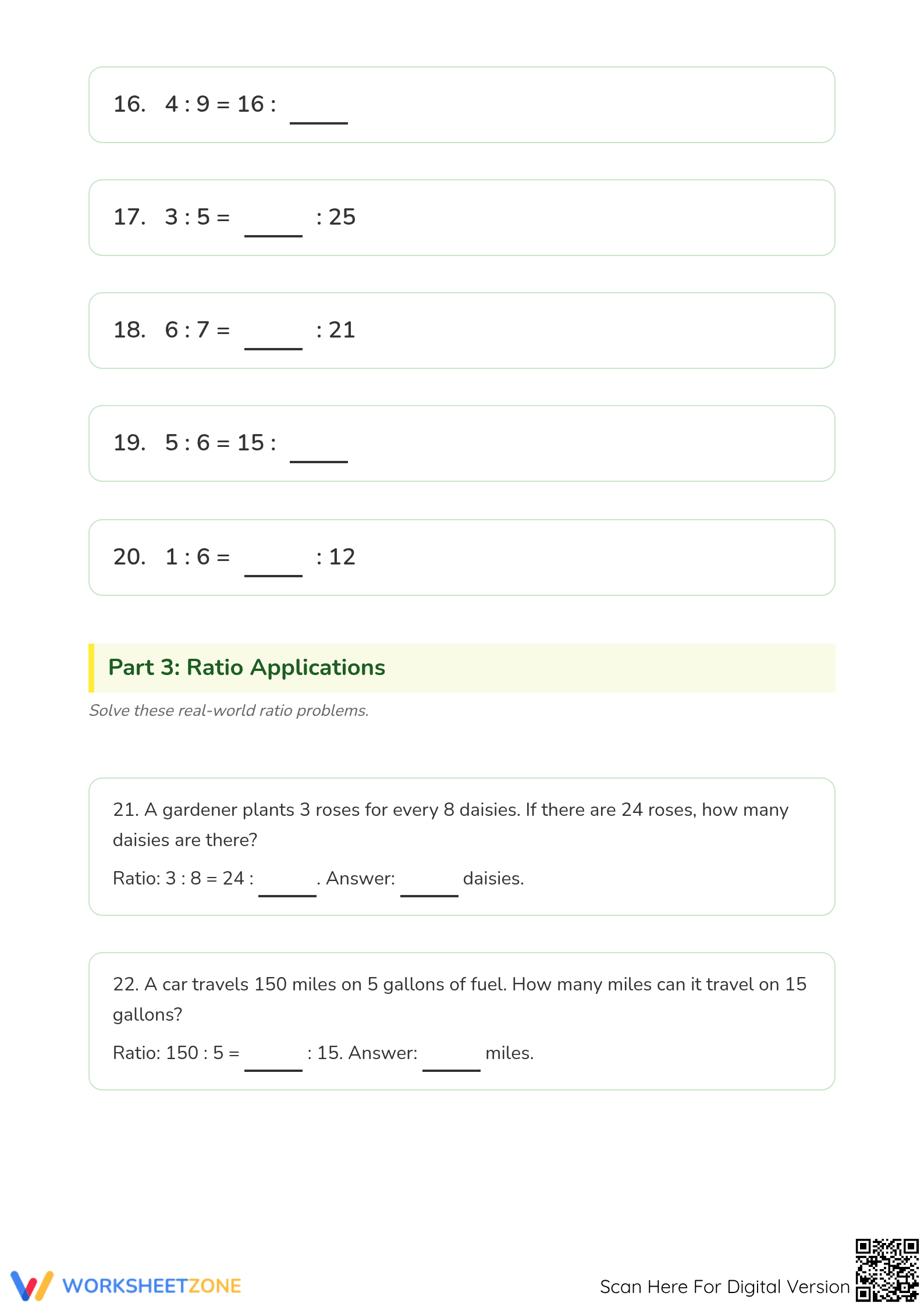
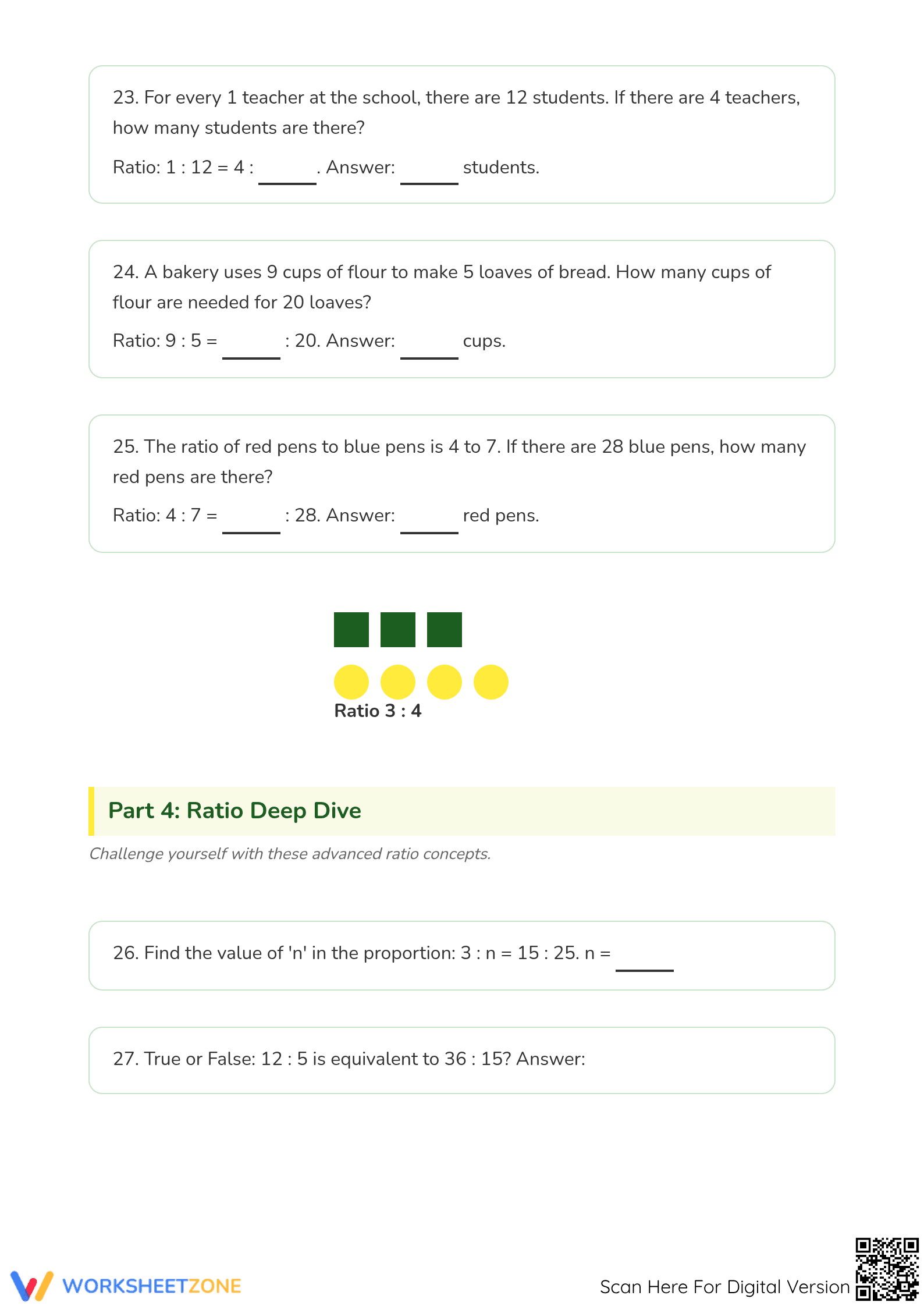
This five-page PDF features four sections moving from fluency to application. It contains 31 problems, including equivalence statements and real-world applications. Ample workspace and a complete answer key are provided for efficiency.
Skill Progression
- Guided Practice: Features 10 basic equivalence statements using multiplication or division to find missing terms.
- Supported Practice: Introduces 10 logic problems requiring students to maintain a constant ratio across slightly more complex pairings.
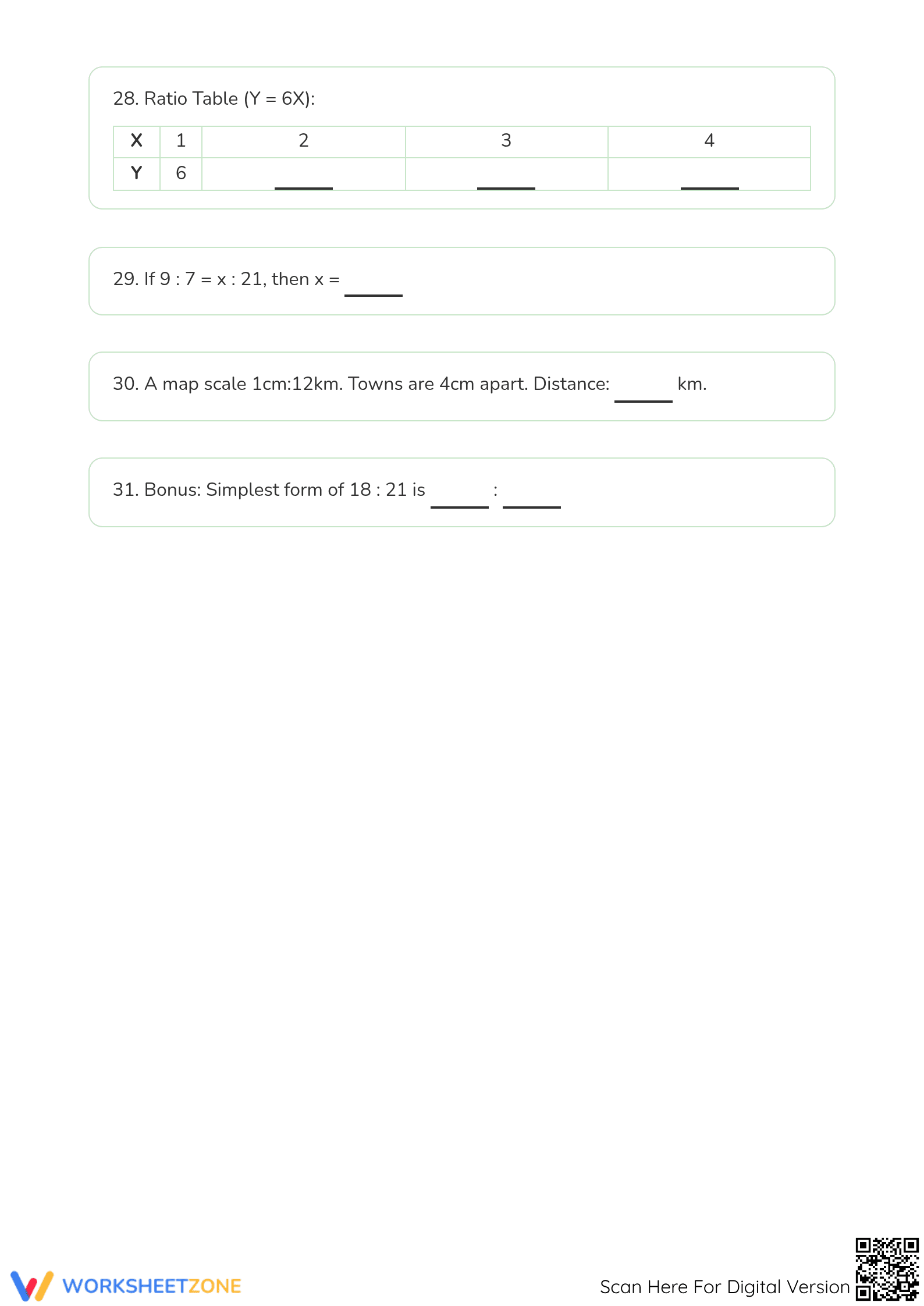
- Independent Practice: Offers 11 tasks including ratio tables, map scales, and deep-dive word problems that demand synthesis.
This structure ensures a smooth transition through the I Do, We Do, You Do instructional cycle.
Standards Alignment
The primary focus is 6.RP.A.3, which requires students to use ratio reasoning to solve mathematical problems. Tasks specifically target finding missing values in equivalent ratio sets. This standard code can be copied directly into lesson plans, IEP goals, or district curriculum mapping tools.
How to Use It
Use this for the "You Do" phase of a lesson. Page one works well for guided practice before students transition to independent sections. Monitor how students calculate scale factors for formative assessment. Total completion time is approximately 45 minutes.
Who It's For
Designed for Grade 4 and 5 students transitioning to ratio notation. Scaffolding supports struggling learners, while the "Deep Dive" section challenges advanced students. Pairs well with ratio anchor charts or direct instruction on scaling.
According to the RAND AIRS 2024 report on mathematics instructional materials, the ability to recognize and manipulate equivalent ratios is one of the strongest predictors of future success in secondary algebra. This worksheet leverages structured repetition and contextual variation to solidify this core competency. The 31 tasks included are specifically engineered to address common misconceptions regarding additive versus multiplicative thinking in proportions. By requiring students to solve for missing terms in both part-to-part and part-to-whole relationships, the resource ensures a robust mental model of proportionality. The alignment with `CCSS.MATH.CONTENT.6.RP.A.3` guarantees that the skill focus is developmentally appropriate for students transitioning into complex mathematical reasoning. Educators can rely on this material to provide the high-dosage practice necessary for long-term retention of ratio concepts. This standalone summary confirms the resource's validity as a high-quality tool for evidence-based math instruction in upper elementary classrooms.


