


























Views
Downloads

Essential Equivalent Ratios Worksheet | Grade 6 Math
Paste this activity's link or code into your existing LMS (Google Classroom, Canvas, Teams, Schoology, Moodle, etc.).
Students can open and work on the activity right away, with no student login required.
You'll still be able to track student progress and results from your teacher account.
Finding the missing value in an equivalent ratio is a critical skill for middle school mathematics. This comprehensive practice set provides students with structured opportunities to identify and calculate proportional relationships. By solving a variety of numerical and situational problems, learners build the fluency required for higher-level algebra and real-world mathematical applications.
At a Glance
- Grade: 6 · Subject: Math
- Standard:
6.RP.A.3— Use ratio and rate reasoning to solve real-world and mathematical problems- Skill Focus: Calculating missing numbers in equivalent ratio pairs
- Format: 4 pages · 34 problems · Answer key included · PDF
- Best For: Independent practice and proportional reasoning mastery
- Time: 30–45 minutes
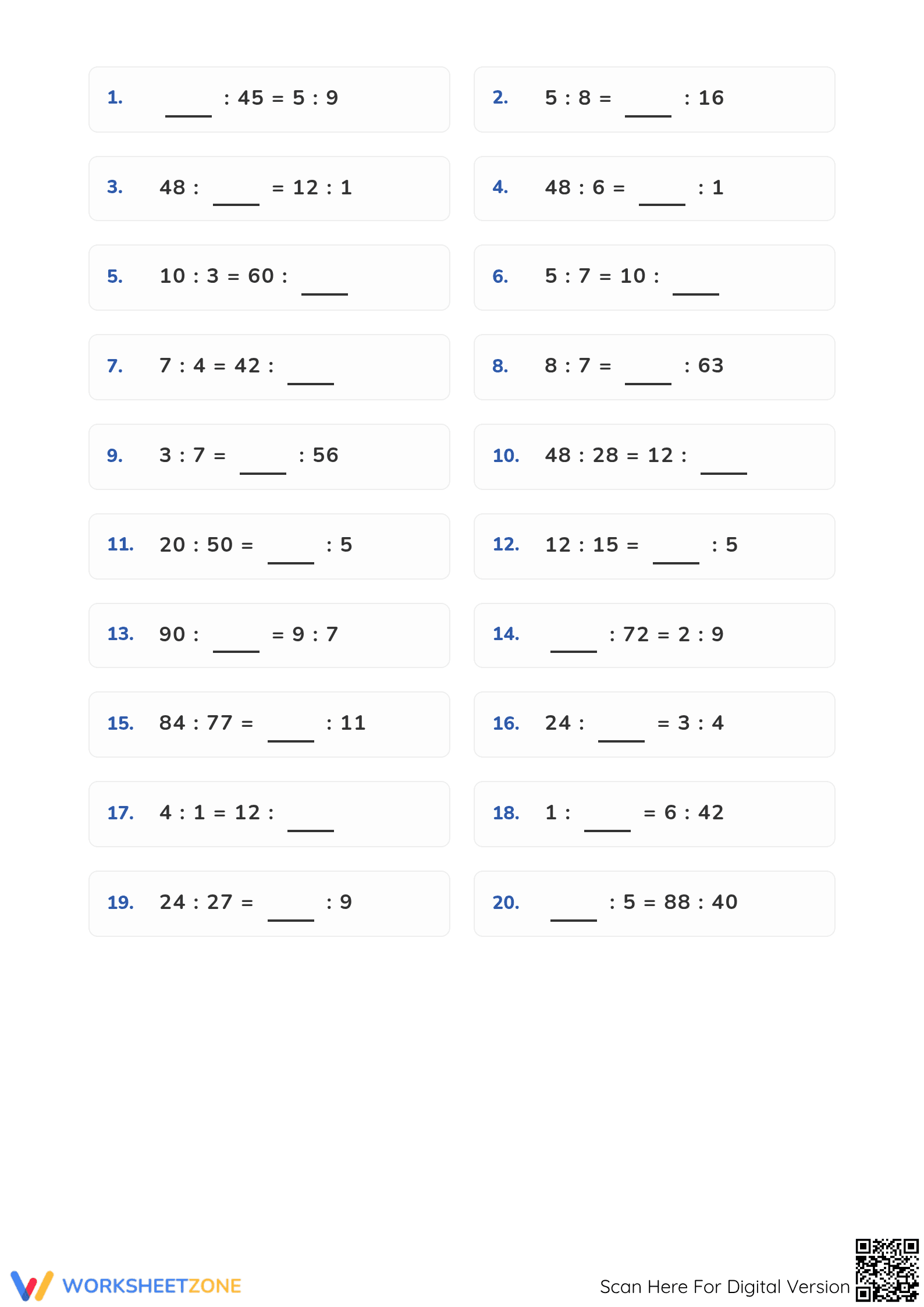
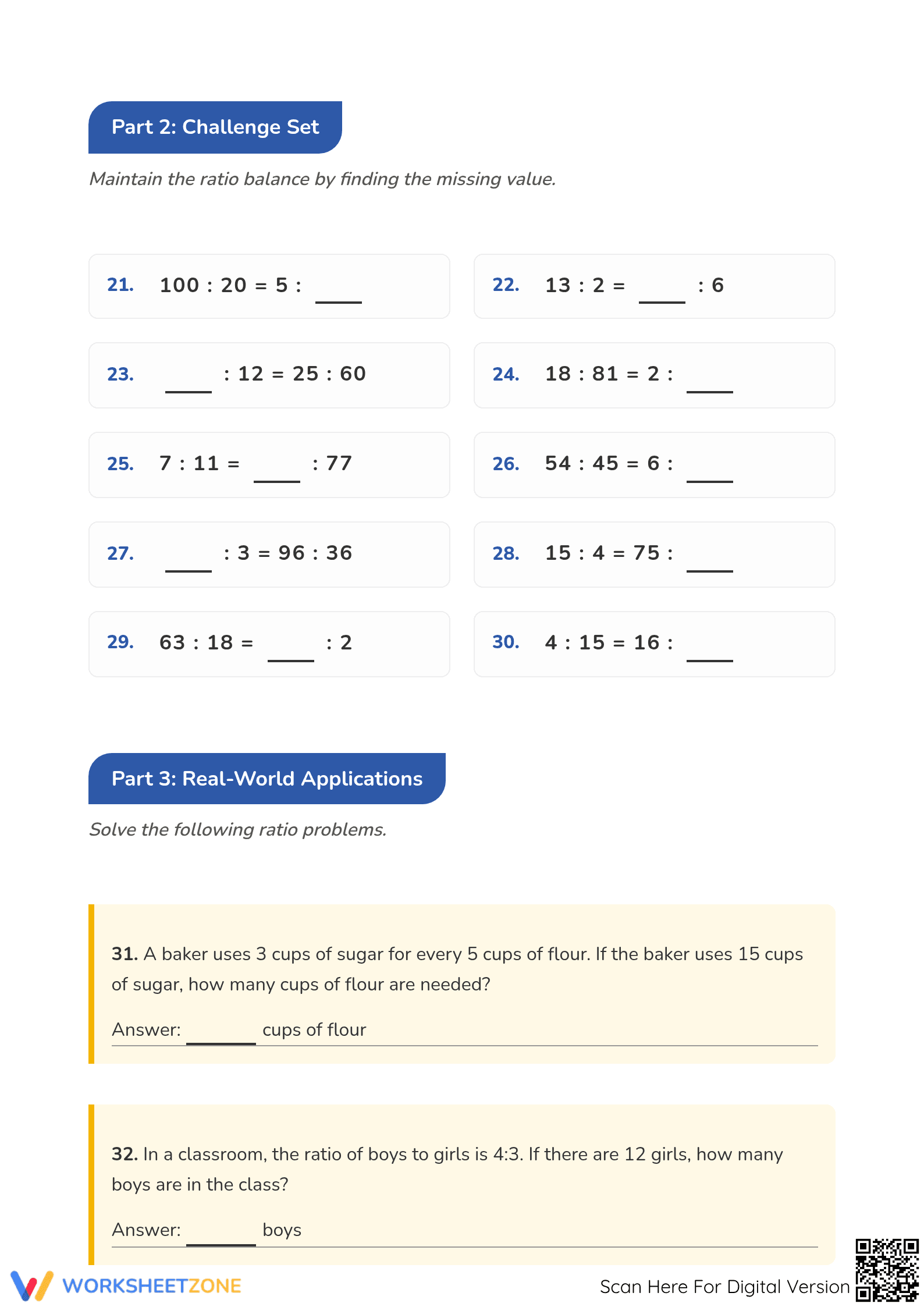
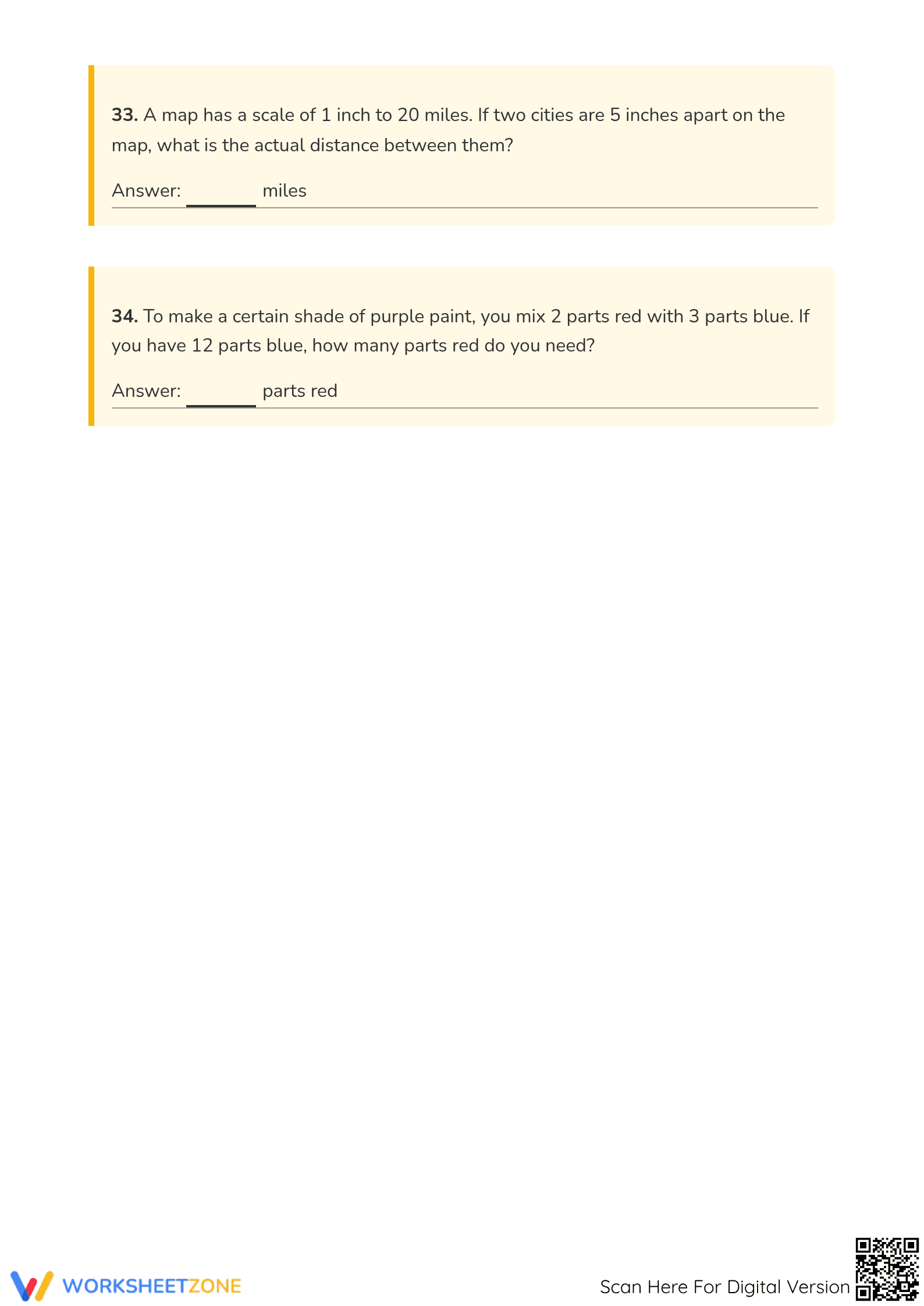
This four-page PDF includes a focused collection of exercises designed to solidify student understanding of ratio equivalence. The packet begins with a title page featuring space for student tracking and notes. It contains 34 unique tasks, starting with 20 direct practice drills that focus on numerical fluency. Following the drills, students encounter a ten-problem challenge set and four real-world word problems involving baking, classroom demographics, map scales, and color mixing.
- Guided Practice: The first 20 problems provide high-repetition drills where students solve basic equivalent ratios like __:45 = 5:9. These tasks establish the core mechanic of identifying the common multiplier across ratio terms.
- Supported Practice: Problems 21 through 30 constitute the challenge set, introducing larger numbers and more complex relationships. Students must maintain ratio balance while working through increasingly abstract numerical pairs.
- Independent Application: The final four tasks present situational word problems. Students must extract the initial ratio from text and apply their calculation skills to solve practical problems like determining ingredient amounts.
This gradual-release model ensures students move from procedural rote memory to conceptual application through a structured instructional framework.
The primary focus is `6.RP.A.3`, which requires students to use ratio and rate reasoning to solve mathematical problems. Exercises specifically target reasoning about equivalent ratios and finding missing values. Word problems also support mathematical literacy by requiring interpretation of quantitative text. Both standard codes can be copied directly into lesson plans.
This resource is ideal for independent practice after students learn ratio scaling. For formative assessment, observe student transition from numerical drills to word problems. Struggles with word problems may indicate a need for support in translating verbal descriptions. Expect completion within 45 minutes.
This worksheet is designed for Grade 6 students developing foundational skills in ratios and proportions. It also serves as an excellent enrichment tool for advanced Grade 5 learners or a remediation resource for Grade 7 students. The inclusion of word problems makes it a natural pairing for instructional units that utilize visual models like tape diagrams to represent equivalent ratios.
Mastering equivalent ratios is pivotal for algebraic thinking, with research showing strong proportional reasoning in middle grades correlates to higher algebra success. This worksheet employs a research-backed gradual-release structure, moving from numerical drills to situational problems. Its 34 distinct tasks ensure sufficient practice for procedural fluency, aligning with scaffolding frameworks. Educators can assess mastery of CCSS.MATH.CONTENT.6.RP.A.3, developing proportional reasoning crucial for STEM and practical mathematical literacy.


