


























Views
Downloads

Essential Equivalent Ratio Worksheet | Grade 5 Math
Paste this activity's link or code into your existing LMS (Google Classroom, Canvas, Teams, Schoology, Moodle, etc.).
Students can open and work on the activity right away, with no student login required.
You'll still be able to track student progress and results from your teacher account.
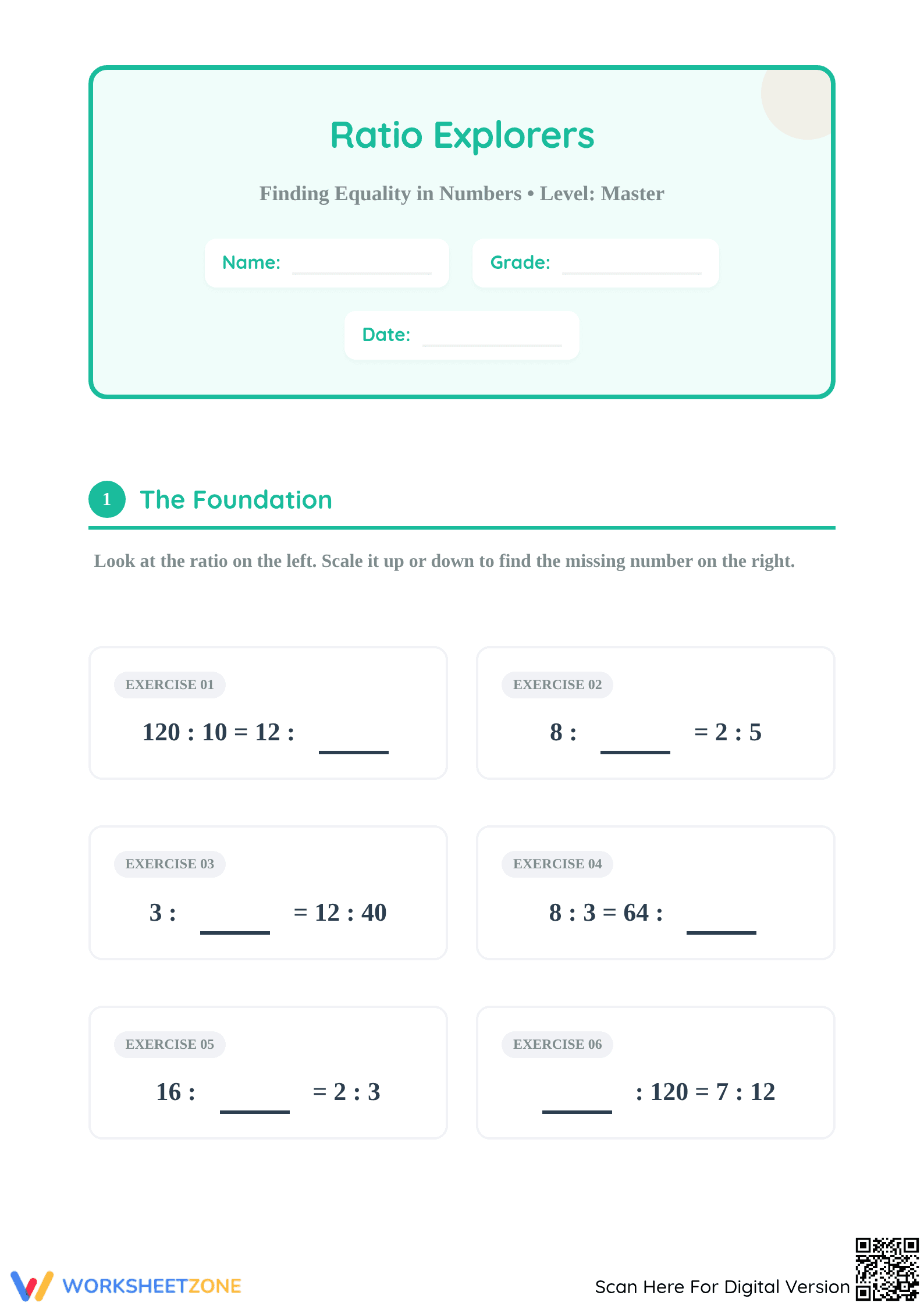
Master the fundamentals of proportional reasoning with this comprehensive ratio worksheet. Designed for upper elementary students, it guides learners through identifying and calculating equivalent ratios using multiplication and division scaling strategies. By filling in missing numbers, students develop the mathematical fluency required for advanced algebraic concepts and real-world problem-solving scenarios across various contexts.
At a Glance
- Grade: 5 · Subject: Math
- Standard:
CCSS.MATH.CONTENT.6.RP.A.3— Use ratio and rate reasoning to solve real-world and mathematical problems- Skill Focus: Equivalent ratios and scaling
- Format: 5 pages · 26 problems · Answer key included · PDF
- Best For: Independent practice and small group instruction
- Time: 40–50 minutes
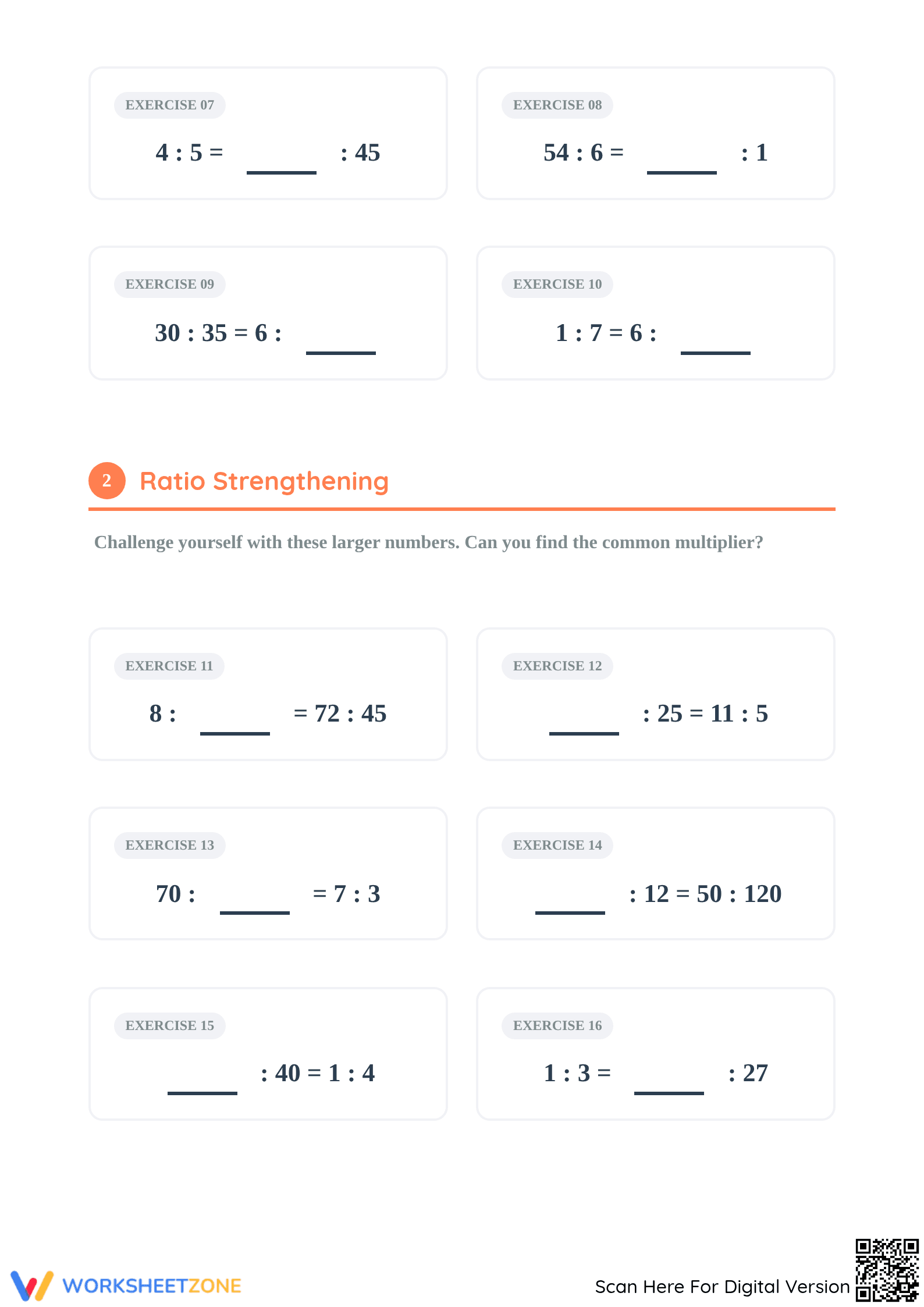
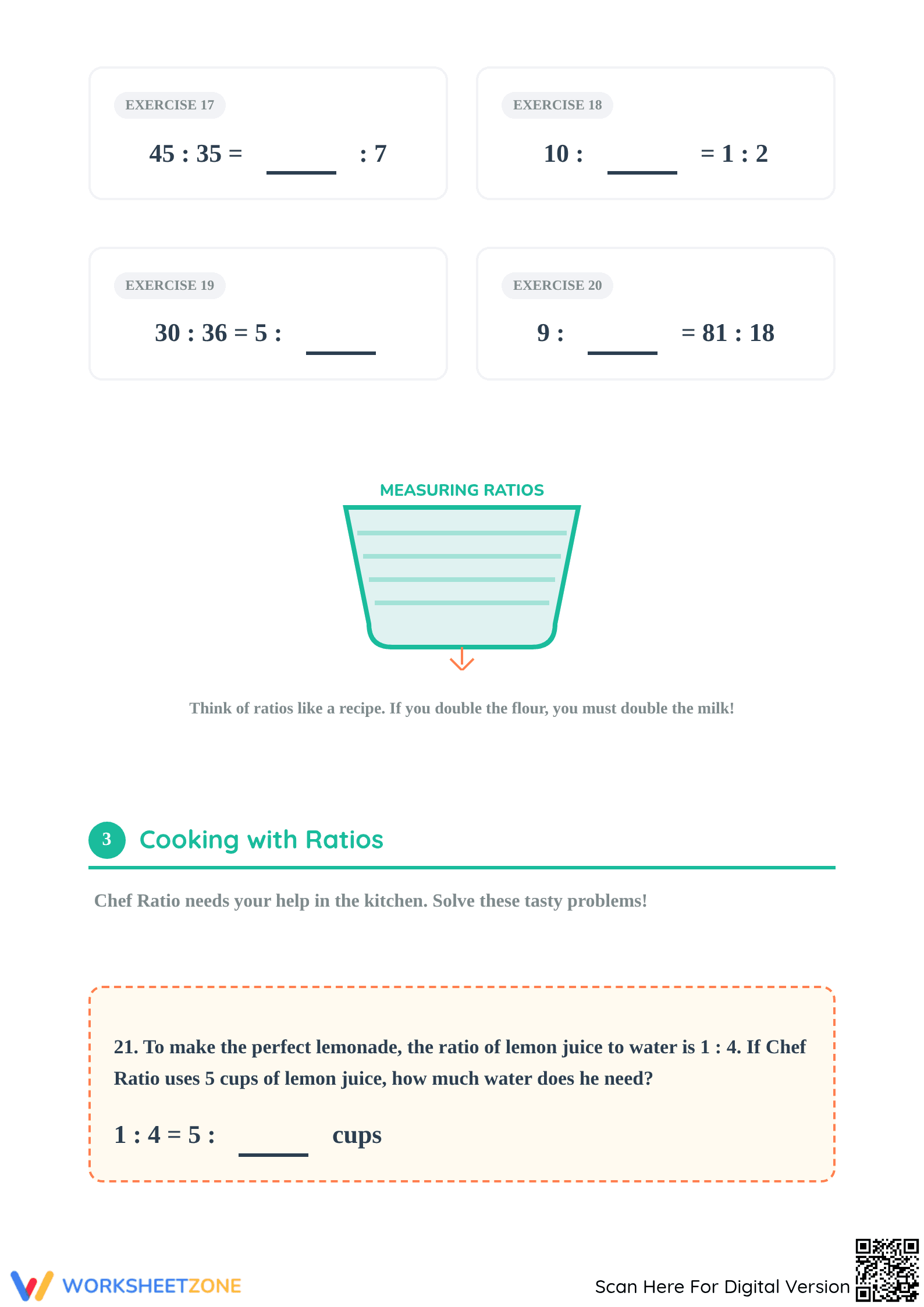
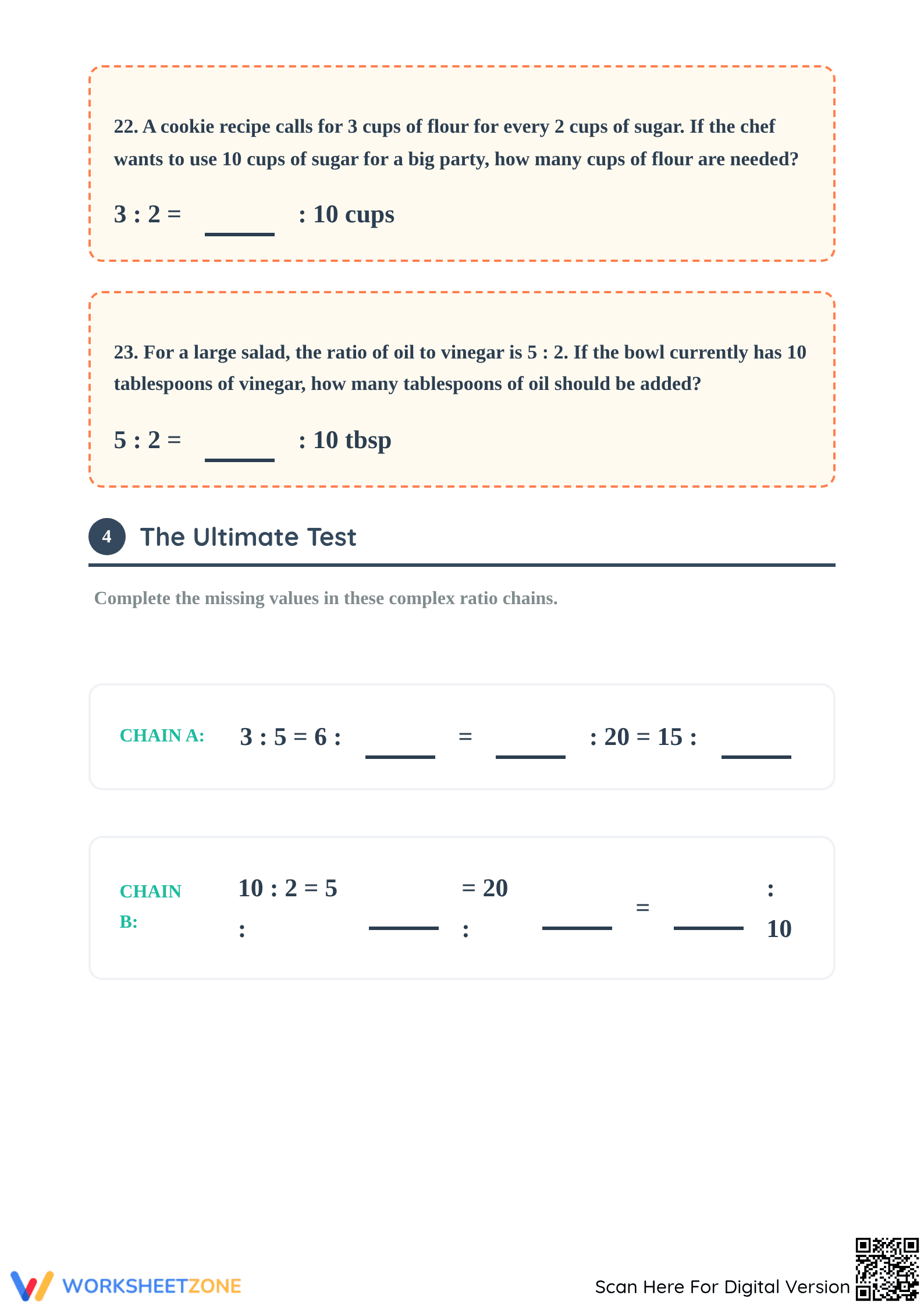
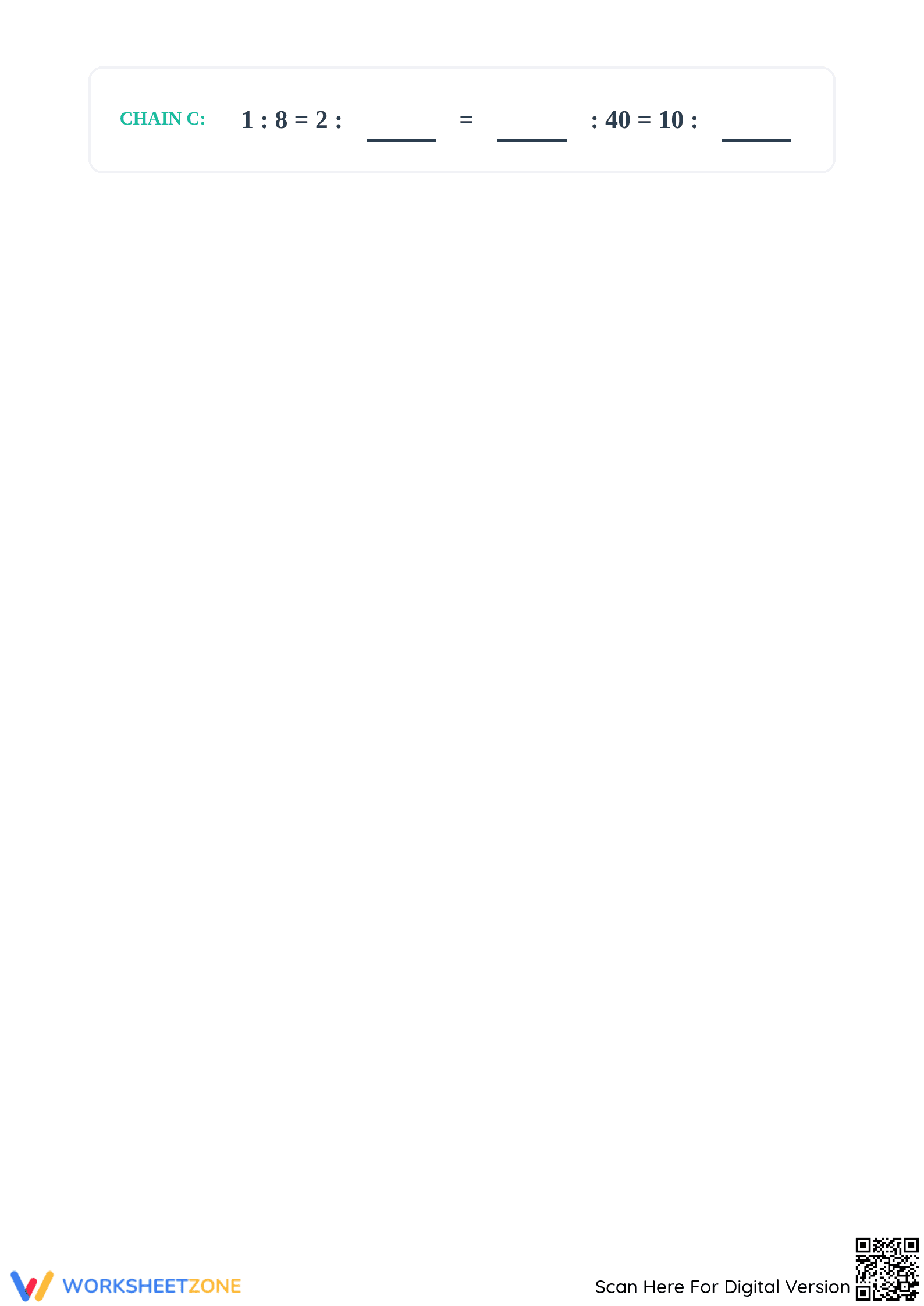
This five-page PDF resource provides a robust collection of exercises organized into four progressive sections. It includes 20 direct calculation exercises, three detailed word problems involving "Chef Ratio," and three complex ratio chains. The clear, uncluttered layout features dedicated workspace for every problem, and a full answer key is provided to facilitate rapid grading or student self-assessment.
Skill Progression
- Guided practice: The initial section offers 10 problems where students find missing values in simple ratios to establish confidence in scaling factors.
- Supported practice: "Ratio Strengthening" increases complexity with 10 problems featuring larger numbers and non-unit ratios requiring more sophisticated computation.
- Independent practice: Word problems and multi-step ratio chains require students to apply logic to advanced scenarios without scaffolds.
This gradual-release approach ensures students move confidently from basic computation to abstract application through a structured framework.
Standards Alignment
This worksheet aligns with `CCSS.MATH.CONTENT.6.RP.A.3`, which mandates that students use ratio reasoning to solve mathematical problems. It also supports foundations for algebraic thinking by bridging the conceptual gap between equivalent fractions and proportional relationships. Both standard codes can be copied directly into lesson plans, IEP goals, or district curriculum mapping tools.
How to Use It
Deploy this resource during the independent practice phase of a lesson on proportions. Assign the first two pages to verify computational accuracy before moving to the word problems as a formative assessment. Educators should observe if students are correctly identifying the common multiplier, which serves as a critical indicator of readiness for middle school. Completion typically takes 45 minutes.
Who It's For
This pack is ideal for Grade 5 students ready for accelerated content or Grade 6 students requiring remediation. It is particularly effective for learners who benefit from visual hierarchy and segmented tasks. Pair this worksheet with a ratio anchor chart or a recipe-based passage to ground the abstract numbers in concrete, relatable contexts for diverse classroom populations.
According to the RAND AIRS 2024 analysis of instructional materials, high-quality math resources must balance procedural fluency with conceptual application to ensure long-term retention of proportional logic. This worksheet achieves that balance by transitioning from direct scaling exercises to real-world word problems and complex ratio chains. By requiring students to identify the common multiplier across twenty-six distinct tasks, the resource reinforces the multiplicative identity property essential for CCSS.MATH.CONTENT.6.RP.A.3 mastery. Research from ScienceDirect indicates that structured repetition in equivalent ratio identification significantly reduces cognitive load when students later encounter complex percentages and unit rates in higher-level mathematics. This resource provides the necessary scaffolding to bridge elementary arithmetic and middle school algebra, ensuring that students develop a deep, transferable understanding of how ratios represent constant relationships between quantities in a measurable mathematical system.


