


























Views
Downloads

Essential Grade 5 Equivalent Ratios Worksheet | Math Practice
Paste this activity's link or code into your existing LMS (Google Classroom, Canvas, Teams, Schoology, Moodle, etc.).
Students can open and work on the activity right away, with no student login required.
You'll still be able to track student progress and results from your teacher account.
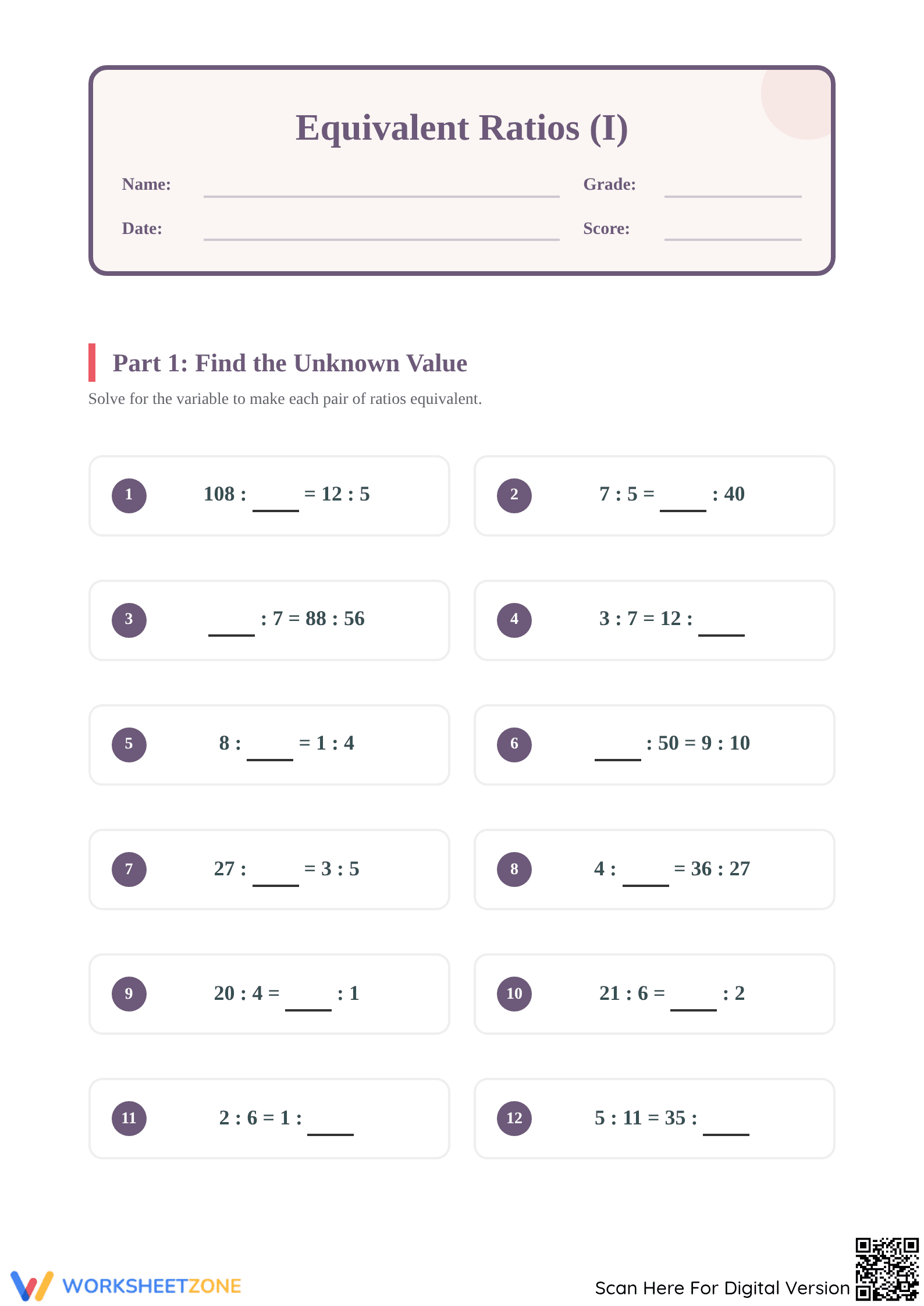
Mastering equivalent ratios is a foundational bridge between elementary fractions and middle school proportional reasoning. This Grade 5 math worksheet provides structured practice for students to identify, compare, and simplify ratios with precision. By solving for unknown values and reducing ratios to their simplest form, learners build the numerical fluency required for advanced algebraic concepts.
At a Glance
- Grade: 5 · Subject: Math
- Standard:
CCSS.MATH.CONTENT.6.RP.A.3— Use ratio and rate reasoning to solve real-world and mathematical problems- Skill Focus: Equivalent Ratios and Proportions
- Format: 3 pages · 30 problems · Answer key included · PDF
- Best For: Independent practice and formative assessment
- Time: 25–35 minutes
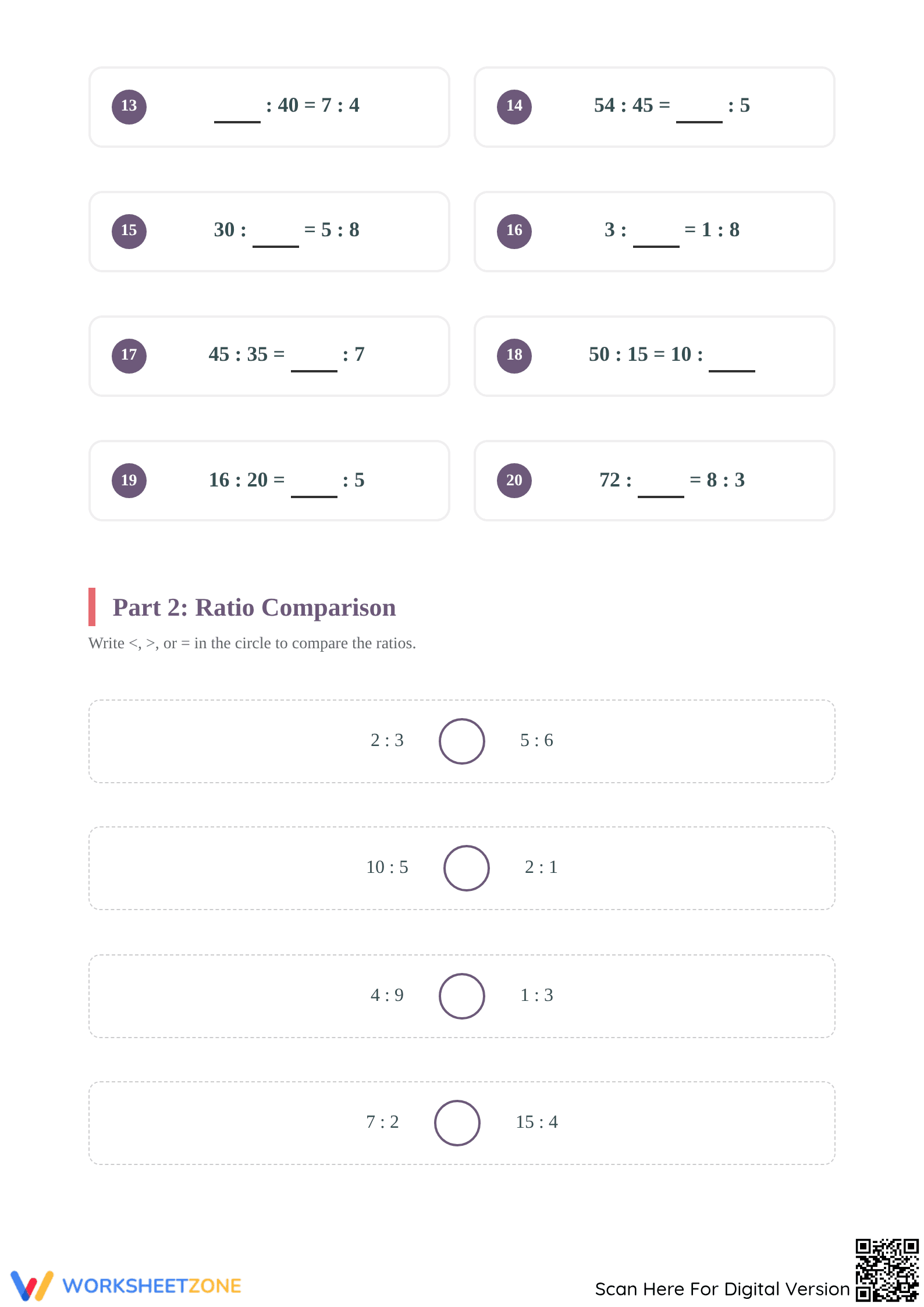
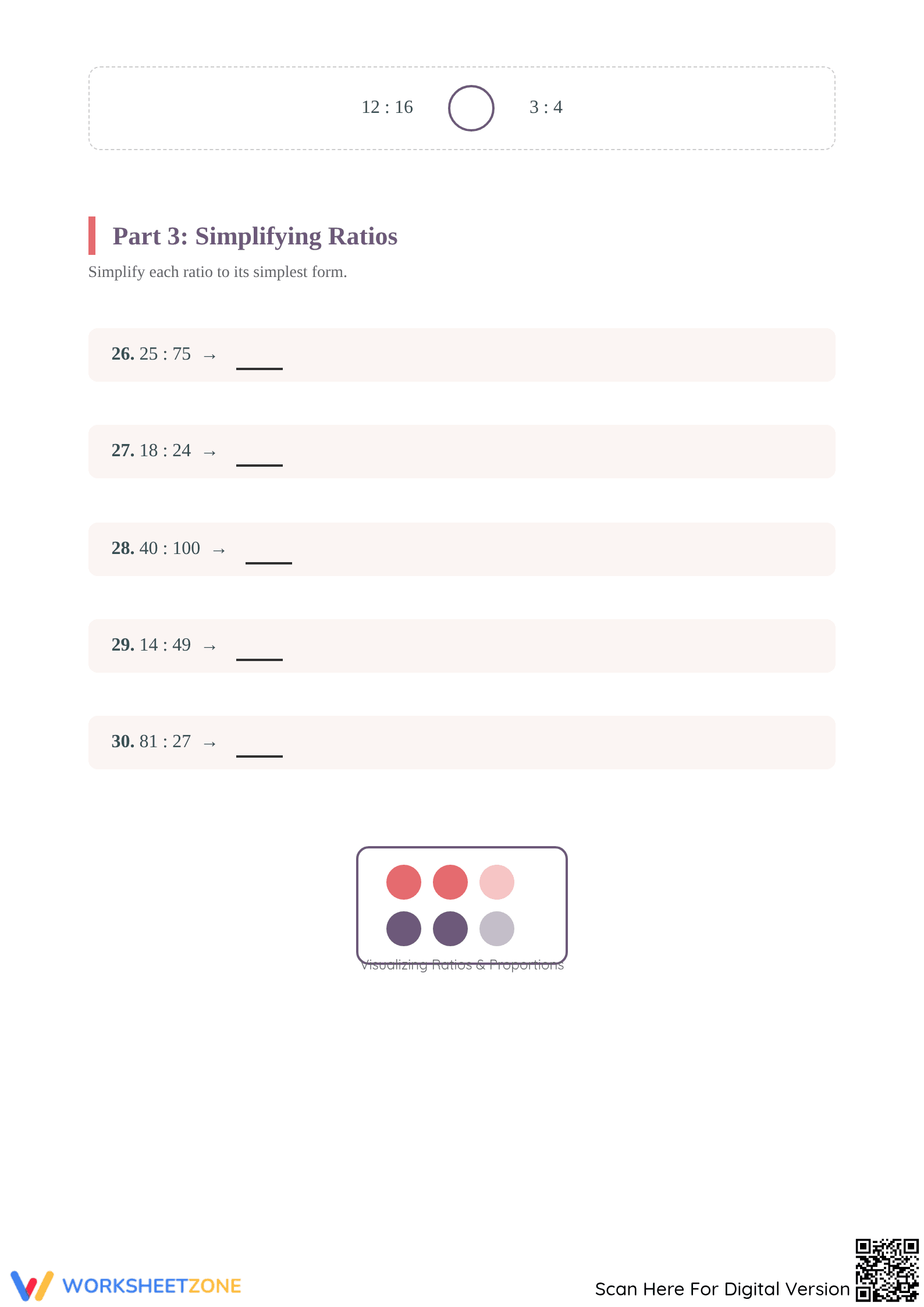
This comprehensive 3-page PDF collection contains 30 distinct mathematical tasks divided into three logical phases of mastery. The first section focuses on finding missing values in ratio pairs, followed by a comparison section using inequality symbols, and concluding with a simplification drill. Each page is cleanly formatted with ample white space for student calculations, ensuring the material is accessible for diverse learners.
Teachers can integrate this resource into their lesson cycle in under two minutes of total preparation. Print the three-page set or upload the PDF for digital distribution. The structured layout allows for a "check for understanding" moment after the first ten problems, enabling educators to provide immediate feedback before students move to the more complex comparison and simplification tasks. This workflow makes it an ideal choice for emergency substitute plans or a reliable homework assignment.
The primary focus of this worksheet is `CCSS.MATH.CONTENT.6.RP.A.3`, which requires students to use ratio and rate reasoning to solve mathematical problems. While technically a Grade 6 anchor, it serves as an essential extension for Grade 5 students who have mastered equivalent fractions. Both standard codes can be copied directly into lesson plans, IEP goals, or district curriculum mapping tools to ensure instructional coherence.
Deploy this worksheet during the "You Do" phase of a gradual release lesson to transition students from teacher-led modeling to independent mastery. It also functions effectively as a "do-now" activity at the start of a unit on proportions to gauge prior knowledge. For a formative assessment tip, observe students during Part 3 to see if they are identifying the greatest common factor or using repeated division to simplify.
This resource is designed for Grade 5 and Grade 6 students who are developing their understanding of proportional relationships. It is particularly effective for learners who benefit from repetitive, scaffolded practice before moving to word problems. Pair this worksheet with a visual anchor chart illustrating the relationship between ratios and fractions to support English Language Learners and students with IEP accommodations.
Educational research emphasizes that fluency with equivalent ratios is a critical predictor of success in high school algebra and physics. According to the EdReports 2024 analysis of middle school mathematics, instructional materials that provide explicit practice in finding unknown values through multiplicative reasoning help students internalize the structure of proportional systems. This worksheet aligns with those findings by moving students through three distinct cognitive levels: identifying missing terms, comparing magnitudes, and simplifying expressions. By providing 30 targeted problems, the resource ensures that students encounter a variety of numerical patterns, which fosters the flexible thinking required for CCSS.MATH.CONTENT.6.RP.A.3 mastery. Educators can use these tasks to identify specific misconceptions regarding the additive versus multiplicative nature of ratios, a common hurdle highlighted in contemporary pedagogical studies. This collection offers the rigorous, standards-aligned practice necessary to bridge the gap between concrete fraction arithmetic and abstract proportional logic.


