


























Views
Downloads




Complete Scaling Equivalent Ratios Worksheet | Grade 6 Math
Paste this activity's link or code into your existing LMS (Google Classroom, Canvas, Teams, Schoology, Moodle, etc.).
Students can open and work on the activity right away, with no student login required.
You'll still be able to track student progress and results from your teacher account.
Mastering ratio equivalence requires understanding multiplicative relationships rather than additive changes. This Grade 6 math worksheet guides middle school students through scaling ratios up and down using whole-number scale factors. Learners calculate missing terms, solve realistic proportion word problems, and evaluate mathematical reasoning to build lasting proportional fluency.
At a Glance
- Grade: 6 · Subject: Math
- Standard:
6.RP.A.3— Use ratio reasoning to solve real-world mathematical problems by scaling quantities- Skill Focus: Generate Equivalent Ratios by Scaling
- Format: 5 pages · 12 problems · Answer key included · PDF
- Best For: Independent practice, homework, small group intervention
- Time: 30–45 minutes
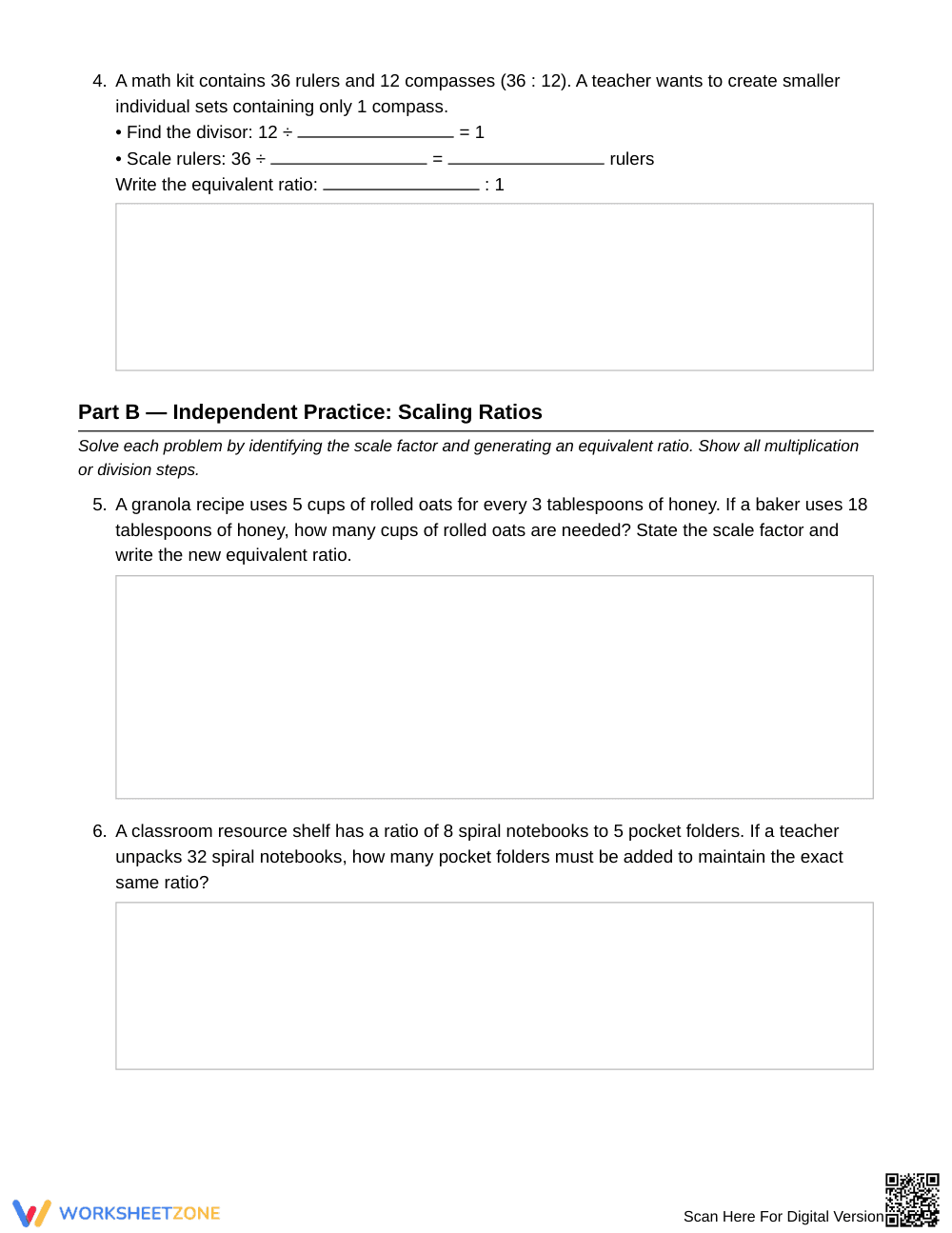
This 5-page printable resource features 12 multi-step math problems divided into three distinct practice sections. It begins with a core concept summary defining scale factors alongside two annotated worked examples. Scaffolds include missing-step prompts in Part A, realistic multi-context scenarios in Part B, error analysis tasks in Part C, and a comprehensive 3-page answer key displaying complete calculations.
Skill Progression
- Guided Practice (Part A, Problems 1–4): Structured missing-step calculations with explicit prompts to identify multipliers and divisors before calculating final equivalent ratios.
- Supported Practice (Part B, Problems 5–10): Six independent word problems spanning recipes and classroom supplies requiring students to determine scale factors.
- Independent Reasoning (Part C, Problems 11–12): Error analysis and ratio comparison tasks that challenge additive misconceptions and verify proportional equivalence.
This structured progression reflects the gradual release model, guiding students toward computational and conceptual independence.
Standards Alignment
This resource aligns directly with 6.RP.A.3: Use ratio and rate reasoning to solve real-world and mathematical problems by scaling equivalent ratios. It supports foundational work in 6.RP.A.1 by reinforcing multiplicative comparisons. Both standard codes can be copied directly into lesson plans, IEP goals, or district curriculum mapping tools.
How to Use It
Deploy this worksheet immediately following direct instruction on ratio relationships. In a core block, assign Part A for partner practice, Part B for independent completion, and Part C for formative assessment. Check whether students incorrectly add values in Part C to catch persistent misconceptions. Expected completion time is 30 to 45 minutes.
Who It's For
This worksheet is designed for Grade 6 math classrooms, Tier 2 intervention groups, and Grade 7 review settings. Scaffolded frames assist English learners and students with IEPs, while reasoning prompts support enrichment. Pair this printable with a visual ratio table anchor chart or direct proportion lesson.
According to Fisher & Frey (2014), implementing a deliberate gradual-release architecture with worked examples significantly strengthens both conceptual understanding and procedural fluency in middle school mathematics. Under standard 6.RP.A.3, students must master generating equivalent ratios by scaling quantities through multiplication and division. Research demonstrates that novice learners often fall back on additive strategies when comparing ratios; providing structured step-by-step scaffolds followed by explicit error analysis directly counters this misconception. This 5-page worksheet offers 12 targeted ratio problems that guide students through identifying scale factors, applying multipliers to real-world contexts, and justifying equivalence mathematically. Educators utilizing this resource provide an evidence-based pathway for Grade 6 learners to transition from concrete arithmetic calculations to abstract proportional reasoning, establishing critical algebraic readiness for future coursework in rate tables, unit rates, percentages, and linear relationships.


