


























Views
Downloads
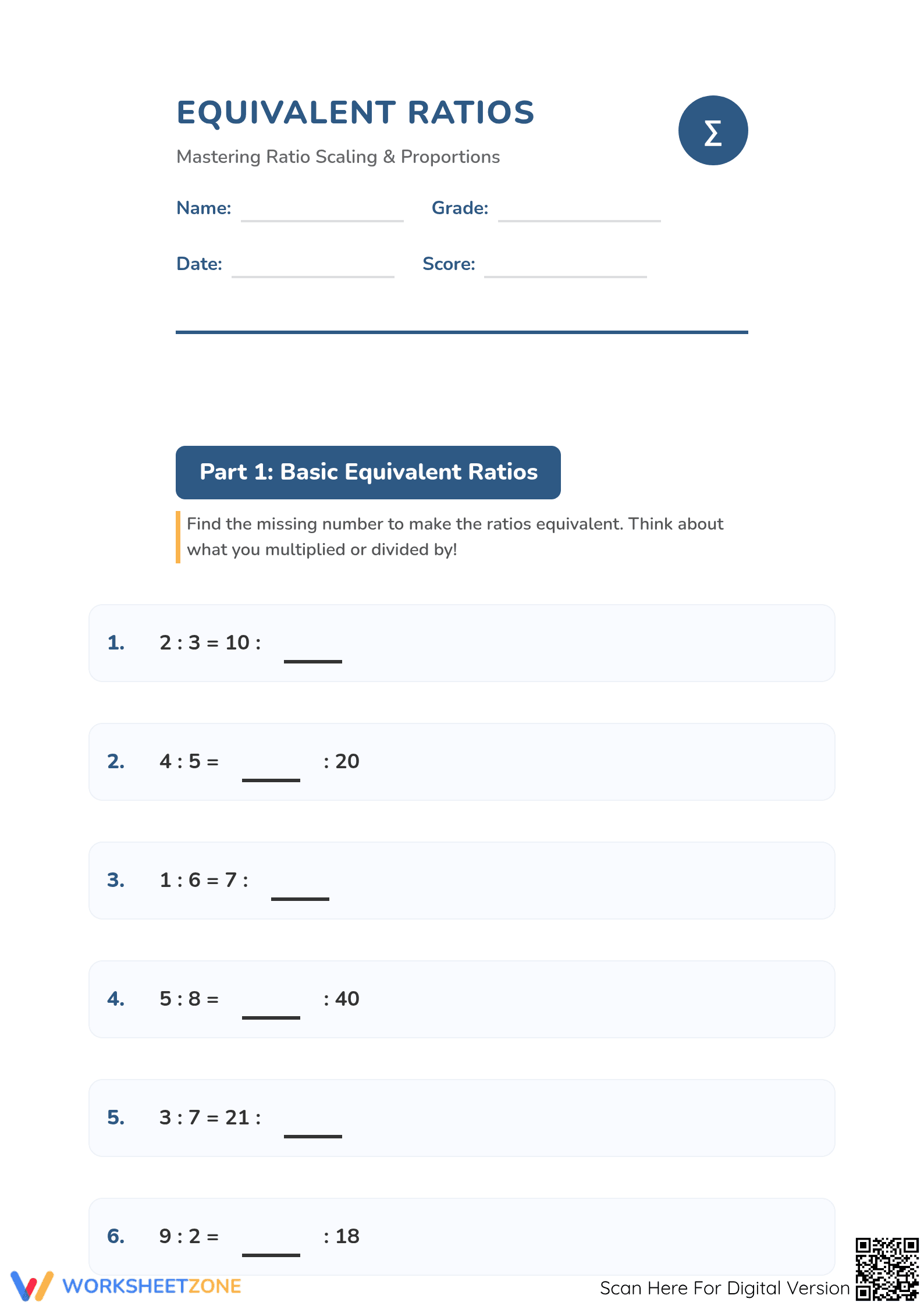


Essential Equivalent Ratios Worksheet | Grade 6 Math
Paste this activity's link or code into your existing LMS (Google Classroom, Canvas, Teams, Schoology, Moodle, etc.).
Students can open and work on the activity right away, with no student login required.
You'll still be able to track student progress and results from your teacher account.
This comprehensive five-page math resource is designed to help students master the foundational concepts of proportional reasoning and ratio scaling. By moving through a logical progression from simple numerical equivalence to complex real-world word problems, students build a deep understanding of how quantities relate to one another in fixed proportions. This worksheet ensures students develop fluency in identifying scaling factors and applying them across various mathematical representations.
At a Glance
- Grade: 6 · Subject: Math
- Standard:
CCSS.MATH.CONTENT.6.RP.A.3— Use ratio and rate reasoning to solve real-world and mathematical problems- Skill Focus: Identifying equivalent ratios and scaling
- Format: 5 pages · 25 problems · Answer key included · PDF
- Best For: Independent practice or comprehensive homework packet
- Time: 45–60 minutes
What's Inside: This packet features twenty-five numbered problems distributed across five distinct sections. It includes basic ratio equations, scaling exercises, three detailed ratio tables (apples/price, miles/hours, and paint mixing), and six contextual word problems. The final page introduces a challenge round with fractional and decimal ratios, providing a rigorous conclusion to the set. A full answer key is provided for immediate feedback and grading efficiency.
Zero-Prep Workflow
- Print: Simply print the five-page PDF for your entire class. Total prep time is under two minutes.
- Distribute: Hand out the packets at the start of your ratios unit or as a review. The self-explanatory sections allow for immediate student engagement.
- Review: Use the included answer key to quickly check for common misconceptions in scaling factors during your end-of-class wrap-up.
Standards Alignment: This resource is explicitly aligned to CCSS.MATH.CONTENT.6.RP.A.3, focusing on the use of ratio reasoning to find missing values in equivalent ratio pairs and tables. Students must identify the multiplicative relationship between the antecedent and consequent to solve for unknowns. Both standard codes can be copied directly into lesson plans, IEP goals, or district curriculum mapping tools.
How to Use It: Assign this packet as a culminating activity after direct instruction on ratio scaling. It works exceptionally well as a sub-plan because the gradual release of difficulty allows students to work independently. During instruction, observe if students are using additive or multiplicative thinking when filling out the ratio tables. Most students will complete the full packet within 45 to 60 minutes.
Who It's For: This resource is ideal for Grade 6 students introduced to the Ratios and Proportional Relationships domain. It is also suitable for Grade 5 advanced learners or Grade 7 students requiring intervention. It pairs naturally with a ratio anchor chart or a short introductory passage on real-world proportions.
According to a ScienceDirect TpT Analysis, high-quality math resources that integrate multiple representations—such as ratio tables, visual scaling factors, and contextual word problems—significantly enhance a student's ability to internalize proportional reasoning. This Grade 6 worksheet is specifically engineered to meet the CCSS.MATH.CONTENT.6.RP.A.3 standard by guiding learners through a gradual release of responsibility. Starting with basic equivalence and moving into complex multi-step real-world scenarios, the resource ensures that students don't just memorize cross-multiplication but understand the underlying multiplicative relationships between quantities. The inclusion of a dedicated 'Challenge Round' featuring decimal and fractional ratios provides the necessary rigor for advanced learners while maintaining accessibility for those requiring supported practice. Educators can confidently implement this printable resource as a primary instructional tool, a comprehensive homework packet, or a targeted intervention for students struggling with the foundational transition from additive to multiplicative thinking patterns in middle school mathematics curricula.


