


























Views
Downloads



Essential Ratio Equivalence Worksheet | Grade 6 Math
Paste this activity's link or code into your existing LMS (Google Classroom, Canvas, Teams, Schoology, Moodle, etc.).
Students can open and work on the activity right away, with no student login required.
You'll still be able to track student progress and results from your teacher account.
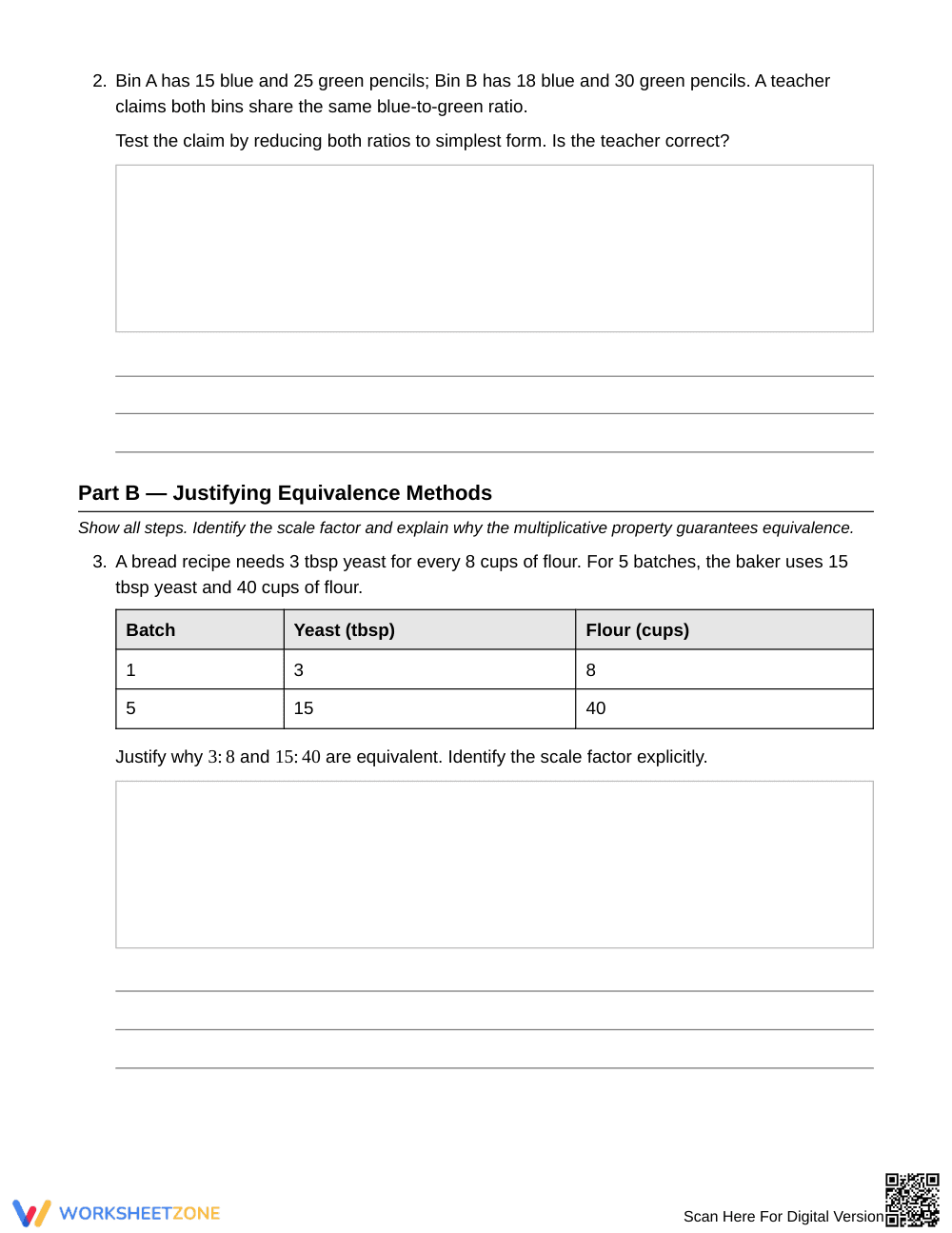
This Grade 6 math worksheet trains students to evaluate, prove, and justify ratio equivalence using multiplicative reasoning and simplest-form reduction. Students articulate mathematical arguments, identify scale factors, and expose additive misconceptions across eight targeted real-world problems.
At a Glance
- Grade: 6 · Subject: Math
- Standard:
6.RP.A.3— Use ratio reasoning to solve mathematical problems and prove equivalence- Skill Focus: Justify Ratio Equivalence
- Format: 5 pages · 8 problems · Answer key included · PDF
- Best For: Post-instruction practice and misconceptions remediation
- Time: 35–45 minutes
Inside this 5-page printable resource, learners find a concise reference box defining equivalent ratios and validity rules, followed by eight rigorous tasks. The worksheet features dual-column ratio tables, GCF reduction tasks, and analytical prompts requiring complete written justifications. A thorough 2-page answer key provides step-by-step scaling calculations and model justifications.
Skill Progression
- Guided Practice (Part A, 2 problems): Students analyze recipe and inventory claims, using the reference rules to verify equivalence via scale factors and simplest form.
- Supported Practice (Part B, 4 problems): Learners complete ratio tables, calculate greatest common factors, and demonstrate how multi-step scaling operations preserve equivalence.
- Independent Practice (Part C, 2 problems): Students refute additive errors and unequal multipliers by writing counterexamples and stating formal validity conditions.
This sequence follows a gradual-release instructional model, moving learners from initial claim testing to independent mathematical proof.
Standards Alignment
This worksheet aligns directly to primary standard `6.RP.A.3`, which requires students to use ratio reasoning to solve real-world and mathematical problems. In supporting standard `6.RP.A.1`, students clarify ratio relationships between quantities. Both standard codes can be copied directly into lesson plans, IEP goals, or district curriculum mapping tools.
How to Use It
Use this worksheet after direct instruction on multiplicative scaling. During independent work, check Part C formatively to ensure students avoid additive logic, such as adding identical amounts to both terms. The entire problem set takes approximately 35 to 45 minutes.
Who It's For
This resource serves Grade 6 math classrooms, targeted intervention groups, and Grade 5 students advancing to proportional relationships. Pair it with ratio table anchor charts or double number line diagrams during small-group support.
Mastering ratio equivalence forms the empirical foundation for middle school algebraic readiness and proportional modeling. According to Fisher & Frey (2014), structured gradual-release frameworks enable students to systematically internalize complex analytical processes by shifting cognitive load from modeled worked examples to autonomous justification. This Grade 6 worksheet directly addresses Common Core standard 6.RP.A.3 by prompting students to explain why ratios are equivalent through constant scale factors and simplest-form reductions. Rather than accepting mechanical computation alone, the tasks compel learners to generate written counterexamples that actively expose common additive misconceptions. Research shows that addressing persistent student errors through explicit argumentation solidifies foundational number sense and structural mathematical thinking. Consequently, this resource equips classroom educators with rigorous formative data, ensuring learners demonstrate both conceptual comprehension and computational precision before advancing to complex unit rates, percentages, and linear functions in subsequent units.


