


























Views
Downloads



Essential Two-Constraint Ratios Worksheet | Grade 6 Math
Paste this activity's link or code into your existing LMS (Google Classroom, Canvas, Teams, Schoology, Moodle, etc.).
Students can open and work on the activity right away, with no student login required.
You'll still be able to track student progress and results from your teacher account.
Mastering multi-condition proportional reasoning requires moving beyond basic equivalent ratios to systemic parameter testing. This worksheet provides students targeted practice scaling base ratios by an integer multiplier to satisfy two concurrent constraints, such as fixed totals and minimum difference requirements, reinforcing critical algebraic thinking and foundational problem-solving strategies.
At a Glance
- Grade: 6 · Subject: Math
- Standard:
6.RP.A.3— Use ratio reasoning to solve real-world and mathematical dual-constraint problems- Skill Focus: Meet Two Constraints with Equivalent Ratios
- Format: 5 pages · 14 problems · Answer key included · PDF
- Best For: Small group intervention and core practice
- Time: 40–50 minutes
What's Inside
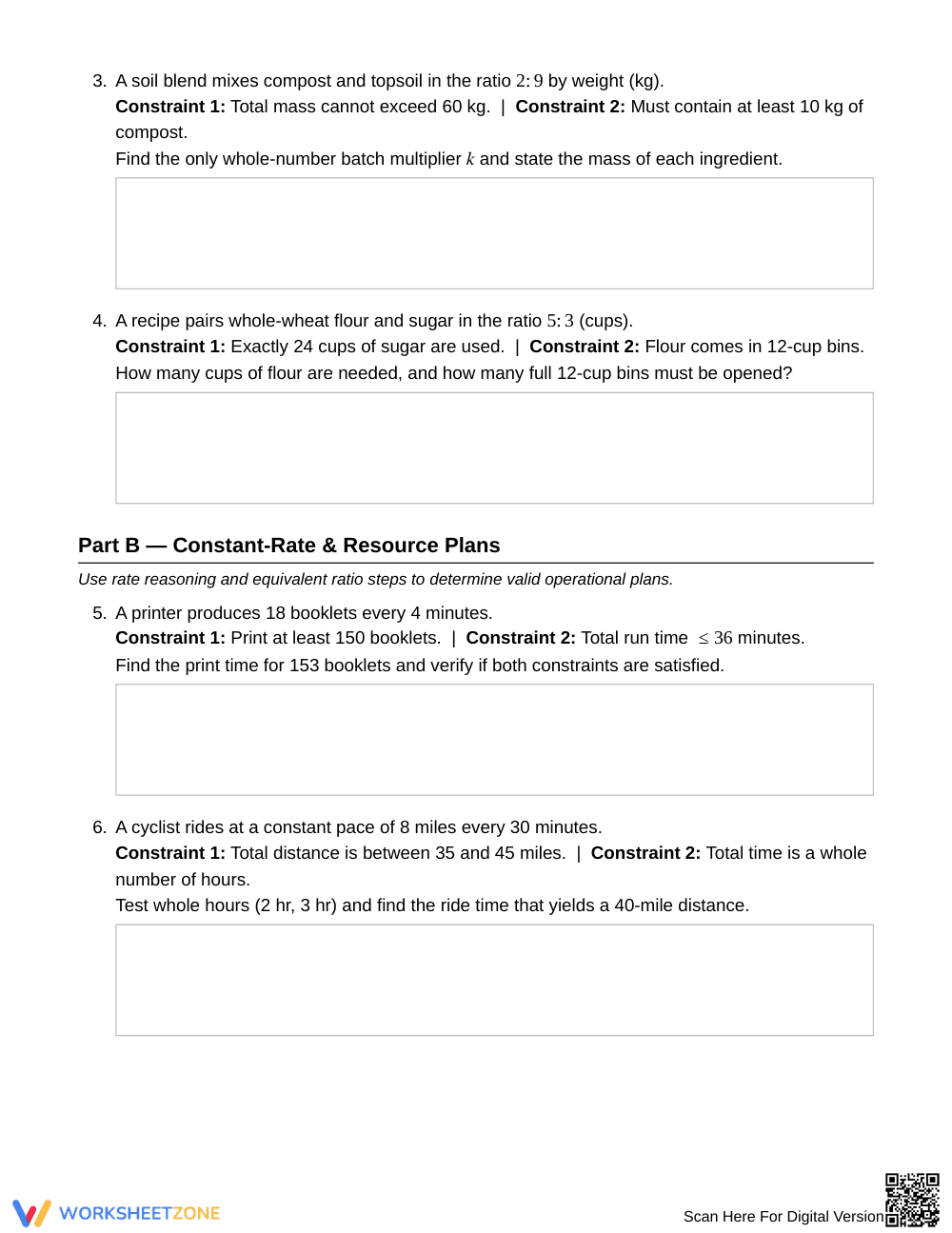
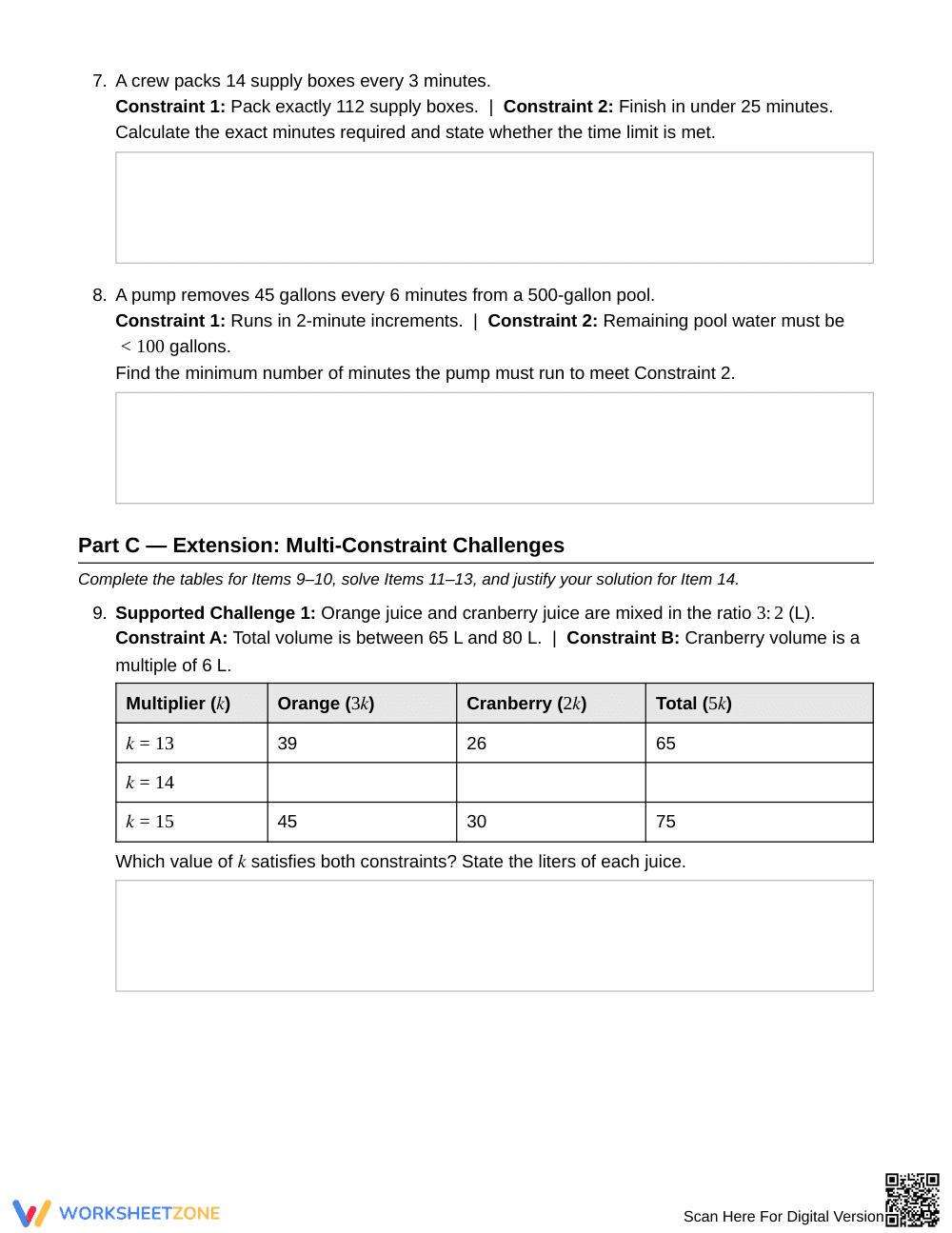
This 5-page printable resource includes 14 structured mathematical tasks arranged across three scaffolded sections, complete with a 2-page detailed answer key. Students explore recipe blends, manufacturing runs, cycling paces, and metal alloys using an upfront core strategy box that introduces multiplier notation alongside two-way ratio tables and justification prompts.
Skill Progression
- Guided Practice: Items 1–4 present dual-constraint contextual recipes and mixtures with explicit multiplier prompts, allowing learners to test candidate values against fixed totals or difference bounds.
- Supported Practice: Items 5–10 incorporate rate reasoning and partial ratio tables, guiding students to systematically track multipliers across running times, packaging workflows, and juice blends.
- Independent Practice: Items 11–14 transition to open-ended multi-constraint challenges, requiring students to isolate integer ranges, calculate unused capacity, and write formal mathematical justifications.
This sequence follows a gradual-release instructional model that transitions learners from structured exploration to fully autonomous reasoning.
Standards Alignment
This resource directly targets 6.RP.A.3, which requires students to use ratio and rate reasoning to solve real-world and mathematical problems, including by reasoning about tables of equivalent ratios, tape diagrams, double number line diagrams, or equations. The problem set also supports 6.EE.B.5 through the evaluation of integer values that satisfy compound inequality conditions. Both standard codes can be copied directly into lesson plans, IEP goals, or district curriculum mapping tools.
How to Use It
Deploy this worksheet after direct instruction on equivalent ratio tables to deepen problem-solving stamina. For mid-unit practice, assign Part A and Part B during collaborative partner rotations where students verify both boundary conditions together. As a formative assessment checkpoint, examine student work on Item 10: check whether learners identify the integer difference between terms rather than merely testing total sums. Typical completion requires 40 to 50 minutes.
Who It's For
This worksheet serves sixth-grade general mathematics students, accelerated fifth graders, and seventh graders requiring targeted intervention in proportional reasoning. The inclusion of structured tables supports multilingual learners and students with learning accommodations by externalizing mental calculations. Pair this practice with an introductory mini-lesson on ratio tables or an anchor chart showing step-by-step multiplier scaling.
Under the Common Core State Standards for Mathematics, 6.RP.A.3 tasks students with applying ratio and rate reasoning to solve real-world and mathematical problems through equivalent ratios. Mastering this standard demands that learners coordinate multiple constraints simultaneously, establishing essential mathematical habits for future linear equations and inequalities. According to Fisher & Frey (2014), purposeful gradual-release structures—moving deliberately from teacher-modeled scaffolds to independent justification—significantly enhance problem-solving retention and conceptual transfer in middle school mathematics. This 14-task worksheet aligns directly with those principles by pairing structured ratio tables with open-ended constraint analysis. Students learn to determine valid integer multipliers, verify bounding conditions, and justify solutions across authentic mixture, rate, and production contexts. By bridging concrete computational practice with abstract parameter testing, the resource ensures students build rigorous mastery of proportional reasoning required for secondary mathematics success.


