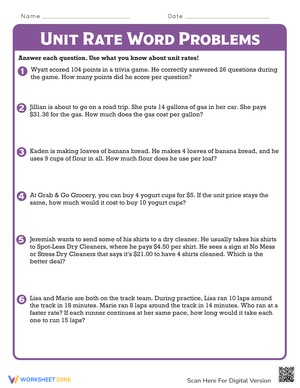
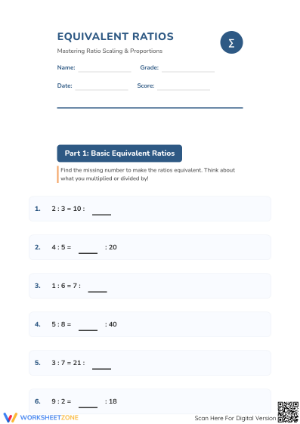
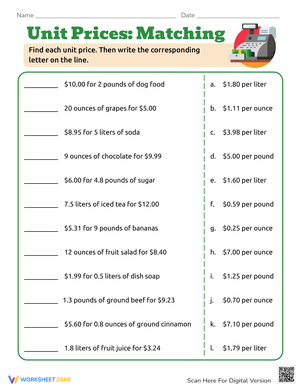
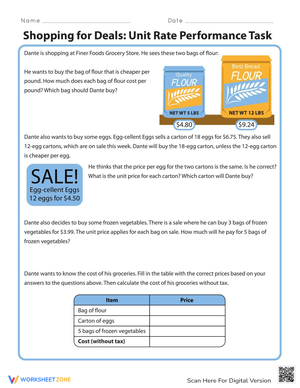
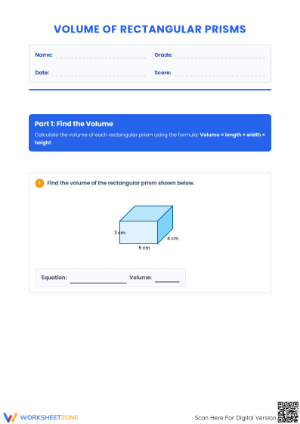
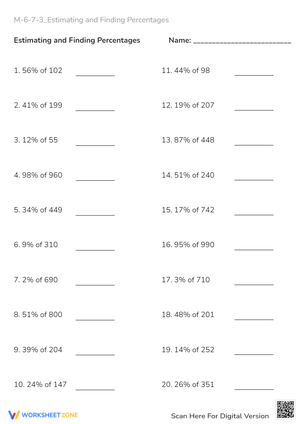
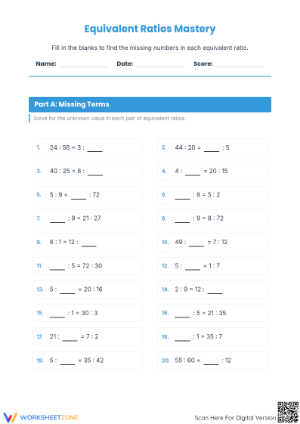
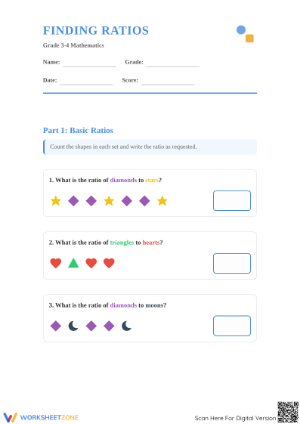
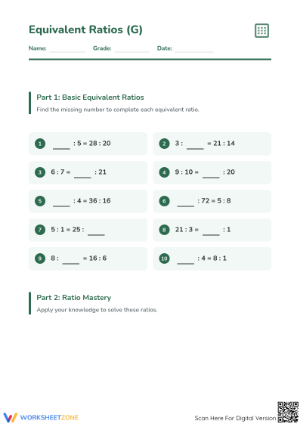
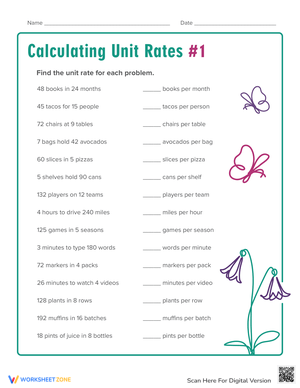
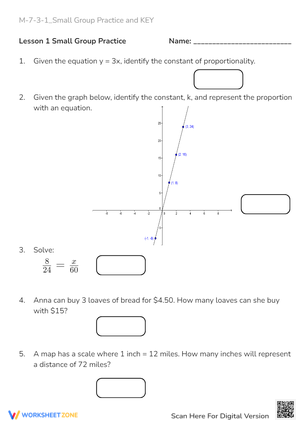
These ratios and rates worksheets files give sixth- and seventh-grade teachers a structured set of standalone practice resources covering every stage of proportional reasoning, from writing basic part-to-part comparisons to calculating unit rates in multi-step word problems. The set spans enough skill variety that teachers can pull a single worksheet to fill a focused 15-minute block or sequence several across a unit without repeating the same problem type.
The Specific Skills Targeted
Each worksheet stays on one skill, which makes the collection easy to navigate when planning a unit or responding to a gap that shows up in formative data. The skills covered include:
- Writing ratios in three forms — Students express the same comparison as a fraction, with a colon, and using "to," then classify each ratio as part-to-part or part-to-whole based on a visual model or word problem.
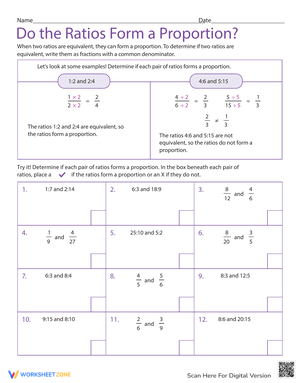
- Simplifying ratios — Students apply GCF to reduce ratios and determine whether two ratios are equivalent without converting to decimals.
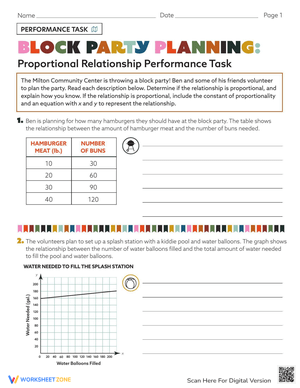
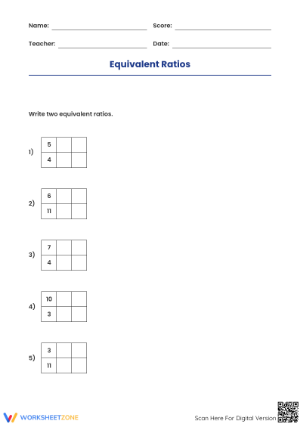
- Ratio tables and equivalent ratios — Students complete tables, identify the scale factor, and use the table to solve missing-value problems. One worksheet uses color tile arrays as the primary representation before any numbers appear.
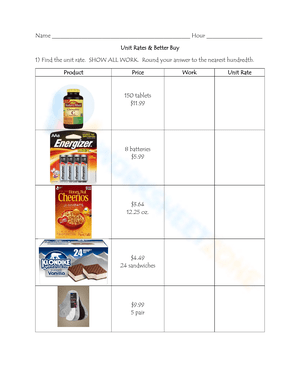
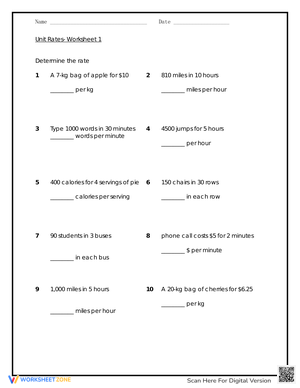
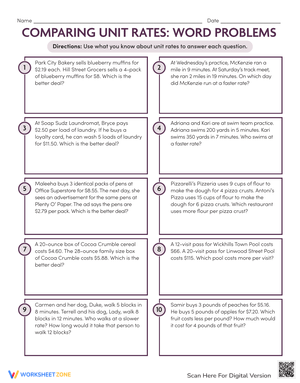
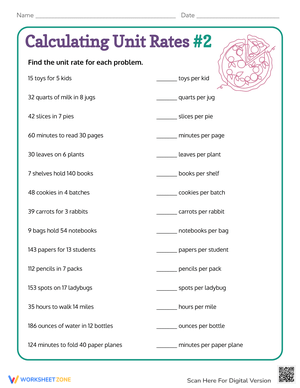
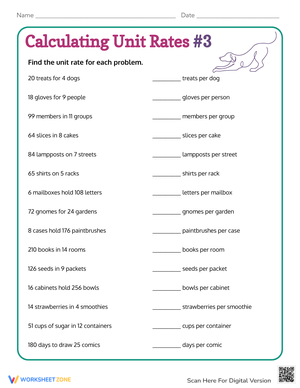
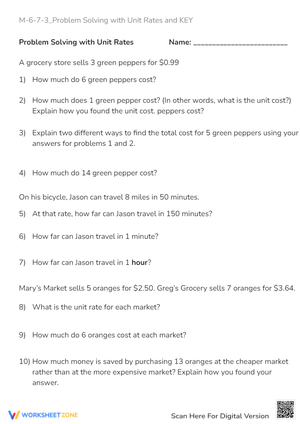
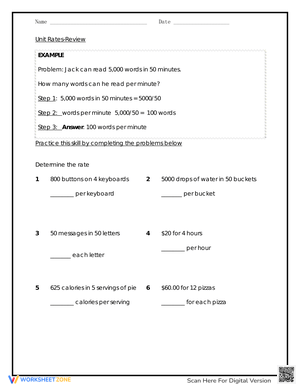
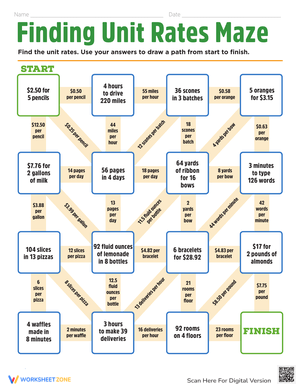
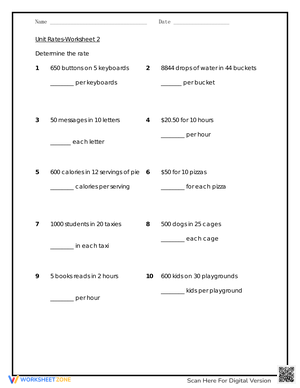
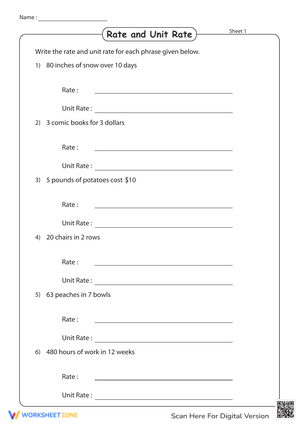
- Unit rates from real-world contexts — Problems use grocery pricing, hourly wages, and distance-time scenarios. Students isolate the unit rate by division, then use it to compare two options in a follow-up question.
- Proportions and multi-step problems — Students set up and solve proportions, with the work connecting directly back to the ratio tables they practiced earlier in the set.
The Developmental Case for Teaching Ratios in Sixth Grade
The shift from additive to multiplicative thinking is one of the steepest climbs in K–8 mathematics, and it tends to surface right in the middle of a sixth-grade ratios unit — often without warning. A student who correctly adds fractions all year will look at the ratio 2:3 and, when asked whether 4:7 is equivalent, answer yes — because both quantities increased by 2. That student is applying additive reasoning, the same logic that works perfectly for "3 more than 4 is 7," to a context where the relationship is multiplicative. These ratios and rates worksheets files give teachers repeated exposure to equivalent-ratio problems that make the multiplicative relationship visible, particularly through ratio tables where students must identify the constant factor rather than a constant difference.
Unit rates carry their own developmental weight. The calculation itself is simple — divide — but the conceptual demand is higher: students must understand that dividing 90 miles by 3 hours doesn't produce a smaller distance, it produces a rate that holds for any number of hours. That abstraction rarely settles in a single class period.
Predictable Errors in Ratio and Rate Work
The most reliable error in ratio work is part-to-part versus part-to-whole confusion. Ask a class to write the ratio of shaded squares to total squares when 4 of 10 squares are shaded, and a meaningful portion will write 4:6 — the ratio of shaded to unshaded — because both involve "the shaded squares." This same error reappears in probability contexts later in the year and again in percent work. Catching it while the visual model is still in front of students is worth the instructional time.
Unit rate inversion is the second consistent error. When students see "150 miles in 3 hours," they recognize that division is involved but not reliably which quantity divides which. Students who arrive at 0.02 miles per hour — dividing 3 by 150 — often notice nothing wrong with the answer because they have not yet built the intuition that 0.02 mph is impossibly slow. Requiring students to write the units at every step ("150 miles ÷ 3 hours = 50 miles per hour") catches the inversion before it becomes a habit. Several worksheets in the set include unit-labeling prompts for exactly this reason.
A subtler error surfaces when students encounter ratios expressed as fractions and import fraction addition rules. Shown that a mixture combines a 1:2 solution with a 1:3 solution, some students write the combined ratio as 2:5 — adding numerators and denominators the way an incorrect fraction shortcut would. This error rarely appears until a worksheet introduces combining or mixing scenarios, which is one reason those problem types belong in the set.
Building These Worksheets Into Your Weekly Lesson Plan
The most effective use of these worksheets is not as end-of-lesson drill but as a spaced retrieval tool — returning to ratio tables two weeks after the initial lesson, when recall has begun to fade. A single ratio table worksheet assigned on a Monday morning, before the day's new content, forces students to reconstruct the skill from memory rather than apply a just-taught procedure. That reconstruction does more for retention than repeating the same problem type on consecutive days.
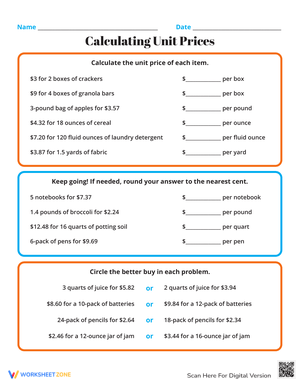
The unit rate worksheets work well as a launch for a price-comparison lesson. Have students complete the worksheet first — calculating unit prices for five grocery items — before showing them actual store flyers. The worksheet primes the calculation routine; the flyers supply the motivation. The combination takes about 25 minutes and connects the procedure to a decision students or their families actually make. For teachers covering the 6.RP.2 standard in October, this pairing gives the abstract standard a concrete anchor that students reference for the rest of the unit.
Printing a single ratios and rates worksheets file as a do-now — projected or distributed — reliably fills the six minutes between the bell and the start of direct instruction without requiring any setup. Students know the expectation; the format is familiar. That is enough.
Adjusting the Worksheets for a Range of Learners
For students still consolidating multiplication facts, ratio table worksheets become unnecessarily frustrating when the scale factor is a two-digit number. Swap in worksheets that use scale factors of 2, 3, 4, and 5 until the arithmetic stops being the obstacle. The goal is for those students to see the multiplicative pattern — not to practice multi-digit computation under a different label.
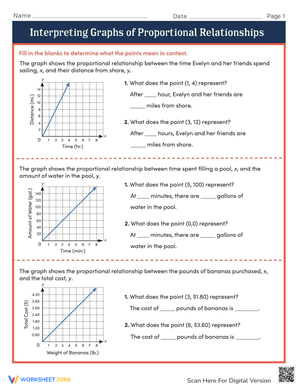
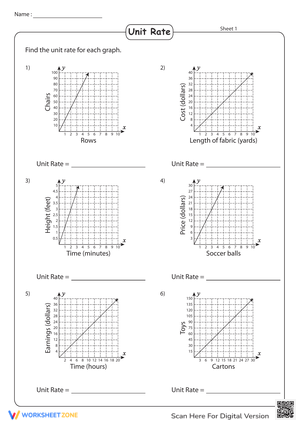
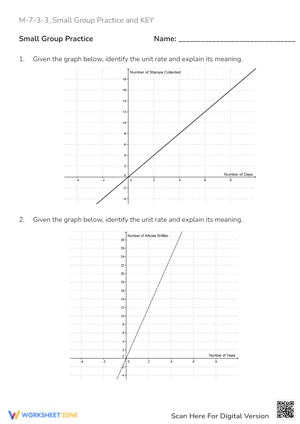
Students who grasp unit rates quickly stall on the standard problem set. The higher-demand worksheets introduce non-integer rates (a runner covering 5 miles in 38 minutes), unit conversions within the problem (feet per second to miles per hour), and graphing equivalent ratios as ordered pairs. That last extension deserves attention: when students plot (1, 3), (2, 6), (3, 9) and see a straight line through the origin, they are building intuition for linear functions a full year before algebra formally introduces the concept. Assign that worksheet as soon as proportionality is secure — don't wait for a later unit.
For students with reading difficulties, word-problem-heavy worksheets create a comprehension barrier that has nothing to do with ratio reasoning. Prioritize the visual-model worksheets — those built around tape diagrams and ratio tables — where the mathematical relationship is visible without dense text. Many of the printable ratios and rates worksheets files in this set use diagrams as the primary representation, which lowers the reading demand without reducing the mathematical rigor.
Standard Alignment
The core worksheets align to CCSS 6.RP.A.1 (understanding the concept of a ratio and using ratio language to describe a ratio relationship) and 6.RP.A.2 (understanding the concept of a unit rate and using rate language in context). The ratio table and equivalent ratio worksheets address 6.RP.A.3a, which requires students to make tables of equivalent ratios and find missing values. In classroom terms, the 6.RP cluster is typically taught in the first quarter of sixth grade; these worksheets map directly onto that instructional window and extend into the proportional relationships work formalized in 7.RP.A.2.
Frequently Asked Questions
What is the difference between a ratio and a rate?
A ratio compares any two quantities by division — the units can be the same or different. A rate is a ratio where the two quantities carry different units: miles and hours, dollars and ounces, words and minutes. All rates are ratios; not every ratio is a rate. The distinction matters in these worksheets because unit rate problems require students to name and track units in their answer, which is a separate cognitive step from the calculation itself.
How do you find a unit rate from a given rate?
Divide the first quantity by the second so the denominator becomes 1. If a recipe uses 3 cups of flour for every 12 cookies, divide 3 by 12 to get 0.25 cups per cookie. Students who write this as the fraction 3/12 and simplify to 1/4 arrive at the same answer, which is a useful connection to prior fraction work that teachers can make explicit.
At what grade level are ratios and rates first introduced?
Foundational ratio language appears in fifth grade through multiplicative comparison problems, but ratios and rates are formally introduced in sixth grade under the 6.RP standards. By seventh grade, the work extends into proportional relationships, constant rates of change, and percent problems. The worksheets in this set are written for the sixth-grade instructional window, though many of the unit rate and proportion worksheets see regular use in seventh grade as review or re-teaching tools.
Do the worksheets include answer keys?
Yes. Each worksheet includes a full answer key, which makes independent practice and homework practical — students check their work immediately rather than waiting a day for feedback. For classroom use, having the key available also lets teachers assign a worksheet as a self-correcting exit task during the last few minutes of a period, freeing them to circulate and observe rather than collect and grade.













 Interactive Worksheet Maker
 Quiz Maker
 Word Search Maker
 Crossword Puzzle Maker
 Word Scramble Generator
 Sentence Scramble Generator
 Handwriting Worksheet Generator
 Name Tracing Generator
 Fill In The Blank Generator