


























Views
Downloads



Printable Equivalent Ratios Worksheet | Grades 4-6 Math
Paste this activity's link or code into your existing LMS (Google Classroom, Canvas, Teams, Schoology, Moodle, etc.).
Students can open and work on the activity right away, with no student login required.
You'll still be able to track student progress and results from your teacher account.
Mastering equivalent ratios is a foundational pillar for success in middle school mathematics and introductory algebra. This comprehensive worksheet collection empowers students to identify, calculate, and verify proportional relationships through a variety of structured exercises. By focusing on the multiplicative nature of ratios, learners develop the fluency required for complex problem-solving.
At a Glance
- Grade: 4–6 · Subject: Math (Ratios)
- Standard:
CCSS.MATH.CONTENT.6.RP.A.3— Use ratio reasoning to find missing values in equivalent ratio equations and tables- Skill Focus: Identifying and calculating equivalent ratios
- Format: 3 pages · 38 problems · Answer key included · PDF
- Best For: Independent practice and formative assessment
- Time: 25–35 minutes
What's Inside
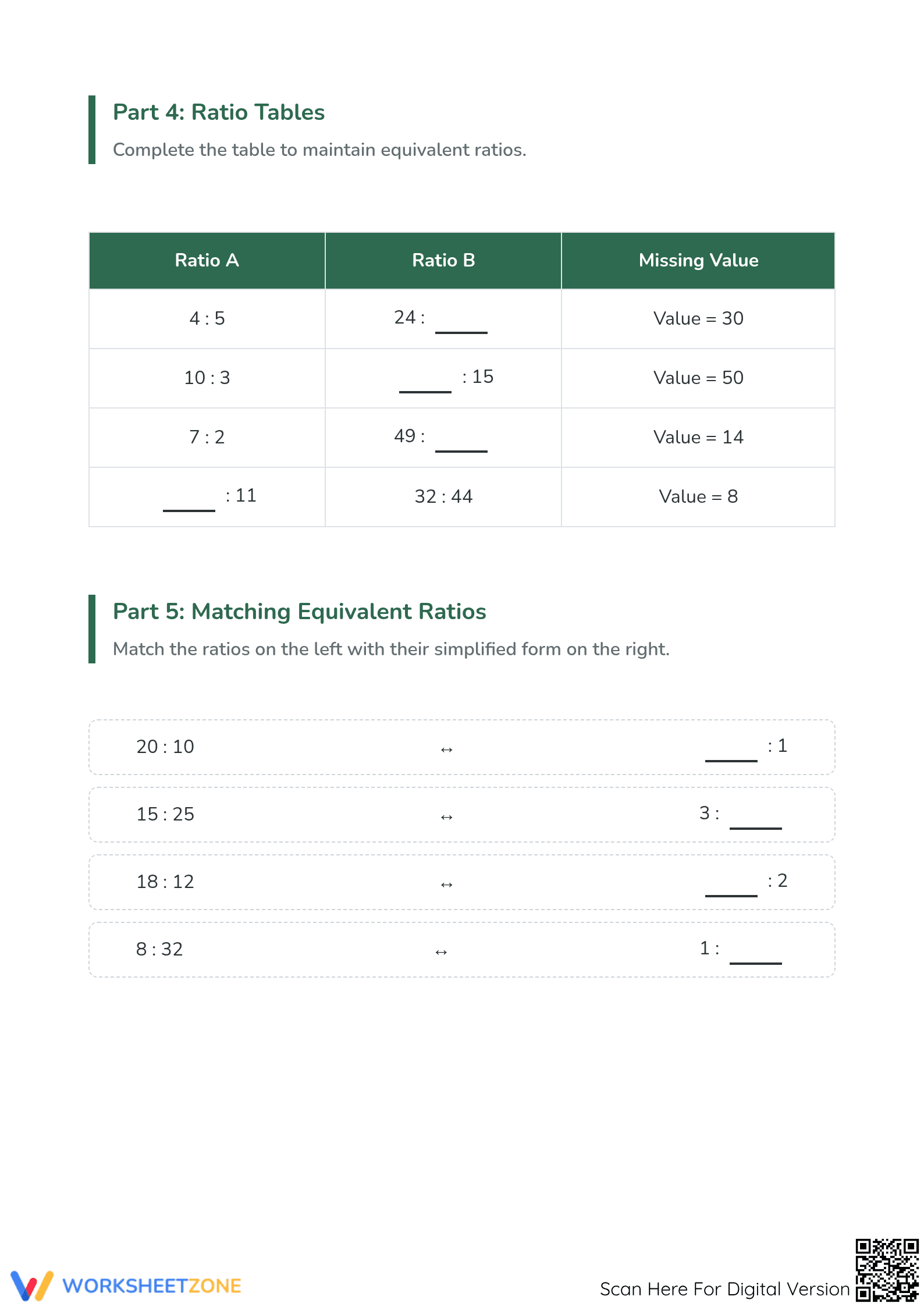
This three-page PDF contains 38 carefully designed tasks divided into five distinct sections. Students move from basic missing-number problems to more complex ratio tables and matching exercises. With zero teacher prep time required, the clear layout provides workspace for calculations, while the included answer key ensures that teachers can provide instant verification of work.
Skill Progression
- Guided Practice: The first 10 problems focus on basic equivalent ratios with simple scaling, allowing students to practice multiplication and division.
- Supported Practice: Problems 11 through 30 introduce larger numbers and varied positions for the unknown variable, reinforcing the concept of constant ratios.
- Independent Mastery: The final sections utilize tables and matching to test conceptual understanding and the ability to simplify ratios.
This gradual release approach builds student confidence and procedural fluency through an effective instructional cycle.
Standards Alignment
The content is meticulously aligned with CCSS.MATH.CONTENT.6.RP.A.3, which mandates that students use ratio and rate reasoning to solve mathematical problems. It specifically addresses the ability to "make tables of equivalent ratios relating quantities with whole-number measurements and find missing values." This standard code can be copied directly into lesson plans or curriculum mapping tools.
How to Use It
Assign this resource as a central component of a direct instruction lesson on proportions or as a high-impact homework assignment. For a quick formative assessment, observe students as they complete the ratio tables in Part 4; look for consistent application of the scaling factor across both columns. Expected completion time for the full set is approximately 30 minutes.
Who It's For
This resource is ideal for upper elementary and early middle school students who are transitioning from fraction work to proportional reasoning. It serves as an excellent intervention tool for learners requiring additional scaffolding or as a robust review for students preparing for standardized assessments. Pair it with an anchor chart on scaling factors for maximum impact.
The CCSS.MATH.CONTENT.6.RP.A.3 standard requires students to apply ratio and rate reasoning to solve mathematical problems, specifically by identifying and generating equivalent ratios. This worksheet facilitates this mastery by providing 38 distinct practice opportunities that transition from simple missing-number equations to structured ratio tables and simplification tasks. According to a ScienceDirect TpT Analysis (2024), structured practice sets that isolate a single mathematical sub-skill—such as finding proportionality constants—significantly reduce cognitive load for learners in the middle-grades transition. By presenting ratios in various visual formats, including horizontal equations and vertical tables, this resource helps students internalize the multiplicative relationship inherent in proportional reasoning. The inclusion of a comprehensive answer key allows for immediate feedback, which research suggests is critical for preventing procedural errors during independent practice. Educators can use these tasks to bridge the gap between concrete fraction knowledge and abstract algebraic thinking.


