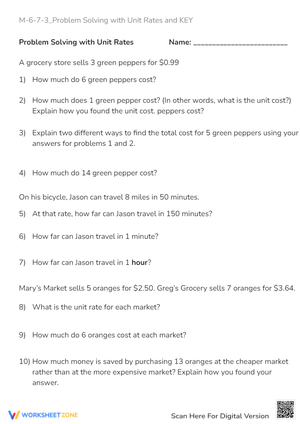
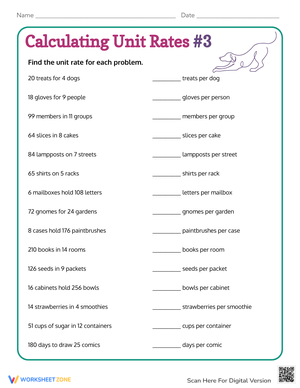
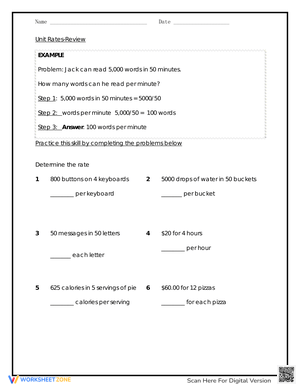
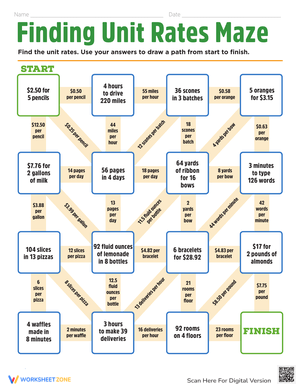
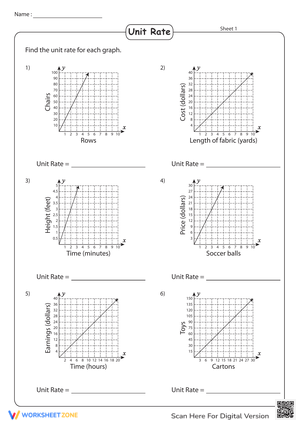
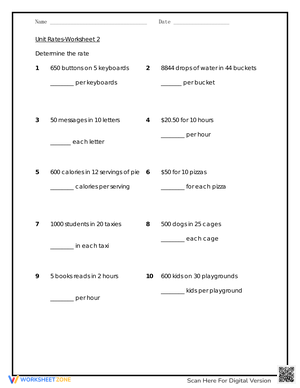
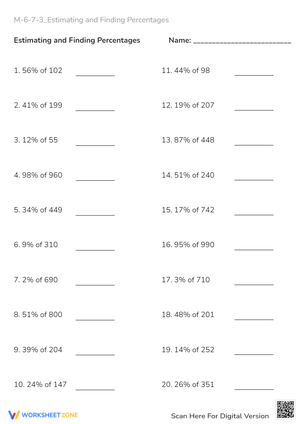
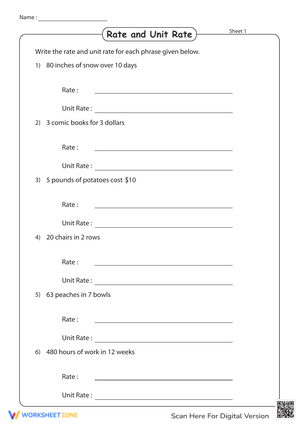
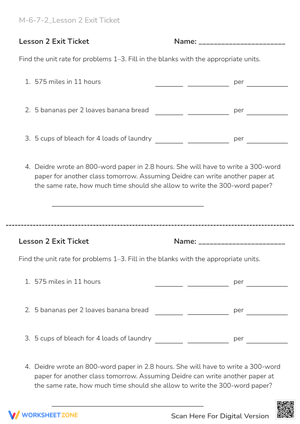
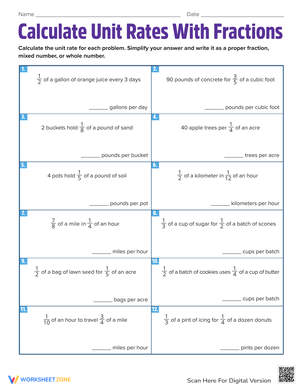
These unit rates printable worksheets give grade 6 and 7 teachers ready-made practice for one of the pivotal conceptual shifts in middle school math: the move from a raw ratio to a rate expressed per one unit. Each worksheet isolates a specific skill — simplifying whole-number rates, comparing unit prices, interpreting rate tables, solving speed-distance-time word problems — so the set functions as a flexible toolkit rather than a generic practice dump. The variety in format means a teacher can pull one worksheet for a Monday warm-up and reach for a different one when a small group needs targeted work on "better buy" comparisons.
The Specific Skills Each Worksheet Targets
The full set of unit rates printable worksheets covers the progression students work through across a standard 6.RP unit, from initial concept-building to multi-step application. Each worksheet addresses one skill slice, which makes it straightforward to match the right practice to the right instructional moment:
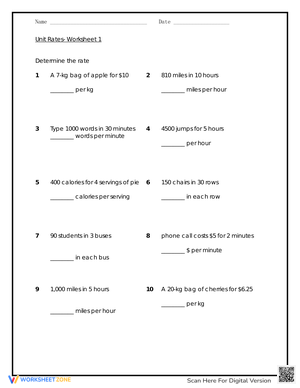
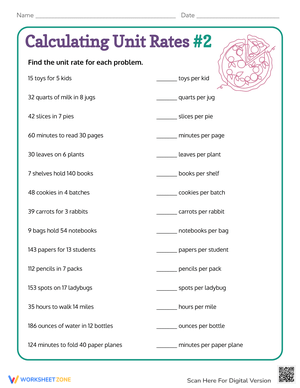
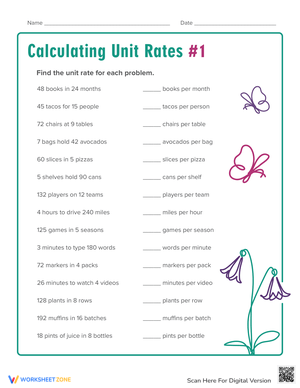
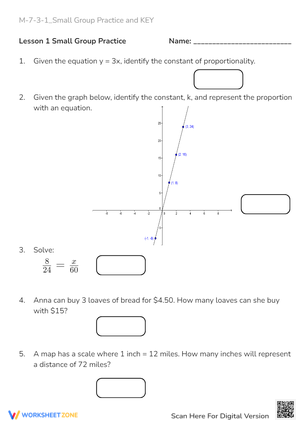
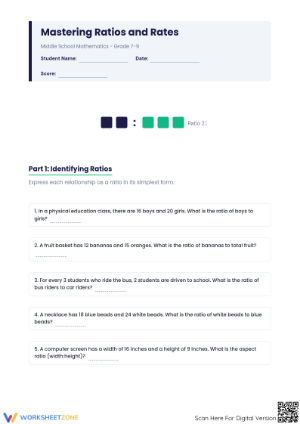
- Basic rate simplification: Students write a given comparison as a fraction, divide numerator by denominator, and label the resulting unit. Problems use whole numbers — 150 words in 3 minutes, 240 miles on 8 gallons — so arithmetic demands do not compete with the conceptual work.
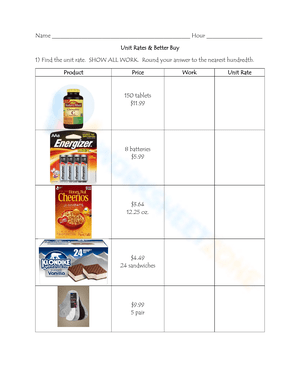
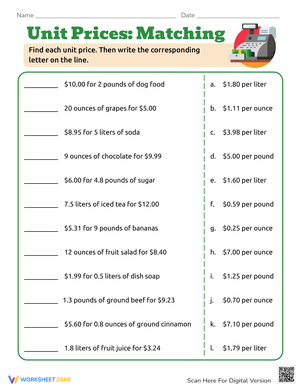
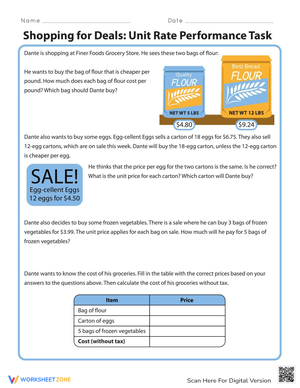
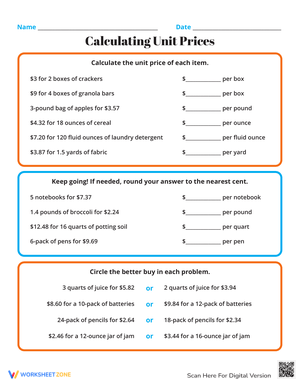
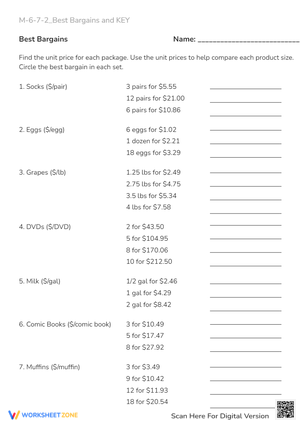
- Unit pricing comparisons: Two or three purchasing options appear side by side, and students calculate cost per ounce, cost per item, or cost per serving before identifying the better deal. These problems reward estimation habits as much as exact calculation.
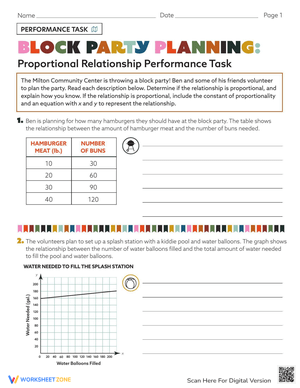
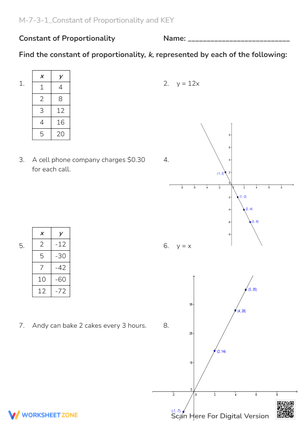
- Rate tables with missing entries: Students find the unit rate first, then use it to complete the table. This format trains students to treat a unit rate as a consistent multiplier — a critical bridge into proportional reasoning.
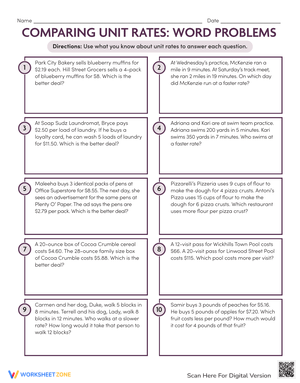
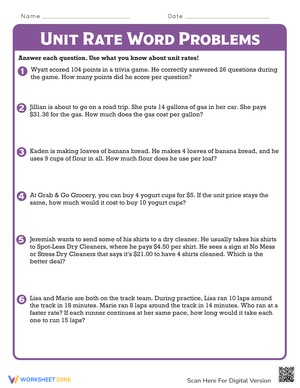
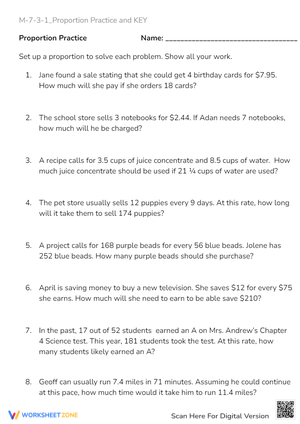
- Multi-step word problems: Speed, distance, and time scenarios, along with fractional-quantity pricing problems, push students to set up the rate correctly before dividing rather than reaching for a procedure by rote.
Common Errors Worth Watching For and Correcting
The most persistent error at this grade level is fraction inversion before dividing. A student who reads "a car travels 240 miles on 8 gallons" frequently writes 8/240 rather than 240/8, arriving at roughly 0.033 miles per gallon — a number that makes no real-world sense, but which many students accept without hesitation because they have not built the habit of checking whether an answer fits the context. The worksheets surface this error quickly because both the correct value and its reciprocal appear among the answer options, forcing a deliberate choice rather than a passive acceptance.
A second pattern shows up specifically with fractional rates. A student who handles whole-number problems cleanly will still stall on a problem like "3/4 pound of coffee costs $6.00 — what is the cost per pound?" Dividing a whole number by a fraction activates fraction-division anxiety even in students who are otherwise performing well. When this happens midway through a worksheet, the breakdown is visible and diagnostic: the teacher sees precisely where the reasoning collapsed rather than simply seeing a wrong answer circled on an exit ticket.
Standard Alignment
These worksheets align primarily to CCSS 6.RP.A.2, which asks students to understand the concept of a unit rate and use rate language in context, and to CCSS 6.RP.A.3b, which addresses unit pricing and constant-speed problems specifically. In classroom terms, 6.RP.A.2 typically lands in the early weeks of the ratio unit — before students begin solving proportions formally — making these worksheets appropriate for initial instruction and for formative checks during that window. The fractional-rate worksheets extend into CCSS 7.RP.A.1, which requires students to compute unit rates involving ratios of fractions. A grade 7 teacher can assign those to assess whether students carry the 6th-grade foundation forward while reaching into the more demanding 7th-grade standard.
Building These Worksheets Into Your Lesson Plans
The unit-pricing worksheets work well as a gallery walk during the first days of instruction. Post enlarged versions around the room, hand students a clipboard, and have them move in pairs to calculate the cost per unit at each station before the class reconvenes to compare. Students who talk through the division with a partner catch their own inversion errors in a way that silent individual work rarely produces. Reserve the rate-table worksheets for the 10-minute independent practice block that follows direct instruction; the structured format gives students just enough support to begin without the teacher hovering, and it frees the teacher to circulate and observe where reasoning breaks down.
The multi-step word-problem worksheets serve a different function: they work best as exit tickets on days when instruction has pushed into complex, two-step reasoning. A single problem at the end of class tells the teacher immediately whether the room understood the procedure or merely watched it happen. That data shapes the next morning's opening activity far more reliably than intuition does.
Adjusting the Worksheets Across Ability Levels
For students who are still developing fluency with long division, restricting them to the whole-number rate worksheets — while allowing calculator use for the division step — keeps the focus on the conceptual work: identifying which quantity is the numerator, which is the denominator, and what the resulting unit actually means. The unit rates printable worksheets in this set format the calculation steps and the answer line as visually separate elements, which makes it easy to tell a student, "Use the calculator for this step, then write the unit label on this line." The arithmetic barrier disappears; the reasoning stays in view.
Students ready for a stronger challenge can work the fractional-rate problems without setup support, then write a second version of each word problem — swapping in new quantities while preserving the mathematical structure. That generative task distinguishes surface-level procedural fluency from genuinely transferable understanding.
Frequently Asked Questions
What grade levels are these worksheets designed for?
The core set targets grade 6 and grade 7. The whole-number rate worksheets align to 6th-grade standards and work well for initial instruction and in-unit review. The fractional-rate and multi-step comparison worksheets align to 7th grade and serve equally well as extension work for advanced 6th graders. Grade 8 teachers occasionally pull the unit-pricing worksheets as a quick proportional reasoning refresher before introducing slope.
What is the difference between a rate and a unit rate?
A rate compares two quantities with different units — 90 miles in 3 hours, $7.50 for 5 apples. A unit rate simplifies that comparison so the second quantity equals one: 30 miles per hour, $1.50 per apple. The distinction sounds minor, but it matters on assessments, and students who cannot articulate it will miss items that use both terms in the same question stem.
How do I decide which worksheet to assign first?
Start with the basic rate-simplification worksheet to establish the procedure — write as a fraction, divide, label the unit. Once students handle whole-number rates without consistent errors, move to unit-pricing comparisons, which add the layer of deciding which calculated value answers the question. Rate tables come next because they require students to apply the unit rate repeatedly across a proportional relationship rather than once. Word problems should arrive last, when the procedure is automatic enough that reading demands do not crowd out the math.
Are these worksheets useful for standardized test preparation?
Unit rates appear on state assessments aligned to CCSS, and the problem formats in this set — particularly the "better buy" comparisons and the speed-distance-time word problems — match the style students encounter on 6th and 7th grade standardized tests. The unit rates printable worksheets in the set use context scenarios and numerical values consistent with actual assessment items, so working through them builds both the skill and the format familiarity that reduce test-day friction.













 Interactive Worksheet Maker
 Quiz Maker
 Word Search Maker
 Crossword Puzzle Maker
 Word Scramble Generator
 Sentence Scramble Generator
 Handwriting Worksheet Generator
 Name Tracing Generator
 Fill In The Blank Generator