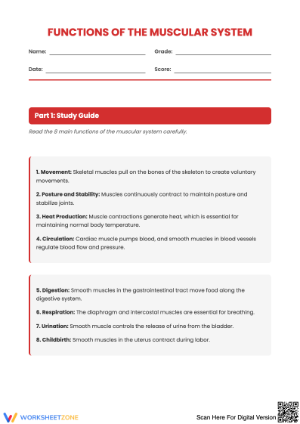
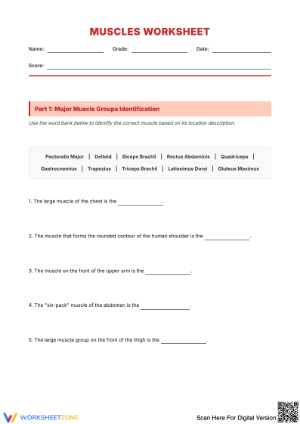
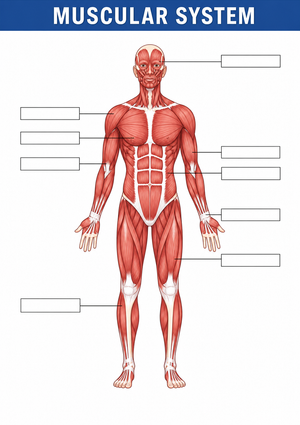
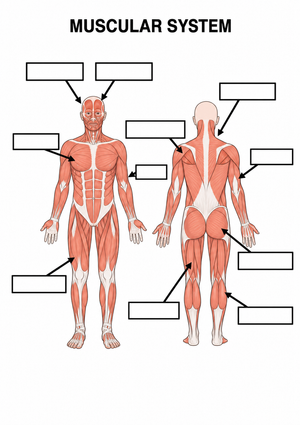
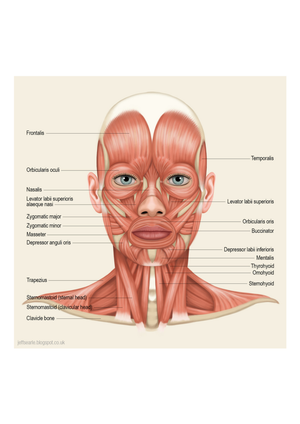
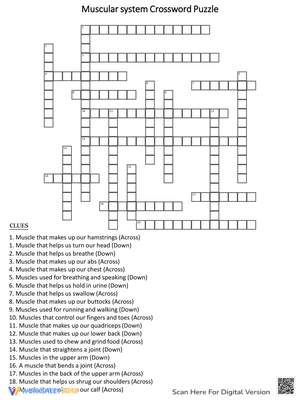
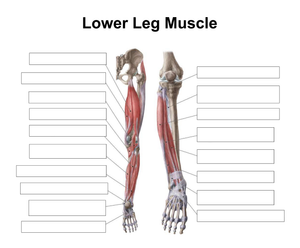
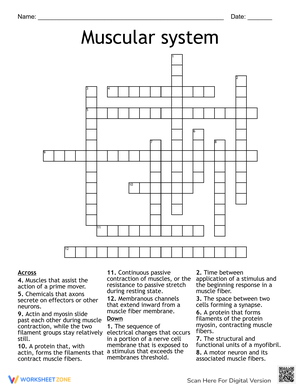
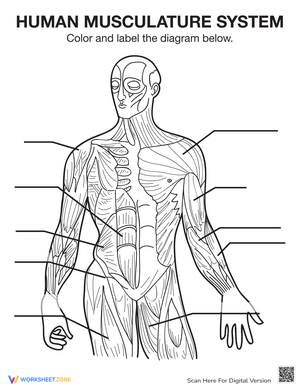
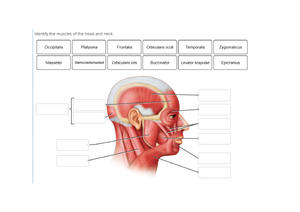
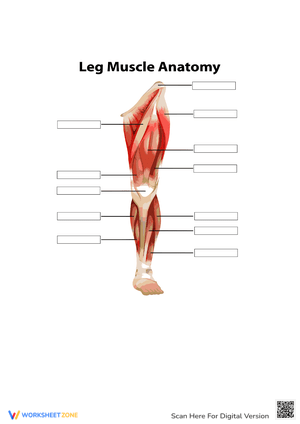
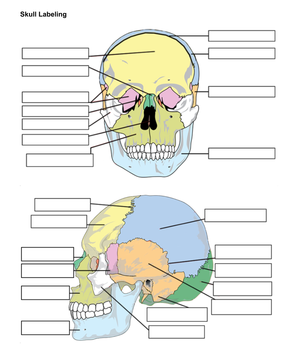
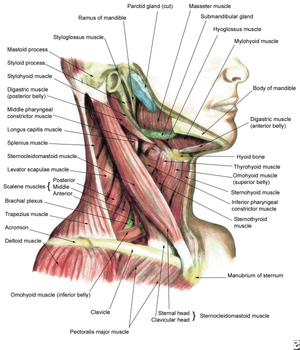
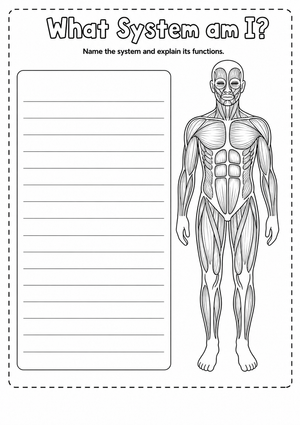
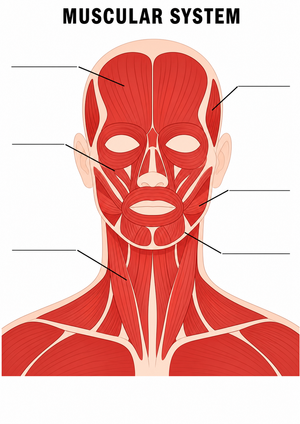
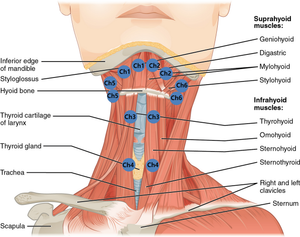
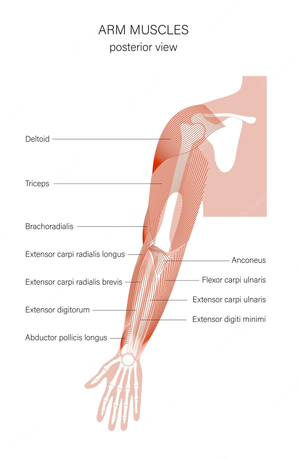
These muscular system printable worksheets for 7th grade cover the three muscle types, major skeletal muscle identification, voluntary versus involuntary control, and the mechanical relationship between muscles and bones. The set includes standalone labeling diagrams, vocabulary matching, cloze passages, and comprehension checks — formats that map directly onto the instructional sequence most middle school science teachers already follow during a human body systems unit.
What's Inside the Set
Seventh grade is typically when students first work with body systems at the level of explaining structure and function rather than simply naming parts. The muscular system printable worksheets for 7th grade in this set keep vocabulary work contextual: terms like tendon, cardiac, and voluntary appear in diagrams, sentence completions, and short readings rather than on isolated definition lists. The specific skills across the set include:
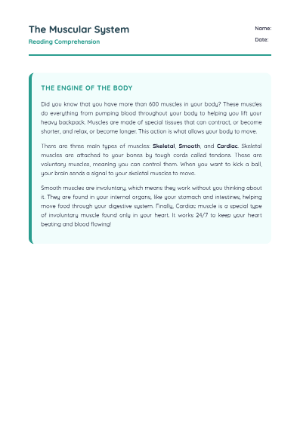
- Muscle type identification: Students distinguish skeletal, smooth, and cardiac muscle by structure, location, and function, and state the primary job of each.
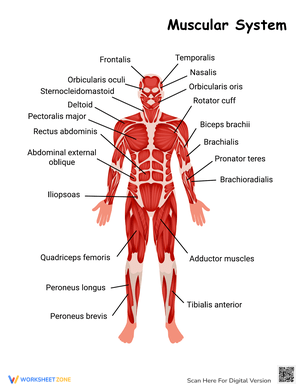
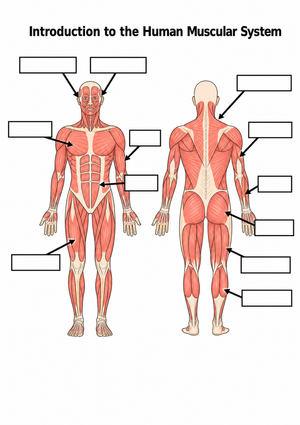
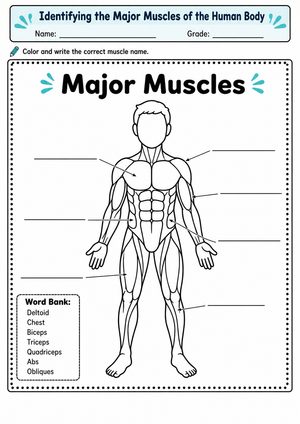
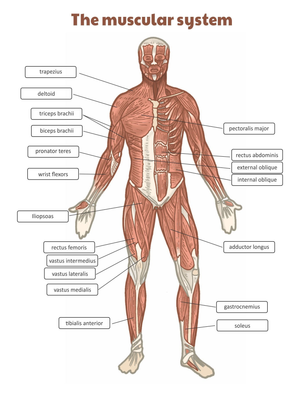
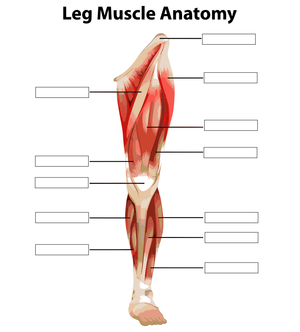
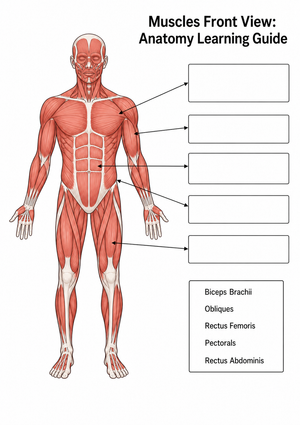
- Major muscle labeling: Each labeling worksheet targets the muscles students encounter most — biceps, triceps, quadriceps, hamstrings, gastrocnemius, abdominals, and pectorals.
- Voluntary versus involuntary control: Students sort muscle actions and connect control type to muscle category.
- Muscle-bone interaction: Students explain that skeletal muscles pull on bones through tendons and that opposing muscle pairs coordinate to produce movement.
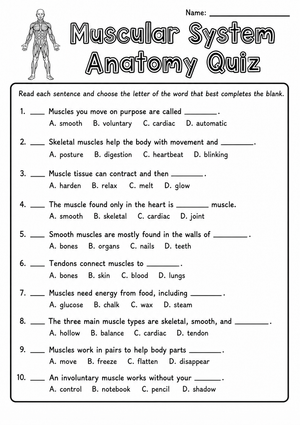
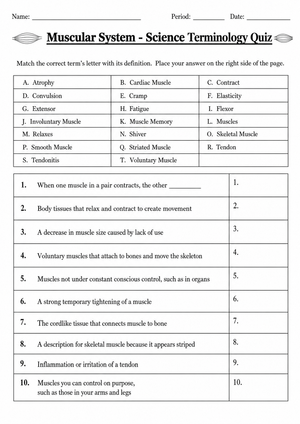
- Vocabulary in context: Short readings and cloze passages require students to apply terms accurately rather than recall them from a list.
That last point matters more than it might seem. Seventh graders memorize definitions quickly, but the real measure of understanding is whether they can use a term to explain something. These worksheets push them toward that level of application.
Mistakes Students Make That These Worksheets Help You Catch
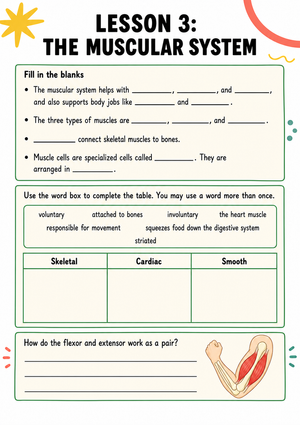
The most persistent confusion at this level involves cardiac and smooth muscle. Students correctly identify cardiac muscle as involuntary but then describe it in the same breath as smooth muscle — something that "just works on its own inside the body." What they miss is that cardiac muscle is striated and structurally distinct from smooth muscle. A three-column comparison worksheet asking students to record structure, location, and control type for each muscle category surfaces this conflation quickly, before it hardens into a quiz-day misconception.
A second pattern worth anticipating: students who correctly label the biceps on a diagram often cannot explain what the triceps does during the same movement. They treat each muscle as an independent structure rather than understanding antagonistic pairs. The most effective correction is a worksheet that shows both muscles during elbow flexion and asks students to annotate which contracts and which relaxes. That task makes the coordinated relationship visible in a way that a simple identification question cannot.
Working These Worksheets Into Your Planning
Each worksheet fits the 10-to-15 minute windows a typical 7th grade block creates — the warm-up before note-taking, the follow-up check right after a demonstration, or the closing segment before the bell. These are targeted tools for specific instructional moments, not extended projects.
- Day one of the muscle types lesson: Use a voluntary/involuntary sorting worksheet as a pre-assessment before introducing the three-category model. What students get wrong tells you where to slow down.
- After a diagram lesson: Move from a teacher-labeled model to an unlabeled student version the same day. Waiting until the review session costs retention.
- Station rotations: Pair a labeling worksheet with a short cloze reading and a comprehension check. Three formats, same content target, 20 minutes.
- Sub day: The vocabulary matching and cloze worksheets work without teacher setup — directions are self-contained and a word bank keeps the task accessible.
- Test prep block: Comprehension check worksheets with short-answer items double as focused review without requiring a separate study guide.
Teachers who work muscular system printable worksheets for 7th grade into the first half of a unit — rather than holding them for end-of-unit review — see stronger vocabulary retention on assessments. The spaced retrieval effect is real: students who encounter the same muscle names across three or four separate worksheets over two weeks recall them more reliably than students who see those names once in a concentrated study session.
One classroom move that consistently improves diagram accuracy: have students flex their forearm and place a hand on the biceps before picking up the labeling worksheet. That brief physical reference grounds an abstract diagram in something students can actually feel, and it reduces the guessing that happens when anatomical diagrams float free of any lived experience.
Where This Content Fits in a Larger Unit
The muscular system rarely lives alone in a 7th grade curriculum. Most teachers sequence it alongside the skeletal system and use it to introduce the idea that organ systems interact rather than operate independently. These worksheets support that cross-system thinking: students who label major skeletal muscles on one worksheet and then answer questions about tendons and bone attachment on another build understanding across lessons rather than collect isolated facts.
The cardiac muscle content creates a natural bridge to circulatory system instruction. When students learn that the heart wall consists of cardiac muscle — involuntary, striated, built to contract without rest — they carry that understanding forward into lessons on heart rate and circulation. A short worksheet connecting muscle type to organ function at that instructional juncture is more useful than repeating the same identification drill under a different heading.
Adjusting These Worksheets Across Ability Levels
Most worksheets in the set support differentiation without requiring separate lesson plans. Students who need more support benefit from a word bank on any fill-in or labeling worksheet, a reduced label count on diagram pages, and sentence frames for short-answer items: "The ______ muscle contracts when ______ because ______." On-level use means removing those supports and keeping the standard label count and comprehension questions intact.
For students ready for extension work, the strongest tasks are comparative: why the heart cannot fatigue the way the biceps does, or what happens to movement if the triceps fails to relax when the biceps contracts. Those questions require genuine understanding rather than recall. One honest limitation worth noting — diagram worksheets frustrate students who haven't yet internalized basic directional vocabulary. Anterior, posterior, medial, lateral: a three-minute review of those terms before distributing a labeling worksheet saves more time than it costs.
Standard Alignment
These worksheets align with NGSS MS-LS1-3, which asks students to use evidence to support the argument that the body is a system of interacting subsystems composed of groups of cells. The muscular system is one of the clearest entry points into that standard because the structure-function relationship is visible, testable, and grounded in students' direct physical experience. Teachers working with state-adapted standards will find that the core content — muscle types, major muscle identification, and muscle-bone interaction — maps onto virtually every 6th through 8th grade life science framework that addresses human body systems.
Frequently Asked Questions
Do these worksheets cover all three muscle types or only skeletal muscle?
Each worksheet specifies its content focus. The set includes worksheets addressing all three types — skeletal, smooth, and cardiac — as well as comparison activities that ask students to work across categories. Labeling worksheets concentrate on skeletal muscle because major muscle identification is the primary task there, but vocabulary and comprehension worksheets address all three types throughout the set.
What grade level is this content appropriate for?
The language and conceptual depth throughout the set target 7th grade, which is the most common placement for human body systems in U.S. middle school science curricula. Teachers at 6th or 8th grade will find the reading level and content appropriate for on-level students at either grade.
Can these worksheets function as assessments rather than just practice?
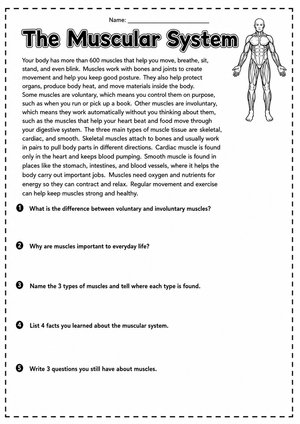
The comprehension check worksheets — which include multiple-choice, true-or-false, and short-answer items — work well as low-stakes formative assessments or exit tickets. They give teachers clear data about which students have grasped muscle type distinctions and which still need direct instruction before a unit test.
How do these worksheets connect to other body systems lessons?
Most directly to the skeletal system, since the muscle-bone interaction worksheets pair naturally with any lesson on joints and bone structure. The cardiac muscle content connects to circulatory system instruction. For teachers planning a full body systems unit, this set of muscular system printable worksheets for 7th grade supports that progression — each worksheet reinforces content from the lesson before while introducing vocabulary students will need in the lesson ahead.












 Interactive Worksheet Maker
 Quiz Maker
 Word Search Maker
 Crossword Puzzle Maker
 Word Scramble Generator
 Sentence Scramble Generator
 Handwriting Worksheet Generator
 Name Tracing Generator
 Fill In The Blank Generator