


























Views
Downloads
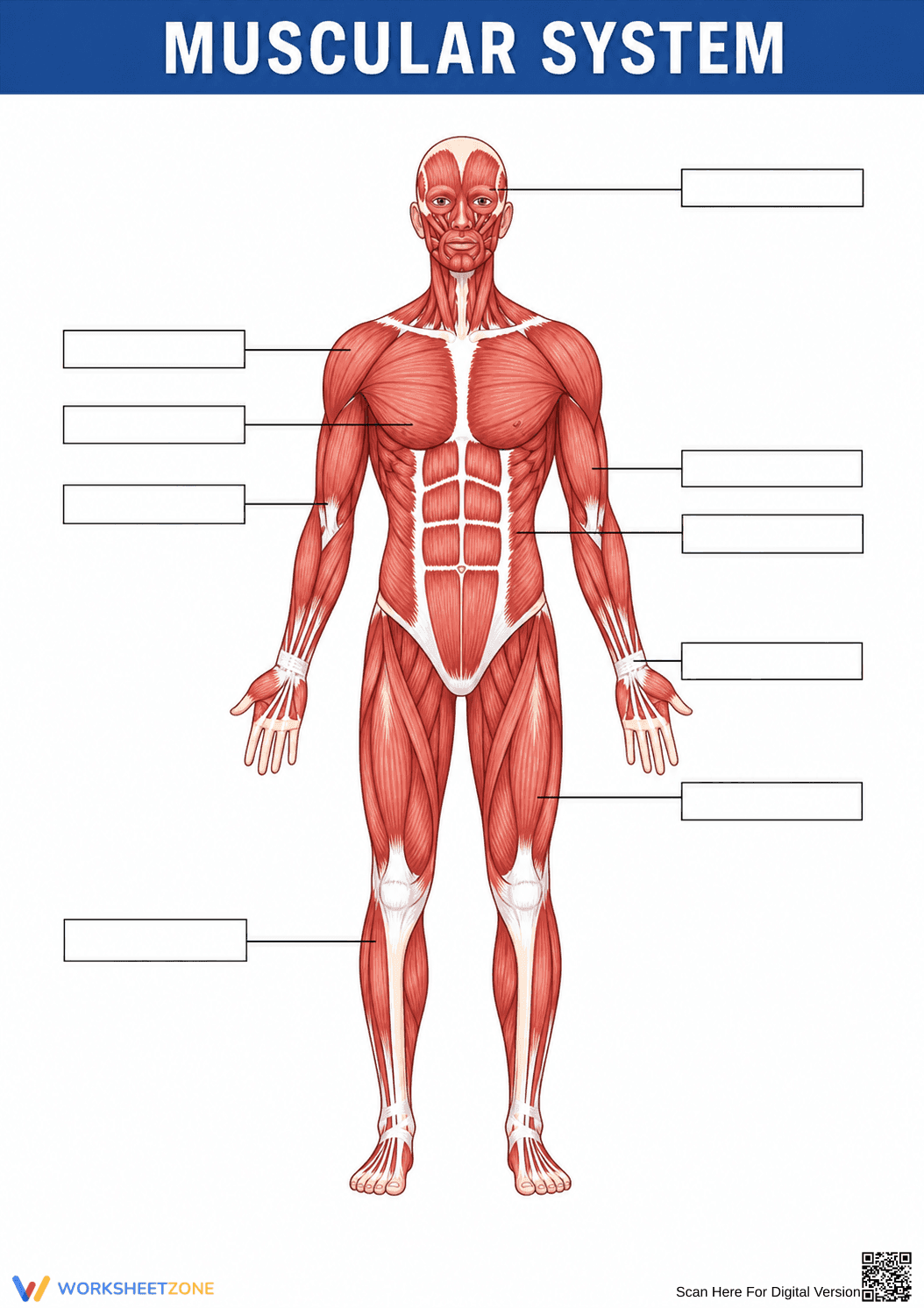

Grade 7 Muscular System — Printable No-Prep Worksheet
Paste this activity's link or code into your existing LMS (Google Classroom, Canvas, Teams, Schoology, Moodle, etc.).
Students can open and work on the activity right away, with no student login required.
You'll still be able to track student progress and results from your teacher account.
This single-page science worksheet requires students to identify and label major muscles of the human body. By completing this visual anatomy exercise, learners will reinforce their understanding of the muscular system's structure and function, building a strong foundation for advanced biology and health science coursework.
At a Glance
- Grade: 7 · Subject: Science
- Standard:
MS-LS1-3— Identify interacting subsystems within the human body- Skill Focus: Labeling the muscular system
- Format: 1 page · 9 problems · Answer key included · PDF
- Best For: Independent practice and review
- Time: 10–15 minutes
This resource features a clear anatomical diagram of the human muscular system. Students fill in nine blank text boxes pointing to major muscle groups, such as the pectoralis major and quadriceps. The download includes a complete answer key for quick grading and a clean layout that focuses entirely on the anatomical structures.
This print-and-go resource is designed for maximum efficiency.
- Print: Generate copies for your class in under one minute.
- Distribute: Hand out the single-page diagram as a bell-ringer.
- Review: Grade submissions rapidly using the provided answer key.
With a total teacher prep time of under two minutes, this worksheet is an excellent addition to any emergency sub plan.
This activity is aligned to MS-LS1-3, which requires students to use an argument supported by evidence for how the body is a system of interacting subsystems composed of groups of cells. By identifying specific muscles, students build the vocabulary necessary to describe how the muscular system interacts with the skeletal and nervous systems. Both standard codes can be copied directly into lesson plans, IEP goals, or district curriculum mapping tools.
Deploy this diagram as a formative assessment after direct instruction on the muscular system, or use it as a quiet, independent review activity before a unit exam. As students work, circulate the room and observe whether they are confusing proximal and distal muscle groups, which can indicate a need for a quick reteach on anatomical terminology. Expected completion time ranges from 10 to 15 minutes, making it a highly flexible tool for various instructional moments.
This worksheet is primarily designed for middle school and early high school students in general science, biology, or health classes. To support learners who need accommodations, teachers can provide a word bank on the board or allow the use of guided notes. It pairs perfectly with an interactive 3D anatomy model or a direct instruction lesson on how muscles contract to produce movement.
Mastering anatomical terminology through visual labeling tasks is a critical step in understanding human biology and physiology. Aligned with MS-LS1-3, this exercise requires students to identify interacting subsystems within the human body. According to a ScienceDirect TpT Analysis, integrating visual diagrams with active recall exercises significantly improves long-term retention of complex biological structures compared to text-based memorization alone. When students physically write the names of specific muscles next to their corresponding anatomical locations on a diagram, they engage multiple cognitive pathways, reinforcing both spatial relationships and physiological functions. This targeted practice ensures learners can confidently discuss how the muscular system supports movement, stability, and overall homeostasis. By isolating this specific skill, educators can accurately measure foundational knowledge, preparing students for more rigorous scientific inquiry and advanced health science coursework in high school and beyond.


