




























0
Views
0
Downloads

Save
0 Likes
Share
Identifying Neck Muscles
0 Views
0 Downloads

Paste this activity's link or code into your existing LMS (Google Classroom, Canvas, Teams, Schoology, Moodle, etc.).
Students can open and work on the activity right away, with no student login required.
You'll still be able to track student progress and results from your teacher account.
Information
Description
What It Is:
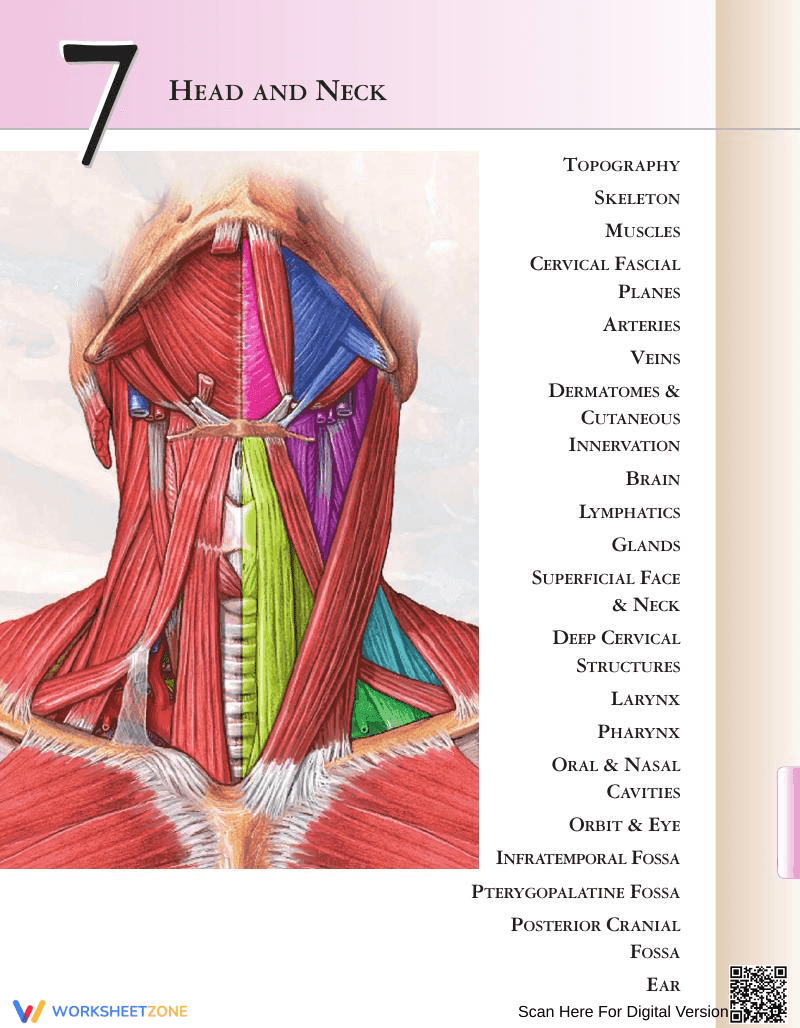
This is an anatomical diagram of the head and neck. The diagram shows the muscles, arteries, veins, and other structures of the head and neck. A list to the right of the diagram provides labels for various anatomical features including topography, skeleton, muscles, cervical fascial planes, arteries, veins, dermatomes & cutaneous innervation, brain, lymphatics, glands, superficial face & neck, deep cervical structures, larynx, pharynx, oral & nasal cavities, orbit & eye, infratemporal fossa, pterygopalatine fossa, posterior cranial fossa, and ear.
Grade Level Suitability:
This worksheet is suitable for high school students (Grades 9-12) and college students studying anatomy, biology, or pre-med. The level of detail and anatomical terminology requires a strong understanding of scientific concepts.
Why Use It:
This worksheet provides a visual aid for learning about the anatomy of the head and neck. It helps students to identify and understand the relationships between different anatomical structures. It is useful for studying the muscles, arteries, veins, and other structures of the head and neck.
How to Use It:
Use the diagram to identify the different anatomical structures of the head and neck. Study the list of labels to learn the names and locations of the various structures. Use the diagram as a reference when studying the anatomy of the head and neck. The diagram can be used for self-testing and review.
Target Users:
This worksheet is ideal for students in high school or college anatomy and physiology courses, medical students, nursing students, and other healthcare professionals. It can also be used by anyone interested in learning more about the anatomy of the head and neck.
This is an anatomical diagram of the head and neck. The diagram shows the muscles, arteries, veins, and other structures of the head and neck. A list to the right of the diagram provides labels for various anatomical features including topography, skeleton, muscles, cervical fascial planes, arteries, veins, dermatomes & cutaneous innervation, brain, lymphatics, glands, superficial face & neck, deep cervical structures, larynx, pharynx, oral & nasal cavities, orbit & eye, infratemporal fossa, pterygopalatine fossa, posterior cranial fossa, and ear.
Grade Level Suitability:
This worksheet is suitable for high school students (Grades 9-12) and college students studying anatomy, biology, or pre-med. The level of detail and anatomical terminology requires a strong understanding of scientific concepts.
Why Use It:
This worksheet provides a visual aid for learning about the anatomy of the head and neck. It helps students to identify and understand the relationships between different anatomical structures. It is useful for studying the muscles, arteries, veins, and other structures of the head and neck.
How to Use It:
Use the diagram to identify the different anatomical structures of the head and neck. Study the list of labels to learn the names and locations of the various structures. Use the diagram as a reference when studying the anatomy of the head and neck. The diagram can be used for self-testing and review.
Target Users:
This worksheet is ideal for students in high school or college anatomy and physiology courses, medical students, nursing students, and other healthcare professionals. It can also be used by anyone interested in learning more about the anatomy of the head and neck.


