




























Views
Downloads
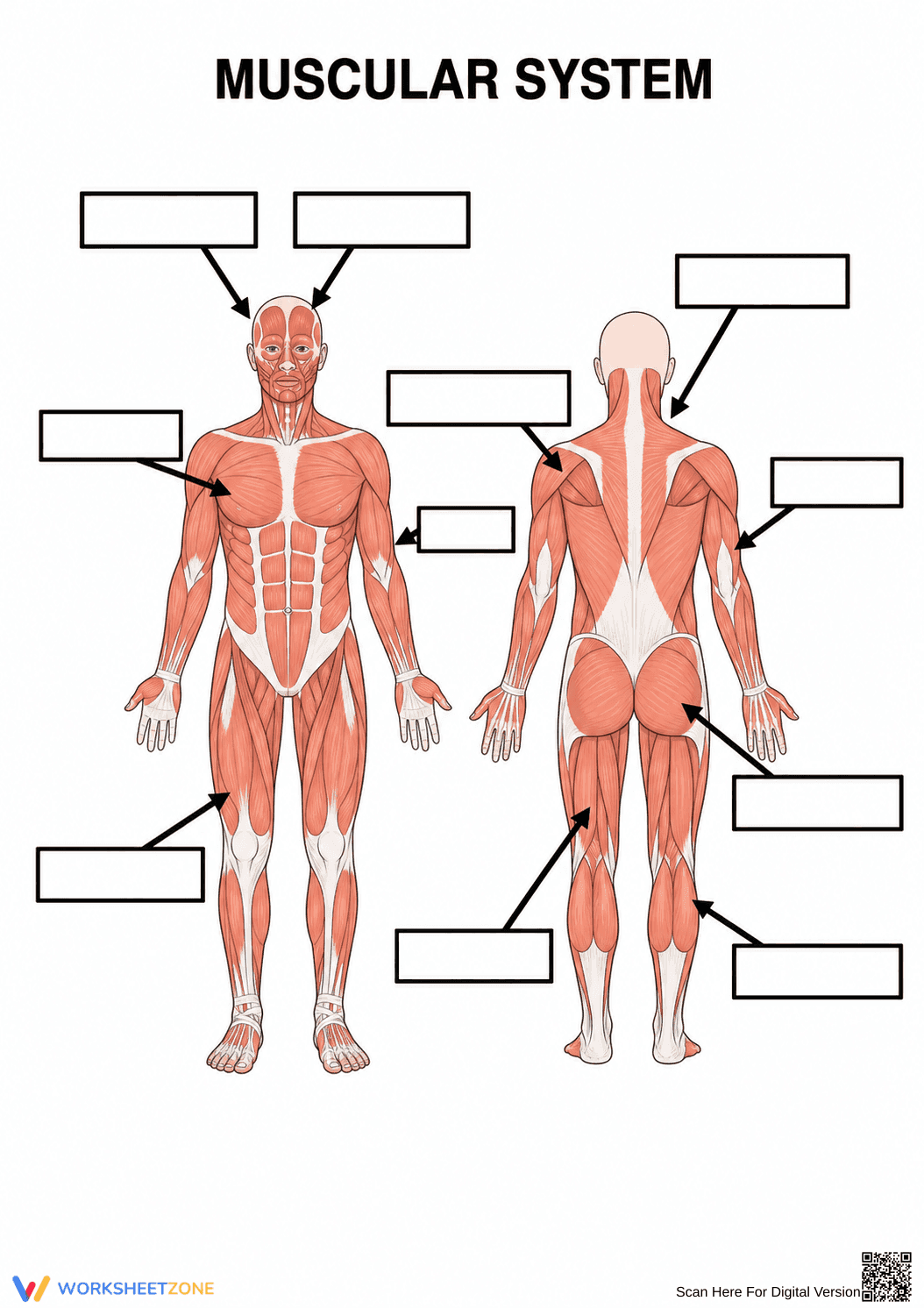

Essential Muscular System Labeling Worksheet | Grades 5-8

Paste this activity's link or code into your existing LMS (Google Classroom, Canvas, Teams, Schoology, Moodle, etc.).
Students can open and work on the activity right away, with no student login required.
You'll still be able to track student progress and results from your teacher account.
This muscular system worksheet provides a comprehensive visual assessment for students to identify and label major muscle groups. By mapping the human body's anterior and posterior views, learners develop a concrete understanding of anatomical structures and their locations. It is an effective tool for reinforcing biological vocabulary and foundational physiology concepts in middle school.
At a Glance
- Grade: 5-8 · Subject: Science
- Standard:
MS-LS1-3— Describe how the body is a system of interacting subsystems composed of groups of cells- Skill Focus: Muscle identification and anatomical terminology
- Format: 1 page · 11 problems · Answer key included · PDF
- Best For: Quick formative assessment or anatomy review
- Time: 15–20 minutes
This single-page PDF features high-quality illustrations of the human muscular system from both the front and back perspectives. It contains 11 strategically placed call-out boxes with arrows pointing to major muscles such as the pectorals, abdominals, and gluteus maximus. The clean layout ensures students have ample space to write, and a full answer key is provided for rapid grading.
This resource is designed for immediate classroom implementation with a total teacher prep time of under 2 minutes. Simply print the required number of copies and distribute them to students. Because the diagram is self-explanatory, it functions perfectly as a standalone sub plan or a quiet bell-ringer activity. Reviewing the answers as a class takes less than five minutes.
The worksheet aligns with `MS-LS1-3`, focusing on how the muscular system serves as a vital subsystem within the human body. Students demonstrate their understanding of structural organization by correctly identifying the components of the system. Both standard codes can be copied directly into lesson plans, IEP goals, or district curriculum mapping tools.
Use this worksheet as a summative check after a lecture on the human body or as a pre-assessment to gauge prior knowledge. For a formative assessment observation, watch for students who struggle to distinguish between the anterior and posterior views. Expected completion time ranges from 15 to 20 minutes depending on student familiarity with the terms.
This activity is tailored for middle school students in grades 5 through 8 studying life science or health. It is particularly helpful for visual learners and can be paired with a 3D anatomical model or a muscular system anchor chart to provide additional support for students who need visual scaffolding.
This anatomy resource targets the MS-LS1-3 standard, requiring students to identify 11 major muscles to demonstrate knowledge of human body subsystems. According to the RAND AIRS 2024 report on instructional materials, high-quality visual aids and labeling tasks significantly improve the retention of complex biological terminology in middle school learners. By engaging in active recall through diagram labeling, students move beyond passive reading to active participation in the learning process. This worksheet provides the necessary repetition for students to master anatomical vocabulary before progressing to more complex physiological functions. The inclusion of both anterior and posterior views ensures a holistic understanding of the muscular system's layout. Educators can utilize this tool to provide evidence of student progress toward NGSS mastery, ensuring that curriculum goals are met with precision and clarity.


