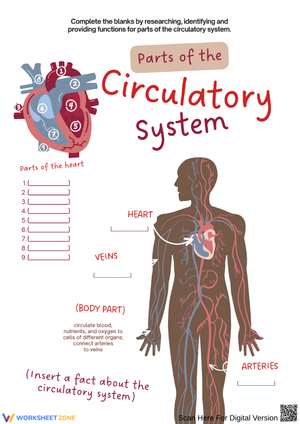
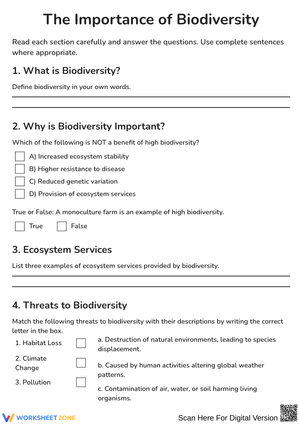
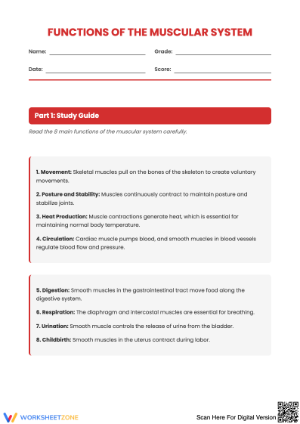
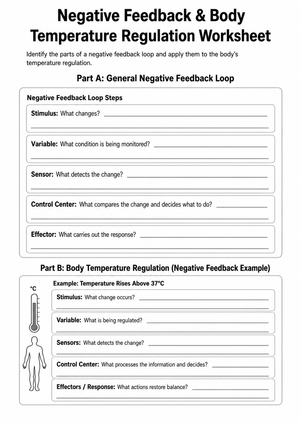
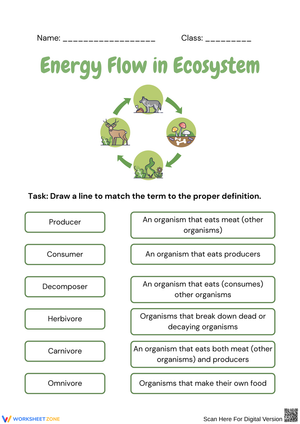
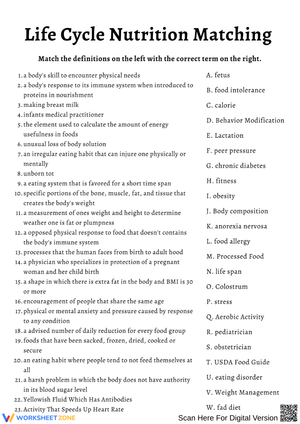
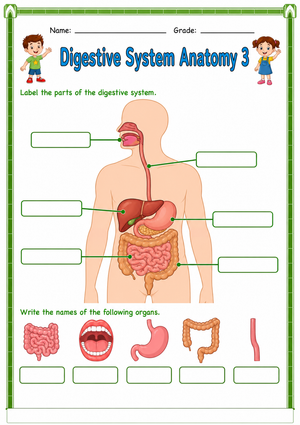
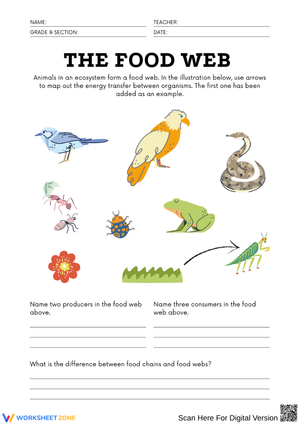
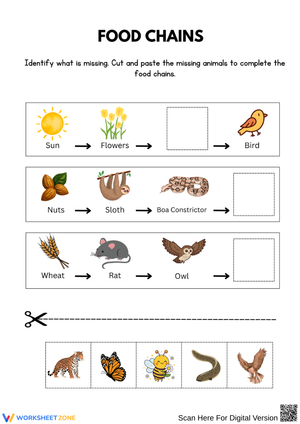
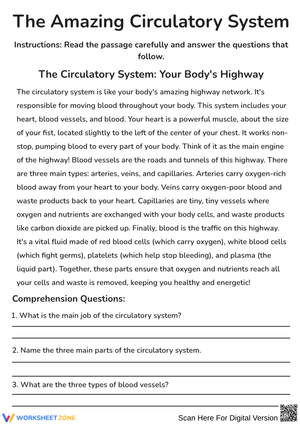
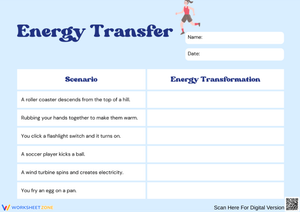
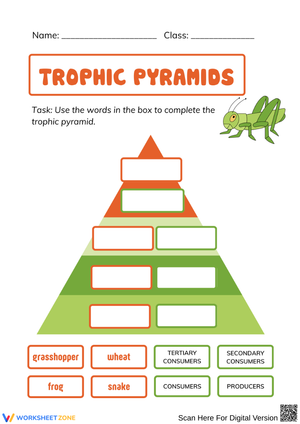
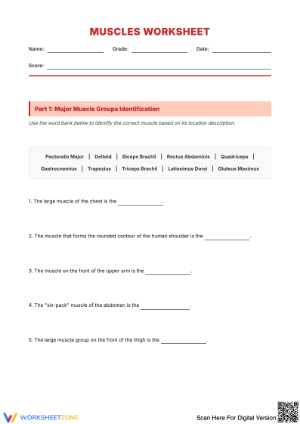
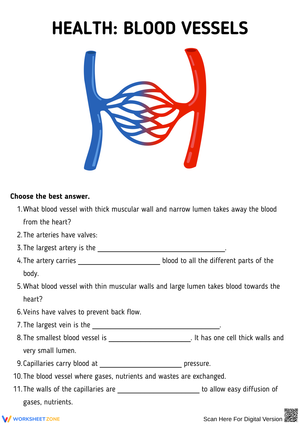
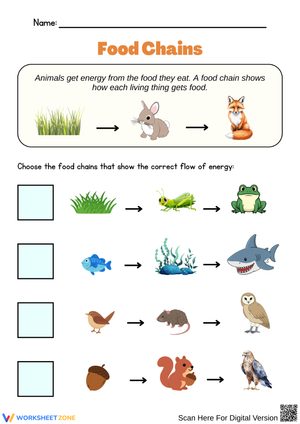
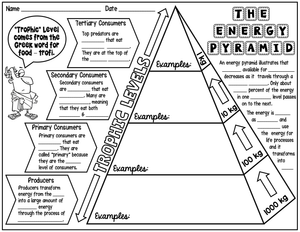
These human body systems pdf worksheets for 7th grade give life science teachers printable practice that goes past organ naming—each worksheet pushes students to explain function and trace how systems interact, which is where understanding actually lives at this grade level. The set covers circulatory, respiratory, digestive, nervous, skeletal, muscular, and immune systems, with task types ranging from diagram labeling and vocabulary matching to short reading response and system-interaction questions.
The Specific Skills Each Worksheet Targets
Seventh graders typically arrive in life science with a rough surface map of the body—they know the heart pumps blood, the lungs do something with air, and bones hold you up. What they lack is the language and the connective thinking to explain how and why. Each worksheet in the set targets one of four skill layers:
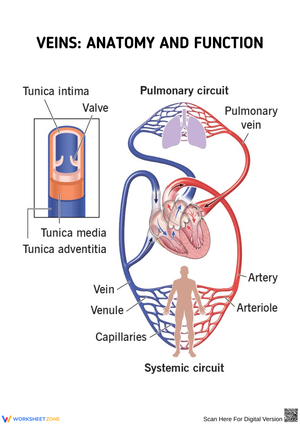
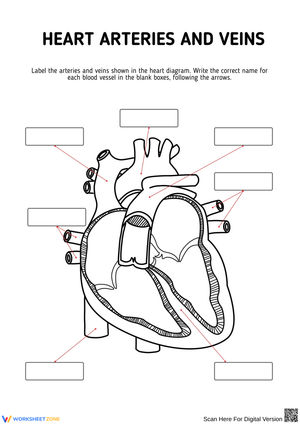
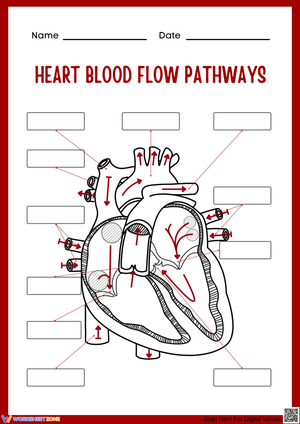
- Structure identification: labeling diagrams of major organs and tracing pathways—blood through the heart's chambers, air through the bronchioles, food through the gastrointestinal tract
- Function explanation: writing or completing sentences that describe what each structure does, not just what it is called
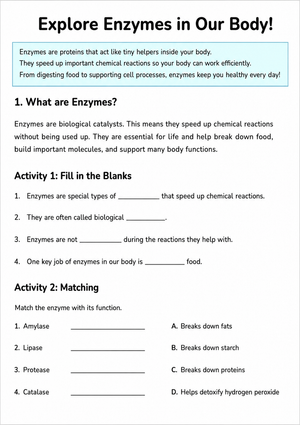
- Vocabulary precision: matching and cloze tasks for terms like alveoli, neuron, tendon, villi, and homeostasis that students need to use accurately in lab reports and on assessments
- System interaction: questions that ask students to connect two or more systems—how the muscular and skeletal systems cooperate in movement, or why the circulatory system is the delivery mechanism for nutrients the digestive system breaks down
That last category carries the most instructional weight. Teachers who have run these units know that students can label a heart diagram correctly and still write "the lungs clean the blood" on a quiz. The interaction questions force students to articulate the mechanism, not just recall the name.
Mistakes Students Make That These Worksheets Help You Catch
The most stubborn misconception in a body systems unit is treating each system as isolated. Students who can label all four heart chambers will still write "the heart makes blood" on a free-response item, because they have memorized structure without tracking what that structure does in context. A related error appears in the respiratory unit: students understand that the lungs take in oxygen but describe the alveoli as filtering oxygen out of the air rather than exchanging gases across a membrane. That distinction—filtering versus diffusion—does not surface unless a worksheet explicitly asks students to explain the mechanism, not just identify the structure.
In the digestive system, the sequence error is common. Students list organs in roughly the right order but place the liver and pancreas as stations that food passes through, rather than glands that release substances into the digestive tract at specific points. Worksheets that ask students to draw arrows showing where enzymes and bile enter the pathway—rather than simply labeling organ names—expose this confusion in about thirty seconds of looking at student work.
The nervous system brings its own predictable trouble. Students often reverse the direction of a nerve signal, writing that the brain sends a pain signal to the finger rather than the finger sending a sensory signal to the brain. A stimulus-response sequencing task, where students order the steps of a reflex arc from stimulus to response, addresses this directly and makes the misconception visible before it shows up on a unit test.
How to Fit These Worksheets Into a Week of Instruction
The most reliable use pattern across a body systems unit is one worksheet per day as a focused opener, with the class period's lab or discussion building on what students noticed while completing it. A labeling worksheet on the circulatory system at the start of class gives students a shared reference before a group discussion about blood pressure or heart disease. A vocabulary matching worksheet the day before a quiz works well as a ten-minute retrieval exercise—students get terms back in front of them without re-reading a full textbook chapter, which is a more efficient use of the last block of review time than re-teaching.
For station rotations, the human body systems pdf worksheets for 7th grade format across this set lets teachers assign one task type per station—labeling at one, vocabulary at another, system-interaction questions at a third—so every student touches the same content through different cognitive demands in a single period. For sub plans, the reading-response worksheets work especially well because directions are self-contained and students do not need teacher modeling to begin.
- Monday warm-up after a weekend: vocabulary matching or cloze notes to reactivate prior knowledge before building new content
- Mid-lesson anchor: one diagram worksheet to ground lecture-based notes before moving to application tasks
- Friday review block: a mixed-question worksheet covering the week's system, used as a self-check students score against an answer key
- Emergency sub day: a reading-response worksheet on a system already taught, with directions clear enough that a non-science sub can distribute and collect without explanation
Adjusting the Worksheets for a Range of Learners
Most 7th grade life science classes carry a wide band of readiness. Some students are still building reading comprehension skills while others are ready for multi-step reasoning about homeostasis and feedback loops. The human body systems pdf worksheets for 7th grade in this set serve both ends without requiring teachers to pull entirely separate materials. Labeling worksheets can be used with word banks intact for students who need retrieval support, or with word banks removed for students who are ready to work from memory. System-interaction questions can be held back until students have solid command of individual system functions, then introduced as an extension rather than a core task for every student on the same day.
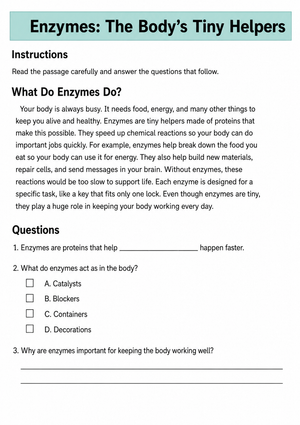
For students who need additional access to content, the reading-response worksheets work well when read aloud in a small group, since the questions are structured enough to be completed independently once the passage is understood. For students ready to go further, asking them to add a third body system to any two-system interaction question—explaining, for instance, how the immune system also responds when the circulatory system delivers pathogens to a tissue—turns a grade-level task into a higher-order one without requiring a separate worksheet to design or print.
Standard Alignment
These worksheets align most directly to NGSS MS-LS1-3, which asks students to use argument supported by evidence to describe how the body is a system of interacting subsystems composed of groups of cells. That standard lands in 7th grade life science sequences in most US states and specifically calls for system-level thinking, not organ-by-organ memorization. The system-interaction questions in the set directly serve that expectation—students trace how two or more systems cooperate, which is the kind of evidence-based explanation MS-LS1-3 requires.
The content also maps to disciplinary core idea LS1.A (Structure and Function) and supports crosscutting concept work in Systems and System Models, where students practice seeing the body as an organized set of parts whose interactions produce outcomes no single system could produce on its own. Teachers in states using supplementary frameworks will find those crosscutting connections the most straightforward to document when aligning lessons to local standards.
Frequently Asked Questions
Which body systems does the set cover?
The worksheets address circulatory, respiratory, digestive, nervous, skeletal, muscular, and immune systems. Each system has at least one labeling worksheet and one function-based or vocabulary worksheet. System-interaction questions appear throughout the set and draw from multiple systems in a single task rather than isolating one at a time.
Do the worksheets include answer keys?
Yes. Each worksheet comes with a corresponding answer key. For labeling tasks, the key shows correct organ placement and names. For written-response items, the key provides sample answers written in grade-appropriate language rather than requiring a single exact phrasing, so teachers can use them as flexible scoring guides rather than rigid rubrics—useful especially when different class sections are at slightly different points in the unit.
Are these printable or digital?
The resources are formatted as PDFs, which keeps diagram layouts and text spacing consistent across any printer or device. Teachers can print directly, attach files to a learning management system for digital completion on a tablet, or project individual worksheets during whole-class instruction. The human body systems pdf worksheets for 7th grade format preserves diagram clarity and label spacing regardless of whether a student prints or annotates digitally.
How do these compare to textbook end-of-chapter review pages?
Textbook review pages typically test recall of bolded vocabulary and chapter facts. These worksheets ask students to explain processes, sequence events, and connect systems—tasks closer to what appears on state science assessments and in lab write-ups. The stimulus-response sequencing tasks, the gas-exchange explanation questions, and the multi-system interaction prompts are specifically the kinds of items students have not seen if their only practice has come from textbook chapter reviews.












 Interactive Worksheet Maker
 Quiz Maker
 Word Search Maker
 Crossword Puzzle Maker
 Word Scramble Generator
 Sentence Scramble Generator
 Handwriting Worksheet Generator
 Name Tracing Generator
 Fill In The Blank Generator