




























Views
Downloads
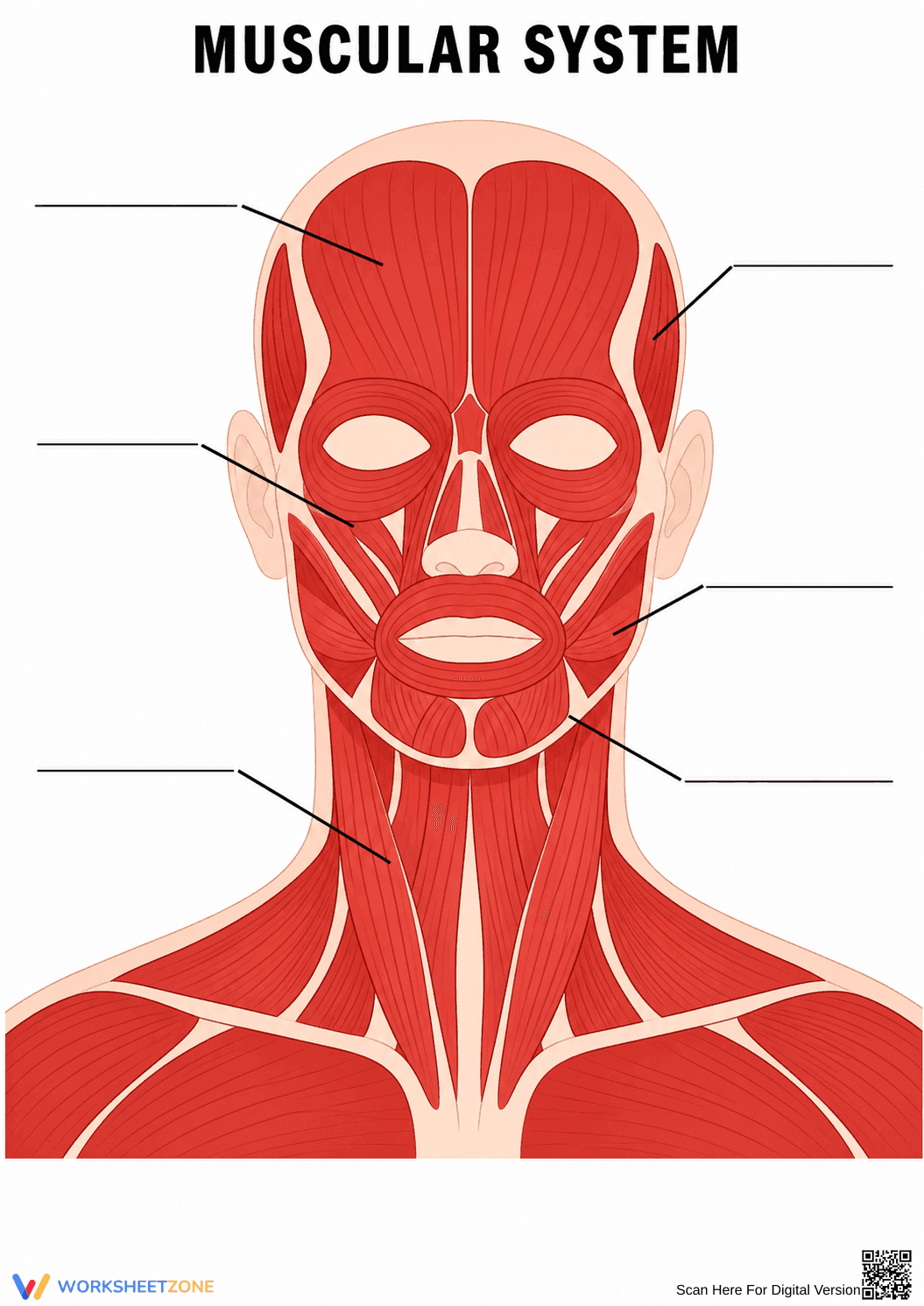

Head and Neck Muscles Worksheet | Essential Grade 7-9

Paste this activity's link or code into your existing LMS (Google Classroom, Canvas, Teams, Schoology, Moodle, etc.).
Students can open and work on the activity right away, with no student login required.
You'll still be able to track student progress and results from your teacher account.
This head and neck muscles worksheet provides a clear, focused labeling exercise for middle and high school biology students. By identifying key muscle groups on a detailed anatomical diagram, learners solidify their understanding of the muscular system's structure and function. It is designed to provide a direct link between visual recognition and scientific terminology.
At a Glance
- Grade: 7-9 · Subject: Biology
- Standard:
MS-LS1-3— Use evidence to explain how body systems interact to maintain function- Skill Focus: Anatomical Labeling
- Format: 1 page · 6 problems · Answer key included · PDF
- Best For: Formative assessment or quick review
- Time: 10–15 minutes
This single-page PDF features a high-resolution medical illustration of the human head, face, and neck musculature. The worksheet includes 6 distinct leader lines pointing to major muscle groups, providing ample space for student responses. A comprehensive answer key is provided to facilitate rapid grading or student self-correction, making it an ideal resource for busy science classrooms.
Teachers can integrate this resource into their lesson plans in under two minutes. Simply print the required number of copies (1 minute), distribute them as an entry ticket or independent practice (30 seconds), and review the correct labels using the provided key (30 seconds). Its self-contained nature makes it an excellent choice for emergency sub plans or quick transitions between lab activities.
This resource aligns with `MS-LS1-3`, which requires students to "use argument supported by evidence for how the body is a system of interacting subsystems composed of groups of cells." By identifying specific muscles, students begin to understand the specialized tissues that drive human movement. Both standard codes can be copied directly into lesson plans, IEP goals, or district curriculum mapping tools.
Use this worksheet as a formative assessment immediately following a lecture on the muscular system to gauge student retention of terminology. Alternatively, assign it as a collaborative activity where students use their textbooks to find the correct names for the 6 indicated muscles. Expect students to complete the labeling in approximately 12 minutes.
This worksheet is tailored for Grade 7 through Grade 9 students in general science or introductory biology courses. It provides necessary visual scaffolding for English Language Learners (ELL) and students with IEPs who benefit from diagram-based learning. Pair this with a 3D muscular model or a digital anatomy atlas for a multi-sensory instructional experience.
According to the RAND AIRS 2024 report on instructional materials, high-quality visual aids like anatomical diagrams significantly improve the retention of complex biological nomenclature in middle school learners. This worksheet targets the MS-LS1-3 standard by requiring students to accurately identify the structural components of the muscular system. Research by Fisher & Frey (2014) emphasizes that instructional effectiveness is highest when students are provided with clear, focused tasks that allow them to apply new vocabulary in context. By isolating the head and neck muscles, this resource prevents cognitive overload while ensuring students meet grade-level expectations for anatomical literacy. The inclusion of 6 specific labeling tasks provides a measurable data point for teachers to assess student mastery of the human body's organizational hierarchy and muscular function.


