


























Views
Downloads

Grade 7 Muscular System — Printable No-Prep Worksheet
Paste this activity's link or code into your existing LMS (Google Classroom, Canvas, Teams, Schoology, Moodle, etc.).
Students can open and work on the activity right away, with no student login required.
You'll still be able to track student progress and results from your teacher account.
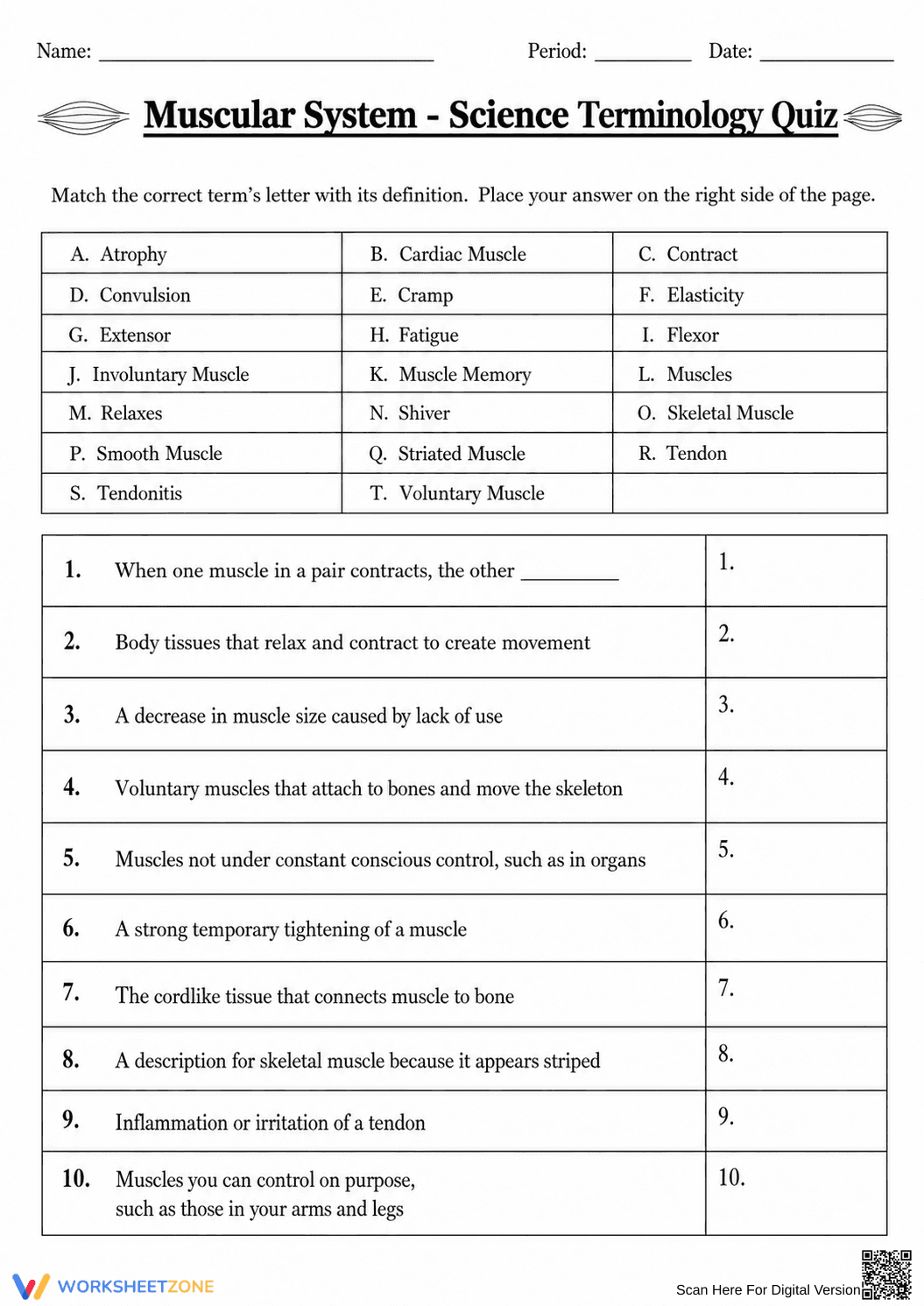
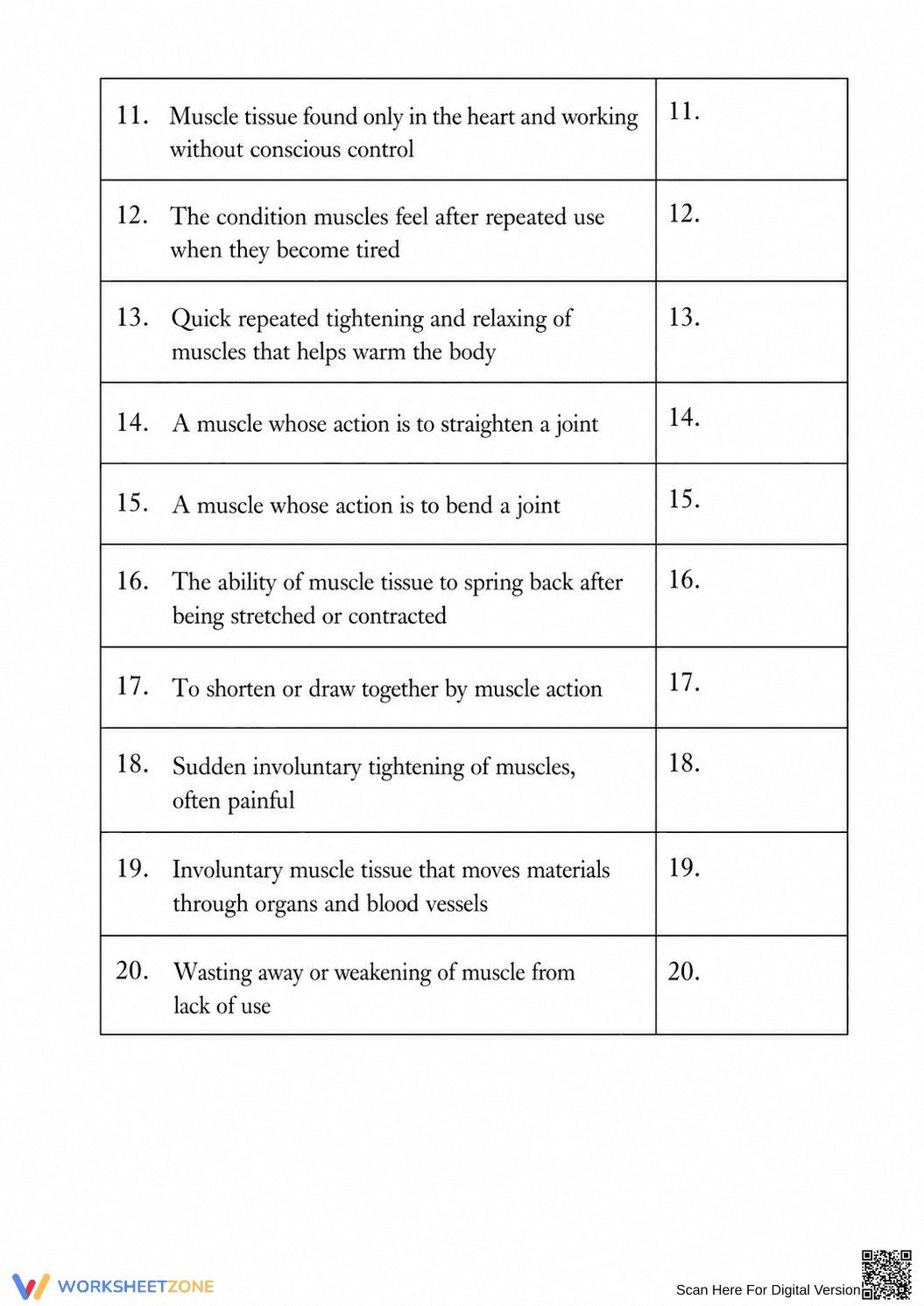
This Grade 7 science worksheet helps students master essential muscular system vocabulary by matching anatomical terms to their correct definitions. By completing this terminology quiz, students build a strong foundational understanding of how muscles function, contract, and interact within the human body.
At a Glance
- Grade: 7 · Subject: Science
- Standard:
MS-LS1-3— Understand how body subsystems interact to function- Skill Focus: Muscular system terminology
- Format: 3 pages · 20 problems · Answer key included · PDF
- Best For: Formative assessment or review
- Time: 15–20 minutes
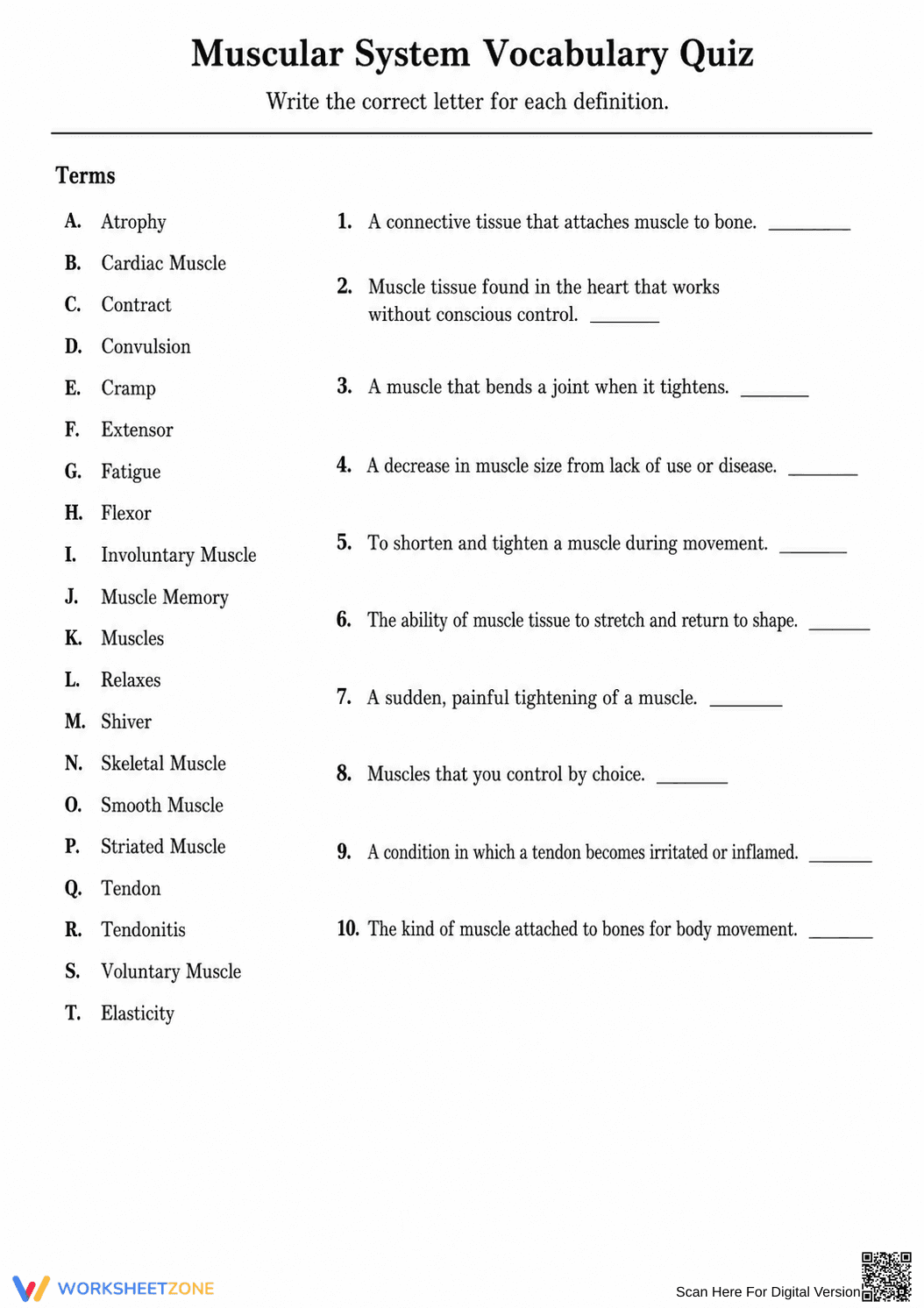
This resource features a comprehensive 20-question matching activity spread across two pages, plus an alternative 10-question modified version on the third page. Students are provided with a word bank of 20 key terms—such as voluntary muscle, tendon, and atrophy—and must write the corresponding letter next to the accurate scientific definition. A complete answer key is included for quick grading.
- Print (1 min): Select the full 20-question version or the modified 10-question version and print copies for your class.
- Distribute (1 min): Hand out the worksheets as a warm-up, homework assignment, or independent review task.
- Review (3 mins): Use the included answer key to quickly grade submissions or facilitate a whole-class review session.
Total teacher prep time is under two minutes, making this an ideal, self-explanatory activity for emergency sub plans or busy science educators.
Aligned to MS-LS1-3: Use argument supported by evidence for how the body is a system of interacting subsystems composed of groups of cells. This vocabulary foundation supports students in explaining how the muscular system interacts with the skeletal and nervous systems. It also supports CCSS.ELA-LITERACY.RST.6-8.4 for determining the meaning of domain-specific words. Both standard codes can be copied directly into lesson plans, IEP goals, or district curriculum mapping tools.
Assign this matching quiz after direct instruction on the human body to solidify new terminology. It works excellently as a Friday review activity or a quiet independent task while the teacher checks in with small groups. For a formative assessment observation tip, walk the room and note which terms students frequently skip or change their answers on, indicating areas that need reteaching. Expected completion time is 15 to 20 minutes.
This worksheet is designed for middle school science students learning about human anatomy. The inclusion of a shorter 10-question version provides built-in differentiation for students with IEPs or those who need reduced workloads. It pairs perfectly with a 3D anatomical model demonstration or a direct instruction lesson on body systems.
Mastering domain-specific vocabulary is a critical step in scientific literacy and a prerequisite for engaging in complex biological concepts. Aligned with MS-LS1-3 to help students understand how body subsystems interact to function, this resource provides targeted terminology practice essential for middle school learners. According to Fisher & Frey (2014), explicit vocabulary instruction combined with repeated exposure significantly improves reading comprehension and retention in content areas like science. When students can fluently identify anatomical structures, they are better equipped to construct evidence-based arguments about bodily functions. By requiring students to actively match terms such as 'striated muscle,' 'involuntary muscle,' and 'extensor' with precise definitions, this worksheet reinforces the foundational language necessary for higher-order anatomical analysis. Consistent practice with these scientific terms ensures that students move beyond rote memorization and begin to conceptualize the human body as a series of interconnected, dynamic systems.


