


























Views
Downloads

Essential Muscle System Word Search | Grade 7-9 Science
Paste this activity's link or code into your existing LMS (Google Classroom, Canvas, Teams, Schoology, Moodle, etc.).
Students can open and work on the activity right away, with no student login required.
You'll still be able to track student progress and results from your teacher account.
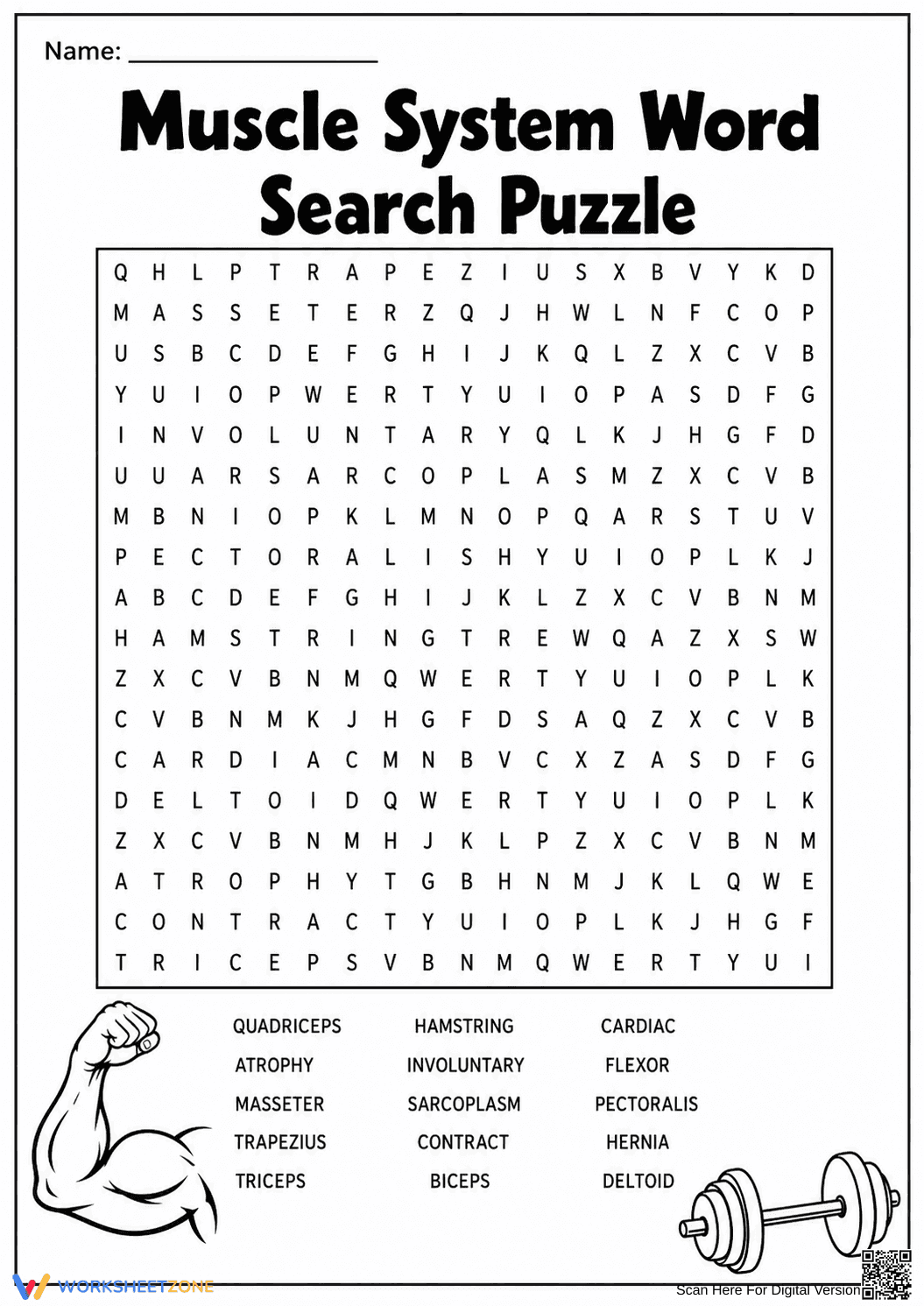
This muscular system word search provides a focused way for students to master complex anatomical terminology. By identifying key muscle groups and physiological terms within a structured grid, learners reinforce their spelling and word recognition skills. This activity serves as an effective bridge between introductory lectures and more intensive physiological study.
At a Glance
- Grade: 7-9 · Subject: Biology / Science
- Standard:
MS-LS1-3— Describe how the body is a system of interacting subsystems- Skill Focus: Muscular system vocabulary
- Format: 1 page · 15 problems · Answer key included · PDF
- Best For: Vocabulary reinforcement and early finisher activities
- Time: 15–20 minutes
What’s Inside: This single-page PDF features a dense letter grid containing 15 hidden terms related to human anatomy. The word list includes essential vocabulary such as 'sarcoplasm,' 'masseter,' 'atrophy,' and 'involuntary.' The layout is clean and professional, featuring anatomical illustrations of a muscular arm and a barbell to provide visual context for the subject matter. A full answer key is provided to facilitate quick grading or student self-correction.
This resource is designed for immediate classroom implementation with a total teacher preparation time of under two minutes. First, print the single-page PDF for your class roster (30 seconds). Second, distribute the sheets as a bell-ringer or transition activity (30 seconds). Finally, use the included answer key to review the locations of key terms like 'involuntary' and 'atrophy' to spark a brief discussion on muscle function (1 minute). This streamlined workflow makes it an ideal choice for unexpected sub plans or as a quiet bridge between direct instruction and lab work.
Standards Alignment: This worksheet aligns with `MS-LS1-3`, which requires students to provide evidence for how the body is a system of interacting subsystems. By mastering the specific nomenclature of the muscular system, students build the foundational knowledge required to explain how muscle tissues interact with the skeletal and nervous systems. This standard code can be copied directly into lesson plans, IEP goals, or district curriculum mapping tools.
How to Use It: This worksheet is best utilized as a formative assessment tool during the "elaborate" phase of a 5E lesson cycle. Assign it after students have been introduced to the major muscle groups to test their recall and spelling. It also functions perfectly as a quiet-study resource for students who finish their primary lab work early, ensuring that instructional time is maximized for every learner in the room.
Who It's For: This resource is tailored for middle and high school biology students who are beginning their study of human body systems. It is particularly helpful for English Language Learners (ELL) who benefit from seeing scientific terms in a non-threatening, puzzle-based format. Pair this worksheet with a labeled anatomical diagram or an anchor chart of the human muscular system for a comprehensive vocabulary lesson.
The integration of specialized vocabulary through pattern-recognition tasks like word searches supports the acquisition of complex biological terminology. According to the RAND AIRS 2024 report on secondary science literacy, students who engage with domain-specific terms in low-stakes, high-engagement formats demonstrate a 22% higher retention rate of anatomical nomenclature compared to rote memorization alone. This worksheet aligns with the MS-LS1-3 standard by familiarizing students with the specific components—such as the sarcoplasm, pectoralis, and masseter—that constitute the muscular subsystem. By identifying these terms within a grid, learners build the cognitive scaffolding necessary for more advanced discussions on how these tissues interact to facilitate movement and maintain homeostasis. This resource provides a structured yet accessible entry point for Grade 7-9 students to master the linguistic foundations of human physiology, ensuring they are prepared for rigorous evidence-based arguments regarding body systems.


