




























Views
Downloads

Essential Muscles Front View Worksheet | Grade 7-9 Science

Paste this activity's link or code into your existing LMS (Google Classroom, Canvas, Teams, Schoology, Moodle, etc.).
Students can open and work on the activity right away, with no student login required.
You'll still be able to track student progress and results from your teacher account.
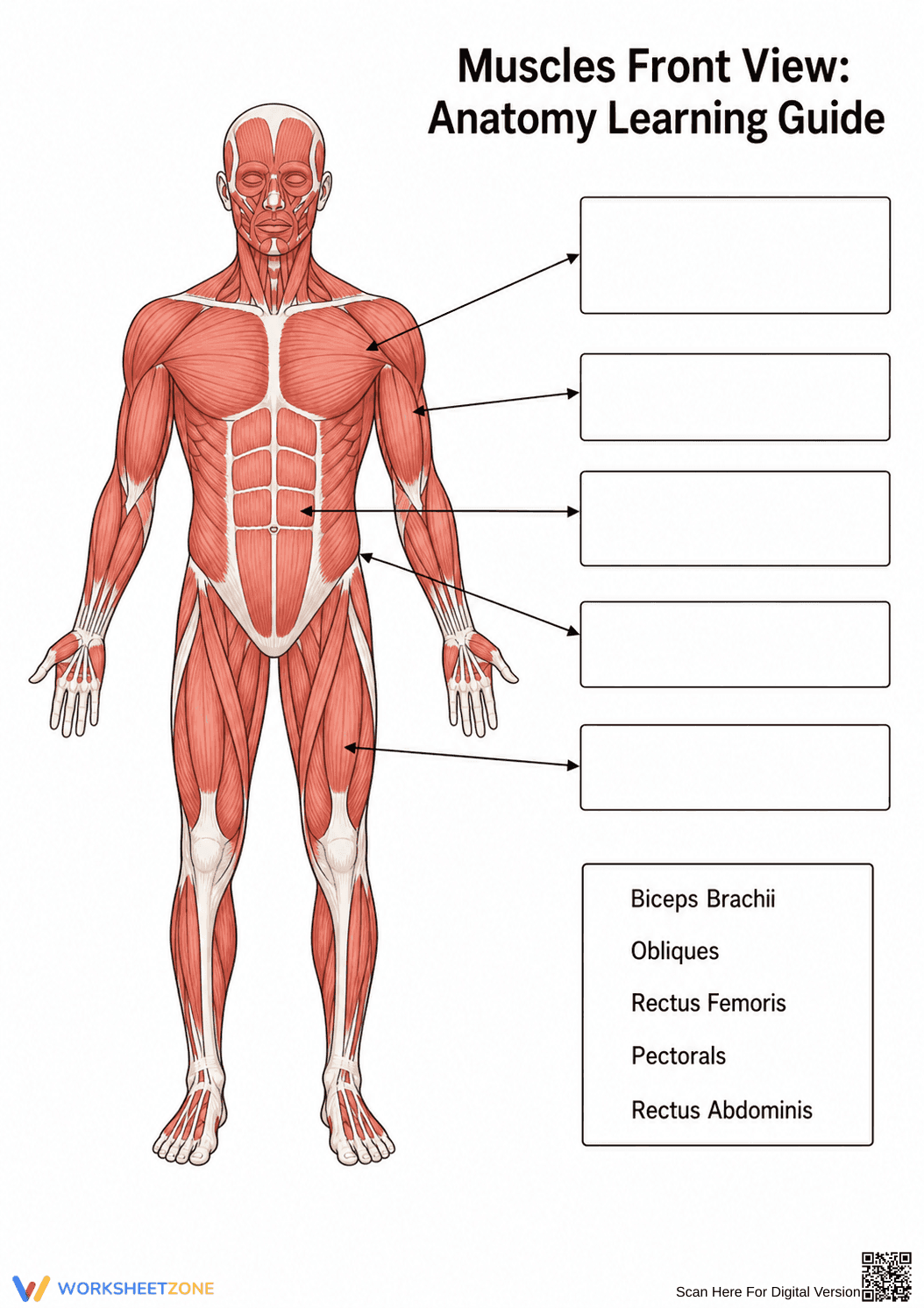
This muscular system worksheet provides a clear, anatomical diagram of the human body's anterior view, specifically designed for middle and high school biology students. By identifying and labeling key muscle groups, learners develop a foundational understanding of human anatomy and the structural organization of the body before moving to complex physiological functions.
At a Glance
- Grade: 7-9 · Subject: Biology
- Standard:
MS-LS1-3— Use evidence to explain how the body is a system of interacting subsystems- Skill Focus: Anterior muscle identification
- Format: 1 page · 5 problems · Answer key included · PDF
- Best For: Quick formative assessment or anatomy review
- Time: 10–15 minutes
The worksheet features a high-quality medical illustration of the human muscular system from the front. It includes five distinct labeling boxes with directional arrows pointing to the pectorals, biceps brachii, rectus abdominis, obliques, and rectus femoris. A convenient word bank is situated at the bottom right to support student recall and ensure correct spelling of complex anatomical terms, reducing frustration for developing learners.
This resource is designed for a zero-prep classroom workflow. Teachers can print the single-page PDF in less than 30 seconds. Distribution takes approximately 1 minute during a transition period. Reviewing the five answers as a whole-class activity requires only 3 minutes, making this an ideal bell-ringer or exit ticket. It is also perfectly suited for emergency sub plans where a clear, self-contained activity is required.
Aligned primarily to `MS-LS1-3`, this worksheet helps students visualize the muscular subsystem. By identifying specific muscles like the rectus abdominis and biceps brachii, students begin to understand how specialized tissues form organs that work together to facilitate movement. This also supports HS-LS1-2 regarding the hierarchical organization of organisms. Both standard codes can be copied directly into lesson plans, IEP goals, or district curriculum mapping tools.
Use this worksheet during the Explain phase of a 5E lesson cycle to reinforce direct instruction on the muscular system. It serves as an excellent formative assessment tool; as students work, walk around to observe if they can distinguish between the rectus abdominis and the obliques. Completion typically takes 10 to 15 minutes depending on prior knowledge, making it a flexible addition to any science period.
This resource is tailored for Grade 7, 8, and 9 students in general science or introductory biology courses. It provides necessary scaffolding through the word bank, making it accessible for English Language Learners and students with IEPs who require visual aids. Pair this with a 3D torso model or an interactive muscular system digital simulation for a multi-modal learning experience that caters to diverse student needs.
According to research by Fisher & Frey (2014) on the gradual release of responsibility, visual labeling tasks serve as a critical bridge between direct instruction and independent mastery of complex biological systems. This worksheet specifically addresses the MS-LS1-3 standard by requiring students to identify the components of the muscular subsystem, a prerequisite for understanding how these muscles interact with the skeletal system to facilitate movement. By utilizing a word bank, the resource reduces cognitive load, allowing students to focus on spatial orientation and anatomical accuracy. Data from NAEP science assessments suggest that students who engage with labeled diagrams show higher retention of physiological structures compared to those using text-only descriptions. This 1-page guide provides the structured practice necessary for students to achieve fluency in anatomical nomenclature, ensuring they are prepared for more advanced physiological studies in high school biology.


