


























0
Views
0
Downloads

0.0
0
Save
0 Likes
Share
Studying Neck Muscle Anatomy
0 Views
0 Downloads
Paste this activity's link or code into your existing LMS (Google Classroom, Canvas, Teams, Schoology, Moodle, etc.).
Students can open and work on the activity right away, with no student login required.
You'll still be able to track student progress and results from your teacher account.
Information
Description
What It Is:
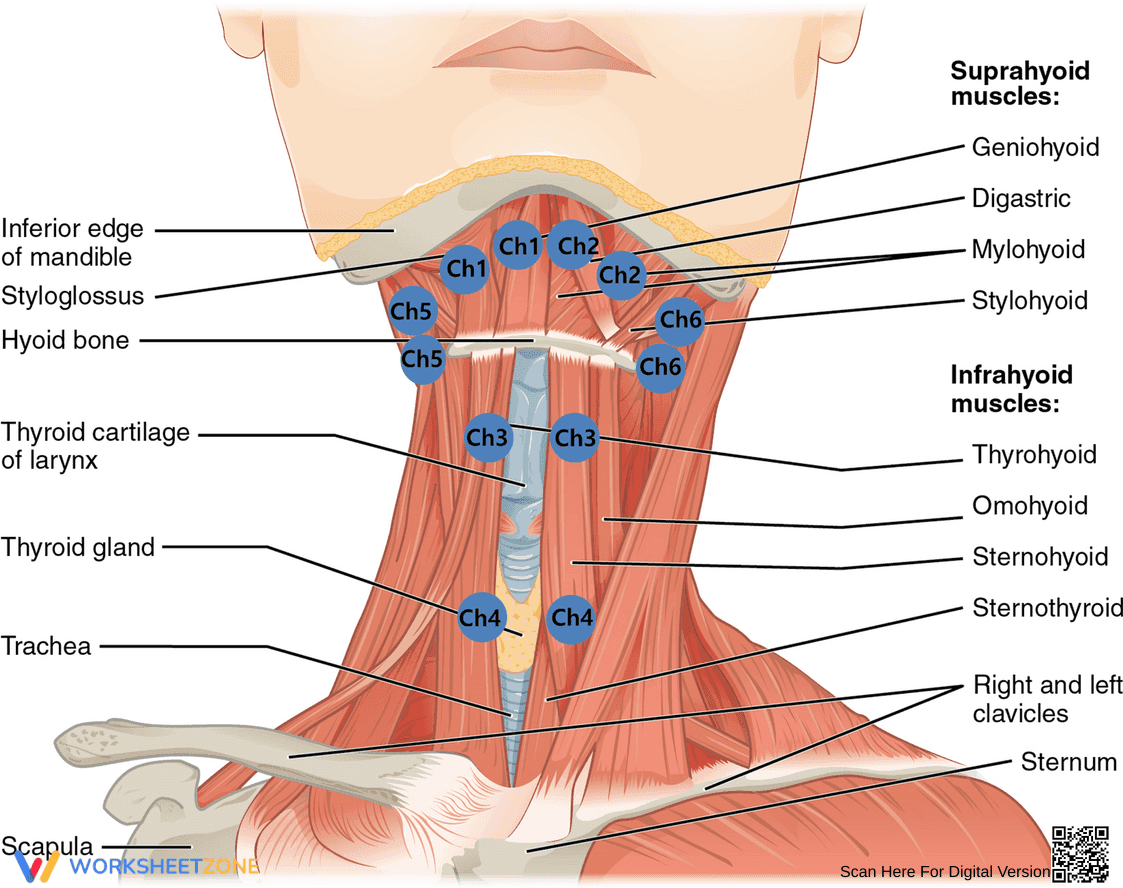
This is an anatomical diagram of the human neck, specifically highlighting the muscles in the neck region. It identifies both Suprahyoid and Infrahyoid muscle groups. The diagram labels muscles such as Geniohyoid, Digastric, Mylohyoid, Stylohyoid, Thyrohyoid, Omohyoid, Sternohyoid, and Sternothyroid. Key structures like the hyoid bone, thyroid cartilage of larynx, thyroid gland, trachea, inferior edge of mandible, scapula, sternum, and right and left clavicles are also labeled. The diagram includes numbered blue circles labeled 'Ch1' through 'Ch6' placed strategically on the neck, likely indicating specific anatomical points or areas.
Grade Level Suitability:
This diagram is most suitable for high school (Grades 9-12) and college-level anatomy and physiology courses. The complexity of the anatomical structures and muscle groups requires a solid understanding of biological concepts. It may also be suitable for introductory medical or nursing programs.
Why Use It:
This worksheet can be used to teach human anatomy, specifically focusing on the muscles and structures of the neck. It helps students visualize the spatial relationships between different muscles and skeletal components in the neck region. It can also be used to assess student understanding of anatomical terminology and muscle identification. The 'Ch' markers suggest a potential for further analysis or study of specific cervical points.
How to Use It:
This diagram can be used as a reference for studying the neck muscles. Students can use it to identify and label the different muscles and structures. The 'Ch' markers could be used as points for further research, such as identifying cervical vertebrae or nerve pathways. It can also be used as a quiz or test, where students are asked to label the different parts of the diagram.
Target Users:
The target users for this worksheet are high school biology students, college students studying anatomy and physiology, pre-med students, nursing students, and other healthcare professionals or students who need to learn about the anatomy of the human neck.
This is an anatomical diagram of the human neck, specifically highlighting the muscles in the neck region. It identifies both Suprahyoid and Infrahyoid muscle groups. The diagram labels muscles such as Geniohyoid, Digastric, Mylohyoid, Stylohyoid, Thyrohyoid, Omohyoid, Sternohyoid, and Sternothyroid. Key structures like the hyoid bone, thyroid cartilage of larynx, thyroid gland, trachea, inferior edge of mandible, scapula, sternum, and right and left clavicles are also labeled. The diagram includes numbered blue circles labeled 'Ch1' through 'Ch6' placed strategically on the neck, likely indicating specific anatomical points or areas.
Grade Level Suitability:
This diagram is most suitable for high school (Grades 9-12) and college-level anatomy and physiology courses. The complexity of the anatomical structures and muscle groups requires a solid understanding of biological concepts. It may also be suitable for introductory medical or nursing programs.
Why Use It:
This worksheet can be used to teach human anatomy, specifically focusing on the muscles and structures of the neck. It helps students visualize the spatial relationships between different muscles and skeletal components in the neck region. It can also be used to assess student understanding of anatomical terminology and muscle identification. The 'Ch' markers suggest a potential for further analysis or study of specific cervical points.
How to Use It:
This diagram can be used as a reference for studying the neck muscles. Students can use it to identify and label the different muscles and structures. The 'Ch' markers could be used as points for further research, such as identifying cervical vertebrae or nerve pathways. It can also be used as a quiz or test, where students are asked to label the different parts of the diagram.
Target Users:
The target users for this worksheet are high school biology students, college students studying anatomy and physiology, pre-med students, nursing students, and other healthcare professionals or students who need to learn about the anatomy of the human neck.


